
Posted on February 05 2026
3 Million Jobs in Germany Over the Next Decade: Job Outlook and Work Visa Options

By , Editor
Updated February 05 2026
Germany is projected to create around 3 million job openings over the next decade, driven mainly by large-scale retirements, skills shortages, and steady growth across key industries. To fill these vacancies, employers are increasingly recruiting international graduates and skilled professionals.
The German government has committed over €1 trillion to infrastructure, industry, defence, and green energy and also simplified immigration policies to speed up hiring. Fast-track options such as the Accelerated Skilled Worker Procedure and the Opportunity Card, allows entering Germany without a job offer to meet ongoing workforce demand. There is strong demand across IT, engineering, healthcare, manufacturing, logistics, automotive, renewable energy, and research, with a stable job market and long-term employment prospects.
*Want to work in Germany? Avail Y-Axis Resume Marketing Services to find the right job faster.
Why Germany is the most preferred destination for Jobs Abroad?
- Europe’s largest and most stable economy with strong job security
- High demand for skilled professionals across key sectors
- Competitive salaries with strong labour protections
- Simplified work visa pathways and faster hiring
- Access to public healthcare and comprehensive social security benefits
- Job opportunities across global companies, advanced manufacturing, and research
- Clear routes to permanent residence and long-term settlement
Job Outlook in Germany for the Next 10 Years
Germany’s job market is expected to remain stable and strong over the next decade, with around 3 million new and replacement jobs projected across the economy. This is mainly driven by large-scale retirements, as over 30% of the workforce is expected to retire by 2035, resulting in labour shortages across multiple sectors.
To meet growing demand, Germany has simplified immigration rules to attract foreign professionals and speed up the recognition of overseas qualifications. Pathways such as the Skilled Immigration Act, the Accelerated Skilled Worker Procedure, and the Opportunity Card (Chancenkarte) make it easier to find jobs in Germany and work legally through clear work visa options.
Top factors for Increasing Job Opportunities in Germany
- Large-scale retirements creating widespread replacement jobs
- Skills shortages across IT, engineering, healthcare, and manufacturing
- Government investment in infrastructure, digitalisation, and green energy
- Simplified work visa policies enabling faster international hiring
Employment Opportunities by 2035
- Around 3 million job openings expected across major industries
- Growing reliance on international professionals to address labour shortages
- Government-backed initiatives supporting foreign worker recruitment
- Increasing availability of jobs in Germany with work visa sponsorship
Who can apply for Job Opportunities in Germany?
Germany welcomes applicants at different career stages who meet basic qualification and skill requirements. Due to ongoing labour shortages, employers across in-demand sectors are actively hiring both early-career and experienced professionals from abroad.
Freshers and Graduates
- Eligible for entry-level, trainee, and junior roles
- Job opportunities available in IT, engineering, logistics, healthcare, and business services
- Germany offers Opportunity Card without a prior offer
- Many employers support work visas after a job offer is secured
*Want to apply for German Opportunity Card? Let Y-Axis help you through the process.
Experienced Professionals
- Mid-level professionals with relevant experience are in strong demand
- Strong hiring across IT, engineering, manufacturing, healthcare, and finance
- Employer-sponsored work visas commonly available for skilled roles
- Stable long-term employment opportunities
Senior and Specialist Professionals
- Suitable for leadership, specialist, and advanced technical roles
- Eligible for the EU Blue Card and German Skilled Worker Visa
- Faster pathways to permanent residence and long-term settlement
Most In-Demand Jobs in Germany over the Next Decade
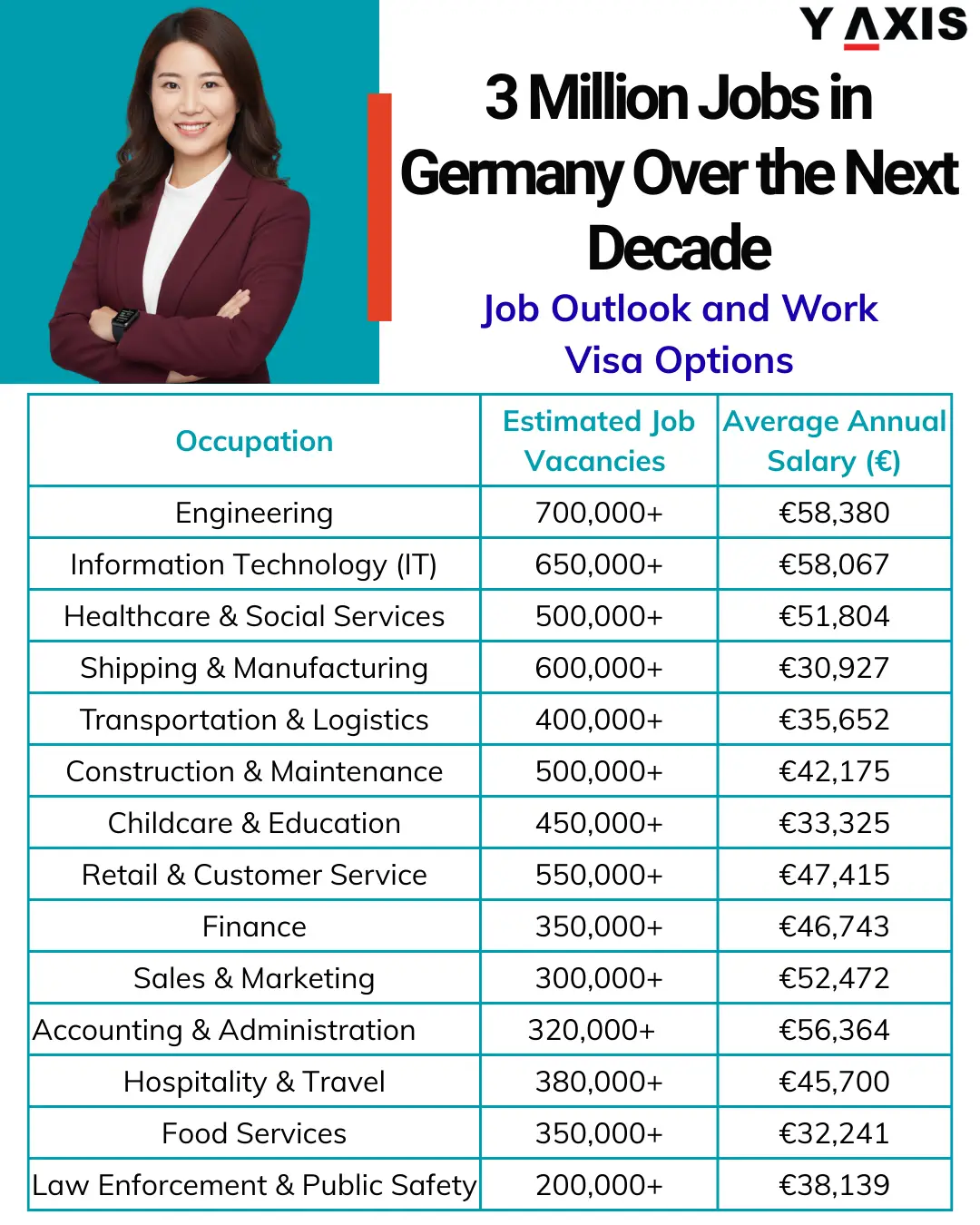
Germany is expected to face significant labour shortages over the next decade, creating strong demand for skilled and semi-skilled workers across multiple sectors. As a result, employers are actively hiring international professionals for roles that cannot be filled locally. Germany offers long-term job opportunities in high-demand industries, with many roles supporting work visa options.
|
Occupation |
Estimated Job Vacancies |
Average Annual Salary (€) |
|
Engineering |
700,000+ |
€58,380 |
|
Information Technology (IT) |
650,000+ |
€58,067 |
|
Healthcare & Social Services |
500,000+ |
€51,804 |
|
Shipping & Manufacturing |
600,000+ |
€30,927 |
|
Transportation & Logistics |
400,000+ |
€35,652 |
|
Construction & Maintenance |
500,000+ |
€42,175 |
|
Childcare & Education |
450,000+ |
€33,325 |
|
Retail & Customer Service |
550,000+ |
€47,415 |
|
Finance |
350,000+ |
€46,743 |
|
Sales & Marketing |
300,000+ |
€52,472 |
|
Accounting & Administration |
320,000+ |
€56,364 |
|
Hospitality & Travel |
380,000+ |
€45,700 |
|
Food Services |
350,000+ |
€32,241 |
|
Law Enforcement & Public Safety |
200,000+ |
€38,139 |
In-Demand Job Roles and Sectors in Germany for Foreign Workers
Many employers in Germany are struggling to fill vacancies due to ongoing labour shortages and an ageing workforce. As a result, hiring has increased across specific job roles and sectors where local talent is not sufficient. Foreign professionals with the right skills are being actively recruited, particularly for roles offering long-term contracts and work visa support. These positions are expected to remain in demand throughout the next decade.
|
Sector |
In-Demand Job Roles |
Job Outlook |
|
IT & Technology |
Software Developers, Data Scientists, AI & ML Specialists, Cybersecurity Experts |
Very High |
|
Engineering |
Mechanical, Electrical, Civil, Automotive Engineers |
Very High |
|
Healthcare |
Registered Nurses, Medical Technicians, Care Workers |
Very High |
|
Manufacturing |
Production Engineers, Quality Engineers, Industrial Technicians |
High |
|
Logistics & Transport |
Supply Chain Managers, Truck Drivers, Warehouse Supervisors |
High |
|
Hospitality & Tourism |
Hotel Managers, Chefs, Restaurant Supervisors, Tourism Services Staff |
Moderate to High |
|
Green Energy |
Renewable Energy Engineers, Energy Technicians |
High |
|
Education & Research |
Researchers, STEM Educators, Technical Instructors, Laboratory Specialists |
Moderate to High |
|
Finance & Business Services |
Accountants, Financial Analysts, Auditors, Risk & Compliance Specialists |
High |
|
Sales, Marketing & Customer Support |
Sales Managers, Digital Marketing Specialists, Business Development Managers, Customer Support Executives |
Moderate to High |
Germany Work Visa Options for Foreign Professionals
Germany offers multiple work visa options for foreign professionals based on qualifications, work experience, and job demand. Skilled workers can apply for visas that allow them to work legally in Germany, with some options require a job offer and others allowing entry to search for employment. These work visas support long-term employment and provide pathways to permanent residence.
EU Blue Card
For highly skilled professionals meeting minimum salary thresholds
Offers faster pathways to permanent residence
Commonly used for IT, engineering, research, and senior professional roles
Opportunity Card (Chancenkarte)
- Allows eligible candidates to enter Germany without a job offer to search for work
- Points-based system considering qualifications, experience, age, and language skills
- Ideal for professionals exploring job opportunities on the ground
*Planning to apply for German Opportunity Card? Let Y-Axis guide you through the process.
Accelerated Skilled Worker Procedure
- Employer-led process that speeds up visa approval
- Reduces waiting time for qualified foreign professionals
- Widely used by companies facing urgent hiring needs
Skilled Worker Visa
- For professionals with recognised academic or vocational qualifications
- Requires a valid job offer from a German employer
- Suitable for roles across IT, engineering, healthcare, manufacturing, and other skilled sectors
How to Apply for Jobs in Germany as a Foreign Professional?
Step 1: Focus on sectors with labour shortages such as IT, engineering, healthcare, finance, and green energy.
Step 2: Research job roles and employers that actively hire international professionals.
Step 3: Prepare a German-style CV and a tailored cover letter matching the job requirements.
Step 4: Apply through trusted job portals and company career pages.
Step 5: Attend interviews and secure a formal job offer from a German employer.
Step 6: Apply for the appropriate Germany work visa using the job offer.
*Want to apply for Jobs in Germany? Let Y-Axis help you through the process.
Top 7 Companies Hiring Foreign Professionals in Germany
Germany is home to many global corporations and industry leaders that regularly hire international talent to address ongoing skill shortages. Many companies across technology, engineering, healthcare, manufacturing, finance, and logistics actively recruit foreign professionals for both entry-level and experienced roles. Many of these employers also support work visa sponsorship, making Germany a strong destination for long-term career opportunities.
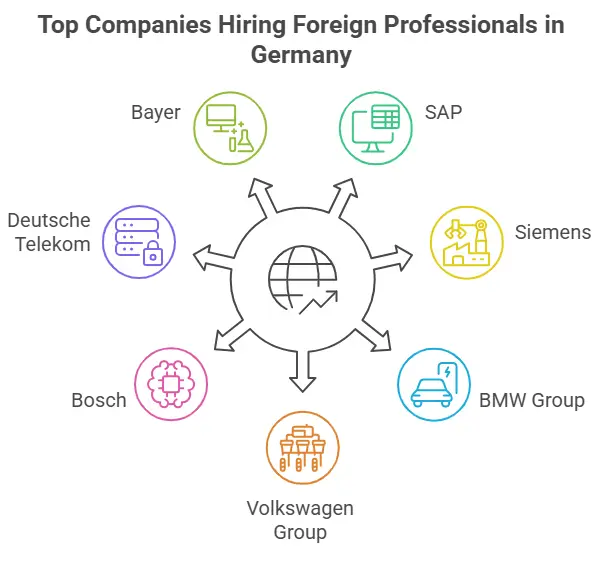
List of top 7 companies hiring foreign workers in Germany:
- SAP: Hires foreign professionals for software development, cloud computing, data analytics, and AI roles across multiple teams.
- Siemens: Recruits international talent for engineering, automation, digital transformation, and industrial technology projects.
- BMW Group: Employs foreign professionals in automotive engineering, IT, electric mobility, and research and development roles.
- Volkswagen Group: Offers job opportunities in engineering, manufacturing, software development, and electric vehicle technology.
- Bosch: Actively hires international professionals for embedded systems, electronics, AI, and advanced manufacturing roles.
- Deutsche Telekom: Recruits foreign professionals in IT infrastructure, cybersecurity, cloud services, and network engineering.
- Bayer: Hires international talent for roles in healthcare, pharmaceuticals, life sciences, and research.
Also Read…
Fast-Track Hiring Options in Germany for Skilled Professionals
Best Cities in Germany to find Job Opportunities for Overseas Professionals
Germany’s job opportunities are concentrated in key cities that act as hubs for technology, engineering, finance, healthcare, manufacturing, and logistics. Foreign professionals often find better hiring prospects in these cities due to the presence of global companies, international work environments, and stronger demand for skilled talent.
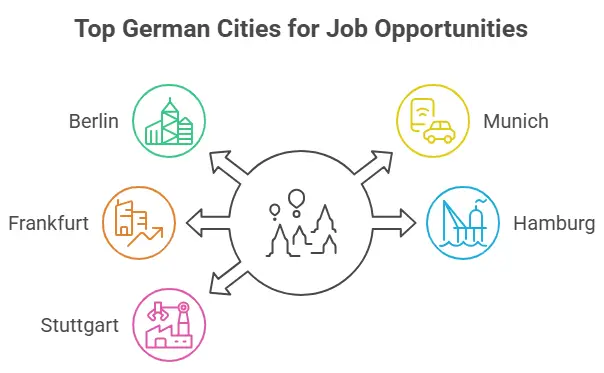
Some of top German cities to find job opportunities for overseas professionals:
- Berlin: A major hub for IT, startups, fintech, and digital roles, with strong demand for software developers, data professionals, and product specialists.
- Munich: Known for engineering, automotive, IT, and finance jobs, with many openings at global companies and higher-than-average salaries.
- Frankfurt: Germany’s financial centre, offering strong opportunities in banking, finance, risk management, IT, and business services.
- Hamburg: A key city for logistics, trade, manufacturing, media, and engineering roles, supported by Germany’s largest port.
- Stuttgart: A major automotive and engineering hub with high demand for mechanical, electrical, and industrial engineers.
Step-by-Step Application Process for a Germany Work Visa
Step 1: Check your eligibility based on qualifications, skills, and work experience.
Step 2: Secure a valid job offer from a German employer
Step 3: Choose the relevant work visa that matches your eligibility and job role.
Step 4: Gather all required documents, including passport, job contract, qualifications, and health insurance.
Step 5: Attend your visa appointment and submit the completed application and documents at the German embassy or consulate.
Step 6: Wait for visa processing and approval.
Step 7: Once approved, travel to Germany, complete local registration, convert your visa into a residence permit, and start working legally.
*Want to apply for Germany Work Visa? Let Y-Axis guide you through the process.
Tips to Improve Your Chances of Getting a Job in Germany
- Target in-demand roles with skill shortages to improve hiring and visa chances
- Use a German-style CV tailored to each job application
- Highlight visa readiness so employers know you can work legally
- Apply directly to employers through official career pages
- Basic German skills can significantly improve interview success
FAQs
Why does Germany have 3 million job openings over the next decade?
Germany is expected to create around 3 million job openings over the next decade, driven mainly by large-scale retirements and an ageing workforce. With over 30% of workers projected to retire by 2035, replacement demand will remain high. At the same time, strong investment in digitalisation, infrastructure, green energy, and innovation is generating new roles, making jobs in Germany increasingly accessible for foreign professionals.
What is the job outlook in Germany for the next 10 years?
The Germany job market outlook remains strong and stable for the next 10 years. Labour shortages across key sectors are expected to continue, ensuring consistent demand for skilled professionals. Industries such as IT, engineering, healthcare, logistics, finance, and renewable energy will see sustained hiring. Government-backed immigration reforms and employer-led recruitment are further strengthening employment opportunities. For foreign professionals, this creates long-term career prospects, job security, and easier access to work visas in Germany.
Are there enough jobs in Germany for foreigners?
Yes, Germany has a growing shortage of skilled workers and actively depends on foreign professionals to fill open roles. Employers across multiple industries are hiring internationally to meet labour gaps. Many jobs in Germany for foreigners also include work visa sponsorship. With simplified immigration pathways and strong employer demand, foreign professionals have increasing opportunities to work, settle, and build long-term careers in Germany.
Which jobs are most in demand in Germany?
The most in-demand jobs in Germany include software developers, engineers, healthcare professionals, logistics specialists, finance experts, renewable energy professionals, hospitality managers, and researchers. These roles are critical to Germany’s economy and face long-term labour shortages. Professionals with recognised qualifications and relevant experience have strong chances of employment, especially in shortage occupations that support work visa sponsorship.
Can I work in Germany without speaking German?
Yes, many professionals can work in Germany without German, especially in IT, engineering, finance, research, and multinational companies where English is the working language. However, basic German skills improve employability, workplace integration, and long-term career growth. For healthcare, hospitality, and customer-facing roles, German language proficiency is usually required. Learning German significantly increases job options in Germany.
Do I need a job offer to get a Germany work visa?
In most cases, a job offer is required to apply for a Germany work visa. However, Germany also offers the Opportunity Card (Chancenkarte), which allows eligible professionals to enter Germany without a job offer and search for jobs locally. Once a job is secured, applicants can convert their status into a work residence permit, making it easier to find jobs in Germany legally.
What are the main work visa options for Germany?
Germany offers several work visa options, including the Skilled Worker Visa, EU Blue Card, Opportunity Card, and Accelerated Skilled Worker Procedure. These visas cater to different skill levels, salary thresholds, and job roles. Most visas allow long-term employment and provide pathways to permanent residence, making Germany a popular destination for skilled foreign professionals.
What is the EU Blue Card Germany and who is eligible?
The EU Blue Card Germany is designed for highly skilled professionals with recognised qualifications and a qualifying job offer meeting minimum salary requirements. It is commonly used by IT specialists, engineers, scientists, and senior professionals. The Blue Card offers faster permanent residence eligibility, family reunification benefits, and strong job mobility within Germany and the EU.
How long does it take to process a Germany work visa?
Germany work visa processing usually takes 4 to 12 weeks, depending on the visa type, embassy workload, and document completeness. Applications supported through employer-led fast-track procedures may be processed faster. Early preparation, recognised qualifications, and accurate documentation help reduce delays when applying for a Germany work visa.
What is the minimum salary required to work in Germany?
Minimum salary requirements depend on the visa type and occupation. The EU Blue Card has higher salary thresholds, while other work permits have lower requirements. Salaries vary by sector, with IT, engineering, and healthcare roles often meeting visa thresholds easily. Meeting salary criteria is essential for legal employment in Germany.
Are jobs in Germany permanent or temporary?
Most professional jobs in Germany are long-term or permanent, especially in shortage sectors. Fixed-term contracts are common initially but often lead to permanent employment. Germany’s labour laws provide strong job security, regulated working hours, and employee protections, making the job market attractive for long-term employment.
Which cities offer the best job opportunities in Germany?
Cities such as Berlin, Munich, Frankfurt, Hamburg, Stuttgart, Cologne, and Düsseldorf offer strong job opportunities. These cities host global companies, startups, manufacturing hubs, and research institutions. Foreign professionals often find better employment prospects and visa-friendly employers in these major economic centres.
Can fresh graduates find jobs in Germany?
Yes, graduates and freshers can find entry-level jobs and trainee roles in Germany, especially in IT, engineering, logistics, business services, and research. Germany’s industry-focused education system supports graduate hiring. Programmes like the Opportunity Card also help early-career professionals explore jobs in Germany before securing long-term employment.
Is Germany a good country for long-term employment?
Germany is considered one of the best countries for long-term employment due to job stability, competitive salaries, work-life balance, and strong social security benefits. Clear pathways from work visas to permanent residence make Germany attractive for professionals planning long-term settlement.
Can family members join me if I work in Germany?
Yes, most Germany work visas allow family reunification. Spouses are generally permitted to work without restrictions, and children can access education and healthcare. This makes Germany a strong choice for professionals planning to relocate with their families.
What documents are required for a Germany work visa?
Common documents include a valid passport, job offer or contract, recognised qualifications, CV, proof of experience, health insurance, and accommodation details. Requirements vary by visa type, so preparing documents early improves approval chances for a Germany work visa.
Can I get permanent residence after working in Germany?
Yes, foreign professionals can apply for permanent residence in Germany after meeting residence and employment requirements. EU Blue Card holders qualify faster, while other work visa holders typically apply after several years. Permanent residence allows unrestricted work rights and long-term settlement.
Do German companies offer visa sponsorship?
Yes, many employers offer jobs in Germany with visa sponsorship, especially in high-demand sectors. Large companies and regulated industries frequently sponsor foreign professionals and assist with work visa applications, improving approval success rates.
How competitive is the Germany job market for foreigners?
Competition depends on the sector. In-demand roles have high acceptance rates for foreign professionals, while non-shortage roles are more competitive. Tailoring applications, meeting qualification standards, and targeting shortage occupations significantly improves success in the Germany job market.
Is now a good time to work in Germany?
Yes, this is one of the best times to work in Germany. With millions of jobs expected over the next decade, simplified immigration rules, and persistent labour shortages, Germany offers strong job security, visa-friendly policies, and long-term career opportunities for foreign professionals.
Tags:
Germany jobs
Germany work visa
Labour shortage
Skilled workers
EU Blue Card
Work permit Germany
Job market Germany
Share
Latest Article
Popular Post
Trending Article
Posted On March 05 2026
Top 10 Countries for Physicians: Salary, Demand & PR Opportunities Compared