

Posted on June 15 2026
What are the eligibility requirements for an Australia Work Visa?

By , Editor & Director
Updated June 23 2026
To qualify for an Australia Work Visa, you need an occupation on the relevant skilled occupation list, a positive skills assessment, relevant work experience, and a valid passport. The Skills in Demand (SID) visa (subclass 482) is the main employer-sponsored route, while the Skilled Independent visa (subclass 189) suits applicants without a job offer. English language proficiency, health and character clearances, and Overseas Visitors Health Cover (OVHC) may also apply depending on your visa subclass.
|
Requirement |
Details |
|
Occupation |
Occupation listed on the skilled occupation list for your visa subclass |
|
Skills Assessment |
Positive skills assessment from the relevant assessing authority for most skilled visas |
|
Age |
No age limit for SID visa (subclass 482); under 45 for subclass 189 and most subclass 186 streams |
|
English Language Test |
IELTS, PTE Academic, OET, or TOEFL iBT results required for most applicants |
|
Work Experience |
Relevant work experience based on the visa subclass and occupation |
|
Employer Sponsorship |
Valid job offer and employer sponsorship for subclass 482 and subclass 186 |
|
Health and Character |
Health examination and police clearance certificates |
|
Minimum Salary |
AUD 76,515 per year for Core Skills stream; reviewed annually |
*Want to apply for an Australia Work Visa? Let Y-Axis guide you through every step of the process.
Eligibility Requirements for an Australia Work Visa
Australia Work Visa eligibility requirements vary based on the visa type, occupation, and migration pathway. Most applicants must meet requirements related to qualifications, work experience, English language proficiency, and health and character checks. Some visa streams may also require employer sponsorship, a positive skills assessment, or an occupation listed on Australia’s skilled occupation list.
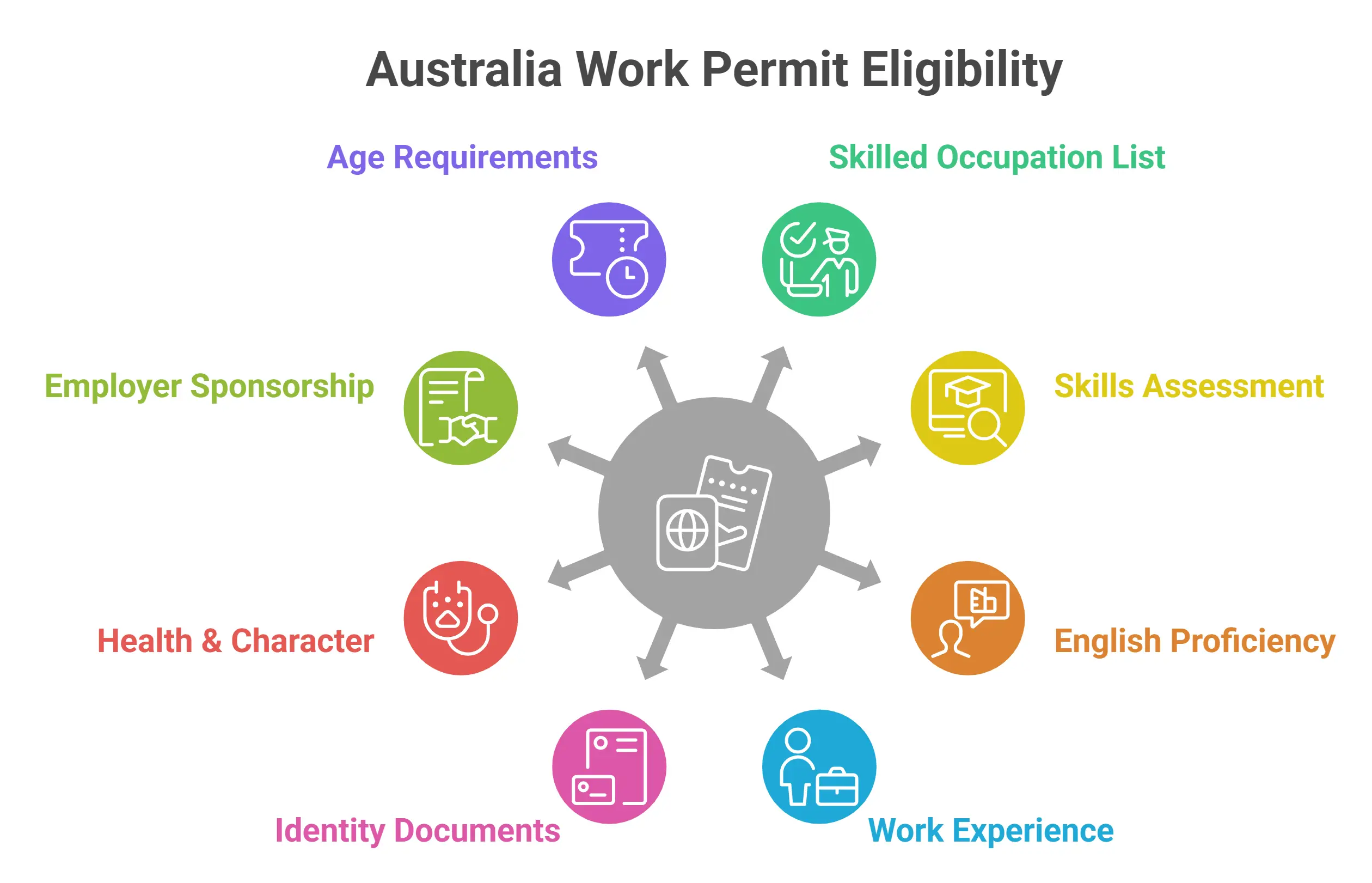
To be eligible for an Australia Work Permit, you may need:
- An occupation listed on the relevant skilled occupation list for your visa subclass
- A positive skills assessment from the relevant assessing authority
- English language test results such as IELTS, PTE Academic, OET, or TOEFL iBT
- Relevant work experience related to your nominated occupation
- A valid passport and identity documents
- Health examinations and police clearance certificates
- Employer sponsorship and a valid job offer for sponsored visa subclasses
- Age requirements for certain visa subclasses
*Want to check your eligibility? Get free eligibility assessment from Y-Axis today.
Documents Required for an Australia Work Permit
When applying for an Australia Work Permit, you must provide documents related to your identity, skills assessment, work experience, English language test results, health insurance, and police clearance. Additional documents may be required based on the visa type, occupation, and sponsorship status.
- Valid passport or travel document
- Skills assessment outcome from the relevant assessing authority
- English language test results such as IELTS, PTE Academic, OET, or TOEFL iBT
- Educational certificates and transcripts
- Employment reference letters and work experience documents
- Job offer letter or employer sponsorship documents for sponsored visa subclasses
- Health examination results and police clearance certificates
- Marriage or birth certificates for dependants travelling with you
How to Apply for an Australia Work Visa from Canada?
To apply for an Australia Work Visa from Canada, select the right visa subclass for your occupation and employment situation, then follow the application steps for your chosen route.
Step 1: Confirm your occupation is listed on the relevant skilled occupation list for your chosen visa subclass.
Step 2: Complete a skills assessment with the relevant Australian assessing authority and sit an approved English language test.
Step 3: Secure an Australian job offer or employer sponsorship for employer-sponsored visas, or lodge an Expression of Interest (EOI) through SkillSelect for points-tested skilled visas.
Step 4: Gather all required documents including your passport, skills assessment outcome, English test results, employment records, and educational certificates.
Step 5: Create an ImmiAccount and submit your Australia Work Visa application online.
Step 6: Complete medical examinations and provide police clearance certificates as part of your application.
Step 7: Receive a visa decision and prepare for your move to Australia.
*Want to apply for an Australia Work Permit? Get expert guidance from Y-Axis professionals.
Apply Now
FAQs
What is the easiest Australia Work Visa to get from Canada?
The Skills in Demand (SID) visa (subclass 482) is generally the easiest Australia Work Visa for Canadians with a job offer from an approved Australian employer. It requires at least one year of relevant work experience and an occupation listed on the Core Skills Occupation List (CSOL). Without a job offer, subclass 189 is a common pathway.
Can Canadian applicants get an Australia Work Permit without a job offer?
Yes. Canadians can apply for certain Australia Work Visa pathways without a job offer. The Skilled Independent visa (subclass 189) is a points-tested permanent visa that does not require employer sponsorship. The Skilled Nominated visa (subclass 190) also offers a pathway without a job offer through state or territory nomination.
Is IELTS required for an Australia Work Visa from Canada?
Most Australia Work Visa applicants must prove English language ability through approved tests such as IELTS, PTE Academic, OET, or TOEFL iBT. Canadian applicants are not automatically exempt. The required score depends on the visa subclass, occupation, and English language requirements for the selected pathway.
What jobs qualify for an Australia Work Permit?
Occupations must appear on the relevant skilled occupation list for the visa subclass. High-demand sectors include healthcare, engineering, information technology, construction, education, accounting, and skilled trades. The subclass 482 visa uses the Core Skills Occupation List (CSOL), while subclass 189 and 190 rely on separate occupation lists.
How much does an Australia Work Visa cost from Canada?
Visa fees depend on the subclass. The Skills in Demand (SID) visa (subclass 482) starts from AUD 3,210, while permanent skilled visas such as subclass 189 and 190 start from AUD 4,910. Additional costs may include skills assessments, English tests, medical exams, police certificates, and document preparation.
Can an Australia Work Permit lead to permanent residency?
Yes. Some Australia Work Visa pathways lead directly or indirectly to permanent residence. The Skilled Independent visa (subclass 189) and Skilled Nominated visa (subclass 190) grant permanent residence immediately. The Skills in Demand (SID) visa (subclass 482) can later transition to permanent residency through subclass 186.
Can I bring my family to Australia on a Work Visa?
Yes. Most Australia Work Visa holders can include a spouse or partner and dependent children in their application. Family members usually receive work and study rights in Australia. Dependants must meet health and character requirements and can apply with the primary applicant or later as subsequent entrants.
How long does Australia Work Permit processing take?
Processing times vary by visa subclass, occupation, and application completeness. The Skills in Demand (SID) visa (subclass 482) may take a few weeks to several months, while subclass 189 and 190 visas usually take longer. Priority occupations and employer-sponsored roles may receive faster processing.
What is the minimum salary for an Australia Work Visa?
For the Skills in Demand (SID) visa (subclass 482), sponsored workers must usually earn at least the Core Skills Income Threshold (CSIT), currently AUD 76,515 per year. Employers must also pay the market salary rate to ensure foreign workers receive wages comparable to Australian employees.
Can Canadians apply for an Australia Working Holiday Visa?
Yes. Canadian citizens can apply for the Australia Working Holiday Visa (subclass 417), which allows work and travel in Australia for up to one year. Canadians can apply up to age 35 and may qualify for second or third visas by completing eligible regional work.
Tags:
Australia Work Visa
Australia Skilled Worker Visa
Australia Work Visa Requirements
Australia Immigration
Work in Australia
Australia Sponsorship Visa
Australia Visa Requirements
Skilled Worker Visa Australia
Australia Work Permit
Share
Latest Article
Popular Post
Trending Article

Posted On October 21 2026
How Can I Get Permanent Residency in the UK?