


Posted on December 20 2025
Fast-Track Hiring Options in Europe for Skilled Professionals

By , Editor
Updated December 20 2025
Europe has more than 10 fast-track hiring options to help employers fill over 5 million current job vacancies across high-demand sectors such as IT, engineering, healthcare, construction, renewable energy, and advanced manufacturing. Leading countries including Germany, France, Netherlands, Sweden, Austria, and Portugal are expanding accelerated hiring pathways due to ongoing labour shortages.
The European Union has announced €1.8 trillion in planned investment across infrastructure, clean energy transition, digitalisation, housing, and industrial innovation. In parallel, individual European countries are committing billions of euros to national projects in green energy, transport, healthcare systems, and digital transformation. These large-scale investments are significantly increasing demand for skilled professionals, making fast-track hiring options a critical part of Europe’s long-term economic growth strategy.
*Want to work in Europe? Let Y-Axis guide you through the entire process.
Top 10 European Countries with Fast-Track Hiring Options for Skilled Professionals
Europe has introduced structured fast-track hiring pathways that allow employers to hire skilled professionals faster than standard work visa routes. These pathways include employer-sponsored work permits, accelerated skilled worker procedures, tech-focused visas, job seeker visas, and priority processing schemes.
Countries such as Germany, France, Netherlands, Sweden, Ireland, and other European nations have well-defined fast-track hiring systems designed to reduce processing times and support quicker workforce entry.
List of the top 10 European countries offering fast-track hiring options for skilled professionals:
1. Germany
Germany has over 1.8 million job vacancies, the highest in Europe, with acute shortages across IT, engineering, healthcare, logistics, manufacturing, construction, and skilled trades. To manage this demand, Germany offers four main fast-track hiring options, led by the Accelerated Skilled Worker Procedure (ASVP), which allows employers to fast-track qualification recognition and work permit approvals. Germany also offers the Opportunity Card (Chancenkarte), enabling skilled professionals to enter without a job offer and transition to employment. Demand continues to rise as Germany invests €1 trillion+ in infrastructure, clean energy, housing, and digitalisation.
2. Austria
Austria faces persistent labour shortages due to an ageing population, particularly in engineering, healthcare, construction, manufacturing, and technical trades. Fast-track hiring is supported through the Red-White-Red Card, which prioritises skilled professionals in shortage occupations and offers quicker processing. Austria also provides a Job Seeker Visa for highly qualified professionals, allowing entry without a job offer and faster transition to employment once work is secured.
3. Sweden
Sweden currently has 109,900 job vacancies, particularly in IT, engineering, manufacturing, green energy, and research. To reduce hiring delays, Sweden applies priority work permit processing for skilled professionals, allowing faster decisions for employer-sponsored roles. Fast-track hiring options include the Sweden Work Permit and Intra-Company Transfer (ICT) permit. Sweden also offers a Job Seeker Visa, which allows skilled professionals to enter and search for work, though faster hiring generally depends on employer sponsorship.
4. Portugal
Portugal is experiencing growing demand for skilled professionals driven by technology expansion, renewable energy projects, construction, and innovation-led investment. Fast-track hiring is available through priority work permits and the Tech Visa, which simplify employer-sponsored recruitment. Portugal also offers a Job Seeker Visa, allowing skilled professionals to enter without a job offer and transition to a work permit after securing employment.
5. Netherlands
The Netherlands has one of the highest job vacancy rates in Europe, particularly in IT, engineering, logistics, finance, and research. Employers rely on the Highly Skilled Migrant Programme, which allows recognised sponsors to hire skilled professionals through streamlined and faster procedures. The Orientation Year Visa further supports talent by allowing skilled graduates to remain without a job offer and move into employment later.
6. Ireland
Ireland continues to attract global investment, creating strong demand in technology, healthcare, pharmaceuticals, finance, and professional services. The Critical Skills Employment Permit is the main fast-track route, offering faster processing, exemption from labour market testing, and a clear pathway to long-term residence for skilled professionals.
7. Denmark
Denmark faces ongoing shortages in engineering, IT, life sciences, energy, and technical roles, particularly as investment in green energy and advanced industries accelerate. The Fast-Track Scheme allows certified employers to hire skilled professionals through priority and flexible permit options, significantly reducing processing times.
8. France
France has large-scale labour shortages across technology, healthcare, engineering, research, and industrial sectors. The Talent Passport serves as the primary fast-track option, offering simplified application procedures and multi-year permits. This pathway helps skilled professionals enter the workforce faster as France continues major public and private sector investments.
9. Finland
Finland faces skill gaps in IT, gaming, clean technology, engineering, and research as innovation-driven industries expand. To support faster recruitment, Finland offers a Fast-Track Residence Permit Service, enabling employer-sponsored applications to be processed in as little as two weeks, one of the fastest timelines in Europe.
10. Spain
Spain is strengthening fast-track hiring to support growth in technology, digital services, renewable energy, and innovation-led roles. The Highly Qualified Professional Permit allows employer-sponsored applications to be processed faster than standard work visas, helping employers reduce hiring delays in priority sectors.
Eligibility Requirements for Fast-Track Hiring in Europe for Skilled Professionals
Fast-track hiring in Europe is designed to help employers fill skill shortages quickly through priority work permit processing. While eligibility rules vary by country, most fast-track routes follow a similar framework. Meeting the eligibility criteria is essential to qualify for faster approvals and avoid delays.
Key eligibility requirements include:
- Recognised educational qualification or professional certification
- Relevant work experience aligned with shortage occupations
- Job offer from an eligible employer
- Salary meeting country-specific minimum thresholds
- Professional licensing or registration for regulated roles
- Language requirements depending on the role and country
Documents Required for Fast-Track Hiring in Europe for Skilled Professionals
Submitting complete and accurate documents is critical for fast-track hiring in Europe. Immigration authorities prioritise applications that meet all documentation requirements.
Key required documents include:
- Valid passport
- Job offer or employment contract (if applicable)
- Educational certificates and professional qualifications
- Work experience letters or reference documents
- Salary details meeting national thresholds
- Health insurance coverage (if required)
- Police clearance or background check
- Proof of accommodation (for some countries)
Step-by-Step Process for Fast-Track Hiring in Europe for Skilled Professionals
Fast-track hiring in Europe follows a structured process designed to reduce delays and prioritise eligible applications. While steps vary slightly by country, the overall process is similar across most fast-track pathways.
Step by step application process for skilled professionals:
Step 1: Identify the European country and fast-track route that matches your skills
Step 2: Secure a job offer from an eligible
Step 3: Check eligibility based on qualifications, work experience, and salary criteria
Step 4: Employer initiates the application process
Step 5: Gather all required documents
Step 6: Submit the work permit or visa application and complete biometrics
Step 7: Receive approval and relocate to start employment
*Want to apply for a fast-track work permit in Europe? Get step-by-step assistance from Y-Axis experts.
Processing Time for Fast-Track Hiring Options in Europe
Fast-track hiring options are designed to significantly shorten standard work visa timelines. Processing times depend on the country, visa type, and document readiness. Employer-sponsored applications are usually processed faster than standard routes.
Average processing timelines include:
- Employer-sponsored fast-track work permits: 2–8 weeks
- Priority or accelerated employer schemes: 1–4 weeks
- Job Seeker Visa pathways: 1–3 months, depending on the country
- Intra-Company Transfer (ICT) permits: often faster due to pre-approved employers
Processing Cost for Fast-Track Work Visas in Europe
The cost of fast-track work visas in Europe varies by country and visa type but is generally affordable. In most cases, government work permit or visa fees range between €100 and €500. Some countries may charge additional fees for priority or fast-track processing. Other costs can include biometrics and residence permit charges, document translation and certification, and health insurance or medical requirements, depending on individual circumstances.
High-Demand Sectors for Fast-Track Hiring in Europe
Fast-track hiring options in Europe focus on sectors facing long-term labour shortages and skills gaps. These industries are prioritised due to economic growth, digital transformation, ageing populations, and large-scale infrastructure and energy investments. Skilled professionals in these sectors are more likely to qualify for accelerated hiring routes.
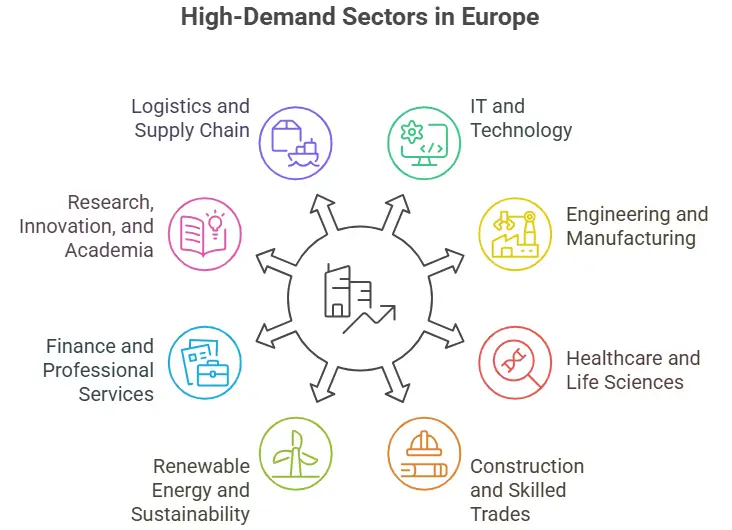
Key high-demand sectors for skilled professionals include:
- IT and Technology
- Engineering and Manufacturing
- Healthcare and Life Sciences
- Construction and Skilled Trades
- Renewable Energy and Sustainability
- Finance and Professional Services
- Research, Innovation, and Academia
- Logistics and Supply Chain
Can I Apply for Fast-Track Hiring in Europe Without a Job Offer?
Yes, it is possible to apply for fast-track hiring in Europe without a job offer, but only under specific visa types. Some countries offer job seeker or points-based visas that allow skilled professionals to enter Europe and search for employment locally. Once a job is secured, applicants can switch to a work permit or employer-sponsored fast-track route. However, employer-sponsored pathways remain the fastest option to start working, as they prioritise applications linked to confirmed job offers.
Can Fast-Track Hiring Options in Europe Lead to Permanent Residence?
Yes, most fast-track hiring options in Europe can lead to permanent residence. Skilled professionals who maintain legal employment and residence can usually apply for permanent residency after 2 to 5 years, depending on the country. Meeting income requirements, paying taxes, and complying with visa conditions are essential. Many fast-track work permits are extendable and support long-term settlement, making them a strong pathway for professionals planning to build a future in Europe.
Tips to Improve Your Chances for Fast-Track Hiring in Europe
Fast-track hiring decisions depend on your eligibility, documentation, and employer readiness. Following the right approach can significantly improve approval speed and success.
Key tips to improve your chances include:
- Target roles listed under official skill shortage occupations
- Choose the country and fast-track route that best matches your profile
- Secure an employer experienced in sponsoring international professionals
- Ensure salary meets country-specific thresholds
- Submit complete and accurate documents, including certified translations
- Prepare early for qualification recognition or licensing if required
*Planning to migrate to Europe? Get expert guidance and end-to-end support from Y-Axis.
FAQs
What are fast-track hiring options in Europe for skilled professionals?
Fast-track hiring options in Europe are accelerated work permit and visa pathways that help employers recruit skilled professionals faster than standard immigration routes. These options prioritise high-demand sectors such as IT, engineering, healthcare, construction, and renewable energy. Fast-track hiring typically involves employer sponsorship, simplified procedures, and shorter processing times, allowing skilled professionals to start work sooner and access clearer pathways to long-term residence in Europe.
Which European countries offer fast-track hiring options for skilled professionals?
Top European countries offer fast-track hiring options to address labour shortages, including Germany, France, Netherlands, Sweden, Austria, Portugal, Ireland, Denmark, Finland, and Spain. These countries provide employer-sponsored fast-track work permits, tech visas, accelerated skilled worker procedures, and job seeker visas. Eligibility rules, salary thresholds, and processing times vary by country, so choosing the right option depends on your skills, experience, and job offer status.
Who is eligible for fast-track hiring options in Europe?
Eligibility for fast-track hiring in Europe depends on the country and visa type, but most pathways target skilled professionals with recognised qualifications or relevant work experience. Applicants usually need a job offer from a European employer, except for job seeker or points-based visas. Salary thresholds often apply, especially for highly skilled roles. Regulated professions such as healthcare or engineering may require licensing or qualification recognition.
Is a job offer mandatory for fast-track hiring in Europe?
A job offer is mandatory for most fast-track hiring options in Europe, as these routes are typically employer-sponsored. However, some countries allow skilled professionals to apply without a job offer through job seeker or points-based visas. These pathways allow entry to Europe to search for employment locally. Once a job is secured, applicants can switch to a work permit or fast-track route.
How long does fast-track hiring in Europe take?
Fast-track hiring options in Europe are designed to reduce processing times significantly. In many countries, employer-sponsored fast-track work permits are processed within 2 to 8 weeks, depending on the visa type and document readiness. Priority employer schemes may be completed in 1 to 4 weeks. Job seeker visas usually take 1 to 3 months. Processing times vary by country, occupation, and application completeness, but fast-track routes are consistently quicker than standard work visas.
What documents are required for fast-track hiring in Europe?
Documents required for fast-track hiring in Europe generally include a valid passport, job offer or employment contract, educational certificates, and proof of work experience. Applicants may also need salary details meeting national thresholds, health insurance, police clearance, and proof of accommodation. Employers may need to submit sponsorship or compliance documents. For regulated professions, qualification recognition or licensing is often required.
What are the costs of fast-track work visas in Europe?
The cost of fast-track work visas in Europe varies by country and visa type. Government work permit or visa fees typically range between €100 and €500. Some countries charge additional fees for priority or fast-track processing. Other costs may include biometrics, residence permits, document translation, certification, and health insurance. While costs vary, fast-track hiring options are generally affordable compared to the long-term benefits of working and settling in Europe.
Which sectors benefit most from fast-track hiring in Europe?
Fast-track hiring in Europe mainly targets sectors facing long-term skill shortages. High-demand sectors include IT and technology, engineering and manufacturing, healthcare and life sciences, construction and skilled trades, and renewable energy. Additional demand exists in finance, professional services, research and innovation, logistics, education, and hospitality. Skilled professionals working in these sectors have a higher chance of qualifying for fast-track work permits due to sustained labour shortages across Europe.
Can fast-track hiring in Europe lead to permanent residence?
Yes, most fast-track hiring options in Europe can lead to permanent residence. Skilled professionals can usually apply for permanent residency after 2 to 5 years of continuous legal employment, depending on the country. Requirements typically include stable employment, meeting income thresholds, paying taxes, and complying with residence rules. Many fast-track work permits are extendable and allow family reunification, making them a strong pathway for long-term settlement in Europe.
How can I improve my chances of fast-track hiring approval in Europe?
To improve your chances of approval under fast-track hiring options in Europe, target occupations listed under official skill shortage lists and ensure your qualifications match job requirements. Secure an employer experienced in sponsoring international professionals, meet salary thresholds, and submit complete documentation. Preparing early for qualification recognition or licensing can reduce delays. Choosing the right country and fast-track route for your profile significantly improves approval success and processing speed.
Tags:
Europe work visa
EU Blue Card
Fast-track hiring
Skilled professionals
European jobs
Work permits in Europe
International careers
Share
Latest Article
Popular Post
Trending Article

Posted On March 07 2026
Top 10 Countries for Chefs: Salary, Demand & PR Opportunities Compared