


Posted on October 30 2025
What are the most in-demand jobs in Australia for the next 10 years?

By , Editor
Updated November 03 2025
What are the most in-demand jobs in Australia for the next 10 years?
The most in-demand jobs in Australia for the next decade will be in Healthcare & Social Assistance, Information Technology (IT), Engineering, Education, and Renewable Energy. Emerging fields such as Artificial Intelligence (AI), Cybersecurity, Data Science, and Sustainability are expected to create thousands of new roles nationwide.
Roles such as Registered Nurses, Tradespeople, Engineers, and ICT Professionals will be among the most sought-after positions. Technological advancement, renewable energy growth, an ageing population, and major infrastructure projects are driving strong demand for skilled professionals.
According to Australian Government projections, nearly 2 million new jobs will be created, bringing total employment to 16.3 million by May 2034. With its robust economy, skilled migration policies, and focus on innovation, Australia remains one of the top destinations for international professionals seeking career growth.
*Want to work in Australia? Let Y-Axis help you through every step of the process.
List of In-Demand Jobs in Australia for the Next 10 Years
Australia’s job market is set for steady growth, with strong demand for skilled professionals across key industries such as Healthcare & Social Assistance, Professional, Scientific and Technical Services, and Education & Training.
As the country continues to invest in innovation, healthcare, sustainability, and infrastructure, opportunities for skilled workers are expected to rise across multiple sectors.
According to the Australian Bureau of Statistics (ABS), there were nearly 330,000 job vacancies in August 2025, reflecting the nation’s on-going demand for qualified professionals across all major industries.
|
Sector |
In-demand Job Roles |
|
Healthcare & Social Assistance |
Registered Nurses, Doctors, Physiotherapists, Aged Care Specialists |
|
Information Technology (IT) |
Software Developers, Cybersecurity Experts, AI & Cloud Engineers, Data Analysts |
|
Engineering & Infrastructure |
Civil Engineers, Project Managers, Architects, Quantity Surveyors |
|
Education & Training |
Teachers, Early Childhood Educators, Vocational Trainers |
|
Renewable Energy & Sustainability |
Solar Technicians, Environmental Scientists, Sustainability Managers |
|
Business & Finance |
Accountants, Financial Analysts, HR Managers, Business Consultants |
|
Hospitality & Tourism |
Chefs, Hotel Managers, Event Coordinators |
High Paying Jobs in Australia
Australia offers some of the most competitive salaries worldwide, especially for skilled professionals in high-demand industries. On average, workers in key sectors earn between AUD 65,000 and AUD 150,000 per year, depending on their role, qualifications, and experience.
Major cities like Sydney, Melbourne, and Brisbane offer the highest salary ranges, particularly in fields such as Information Technology (IT), Finance, Engineering, and Healthcare. For Canadians seeking career growth and attractive pay, Australia provides a strong job market with excellent earning potential and long-term opportunities.
|
Sector |
Average Annual Salary (AUD) |
|
Healthcare & Social Assistance |
$70,000 – $120,000 |
|
Information Technology (IT) |
$85,000 – $150,000 |
|
Engineering & Infrastructure |
$75,000 – $130,000 |
|
Education & Training |
$65,000 – $110,000 |
|
Renewable Energy & Sustainability |
$70,000 – $120,000 |
|
Business & Finance |
$75,000 – $125,000 |
|
Hospitality & Tourism |
$55,000 – $95,000 |
Top In-Demand Skills Required in Australia
As Australia’s economy evolves, the demand for skilled professionals continues to rise across technology, healthcare, renewable energy, and engineering sectors. Employers are prioritising candidates with both technical expertise and strong soft skills, as industries undergo rapid digital and green transformation.
Skills related to technology, healthcare innovation, sustainability, and leadership will be particularly valuable over the next decade, giving professionals a strong edge in the Australian job market.
|
Category |
Top Skills in Demand |
|
IT & Tech |
Artificial Intelligence (AI), Data Analytics, Cybersecurity, Cloud Computing, Software Development |
|
Healthcare & Social Services |
Nursing, Aged Care, Mental Health Support, Allied Health, Medical Technology |
|
Engineering & Green Energy |
Renewable Energy Systems, Civil & Electrical Engineering, Environmental Management, Project Design |
|
Business & Leadership |
Strategic Planning, Financial Analysis, Project Management, Business Development, HR Management |
|
Skilled Trades & Vocational |
Construction, Plumbing, Electrical Work, Automotive Repair, Welding |
|
Soft & Transferable |
Communication, Adaptability, Problem-Solving, Teamwork, Time Management |
Best Cities in Australia for Career Growth
Australia’s major cities are thriving economic hubs offering diverse job opportunities, high living standards, and excellent infrastructure. Each city has its own strengths, making it ideal for professionals across various industries.
|
City |
Key Industries |
Why Consider This City? |
|
Sydney |
Finance, IT, Healthcare, Education |
Major business and financial hub offering global career opportunities. |
|
Melbourne |
Technology, Professional Services, Education |
Innovation centre with a strong start-up culture and diverse job market. |
|
Brisbane |
Engineering, Construction, Healthcare |
Rapidly growing economy with affordable living and work-life balance. |
|
Perth |
Mining, Energy, Engineering |
High-paying roles in resources and energy sectors. |
|
Adelaide |
Defence, Manufacturing, Clean Energy |
Emerging hub for defence, advanced manufacturing, and renewable industries. |
Fast-Growing Sectors Creating Jobs in Australia
Australia’s future job market is being reshaped by digital transformation, sustainability targets, and government-backed innovation.
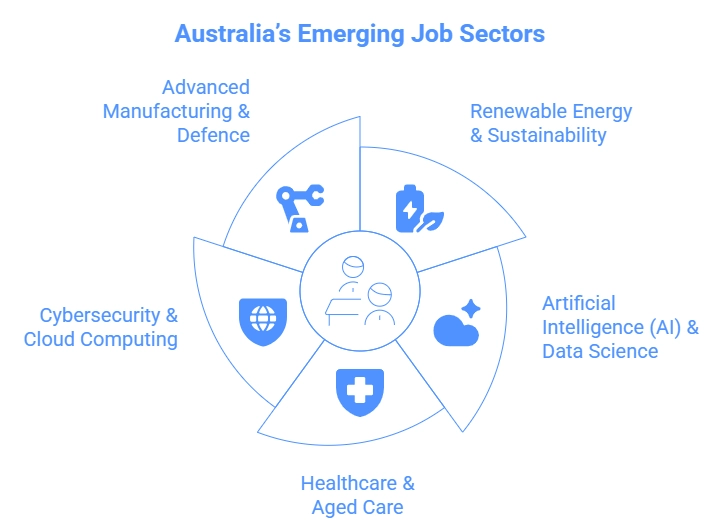
The nation’s commitment to achieving net-zero emissions by 2050, growing investment in AI and advanced manufacturing, and a strong focus on healthcare and digital infrastructure are expected to fuel job creation across emerging industries.
|
Sector |
Growth Outlook |
|
Renewable Energy & Sustainability |
Expected to create 100,000+ jobs by the 2030s as Australia moves toward net-zero emissions. |
|
Artificial Intelligence (AI) & Data Science |
Could add up to AUD 315 billion to the economy by 2030; strong demand for AI and data experts. |
|
Healthcare & Aged Care |
Projected to add 250,000+ new roles by 2034 due to an ageing population. |
|
Cybersecurity & Cloud Computing |
One of the fastest-growing tech fields as digitalisation accelerates across industries. |
|
Advanced Manufacturing & Defence |
Supported by the AUD 15 billion National Reconstruction Fund, driving high-skill job creation. |
How can I get a Job in Australia from Canada?
Australia’s booming job market and skill shortages make it an attractive destination for Canadian professionals. With strong economic ties, similar work cultures, and high living standards, Canada and Australia offer seamless career mobility making it easier for Canadians to find skilled job opportunities in Australia.
Step 1: Check if your occupation is on the Skilled Occupation List (SOL).
Step 2: Obtain a skills assessment from an approved authority.
Step 3: Create an Australian-style resume highlighting skills and achievements.
Step 4: Apply on top job portals like Seek, Indeed, LinkedIn, and JobActive.
Step 5: Apply for a visa such as Subclass 189, 190, or 482.
Step 6: Once approved, plan your relocation and settlement in Australia.
With thousands of job openings across key sectors and clear visa pathways for skilled workers, Canadian professionals can find excellent opportunities to advance their careers in Australia.
*Planning to work in Australia? Let Y-Axis guide you through every step of your journey.
FAQs
What are the most in-demand jobs in Australia for the next 10 years?
IT, Healthcare, Engineering, Construction and Renewable Energy will drive demand. Roles like software developers, cybersecurity experts, nurses, aged-care workers, civil engineers and electricians are expected to be highly sought after as digital transformation and population growth continue.
Which industries in Australia will have the highest job growth by 2035?
Healthcare, Information Technology, Construction, Education and Renewable Energy are forecast to grow fastest to 2035—driven by demographic change, urban development and sustainability investments.
Are IT and technology jobs in demand in Australia?
Yes. Software engineers, cloud architects, data scientists and cybersecurity specialists are in strong demand across startups and large enterprises as businesses accelerate digital projects and cloud adoption.
What are the most in-demand healthcare jobs in Australia?
Registered nurses, aged-care workers, doctors, physiotherapists and mental-health professionals will be highly needed—especially in regional areas and in telehealth/medical-technology roles.
Is engineering a good career choice in Australia’s future job market?
Absolutely. Civil, mechanical, electrical and mining engineers are crucial for infrastructure, renewable projects and advanced manufacturing—offering long-term opportunities and competitive salaries.
What trades and vocational jobs will be in demand in Australia?
Electricians, plumbers, carpenters, mechanics and welders will remain essential as construction and energy projects expand. Apprenticeships and vocational training are actively supported to fill these gaps.
Are green and renewable energy jobs growing in Australia?
Yes. Solar installers, wind-turbine technicians, environmental engineers and sustainability consultants are increasingly needed as Australia invests in a low-carbon transition.
Which cities in Australia offer the best job opportunities for skilled workers?
Sydney, Melbourne, Brisbane and Perth are major hubs—Sydney for tech and finance; Melbourne for healthcare and education; Brisbane and Perth for construction, mining and renewables. Regional centres like Adelaide also offer sectoral opportunities and incentives.
What skills are most needed to get high-demand jobs in Australia?
Technical skills (programming, data analytics, cloud, renewable-tech), project management and healthcare competencies are top priorities. Soft skills—communication, adaptability and leadership—boost employability. Upskilling via short courses and certifications helps a lot.
How can international workers find in-demand jobs in Australia?
Use the Skilled Migration Program, employer sponsorships or regional visas. Check the Skilled Occupation List (SOL), apply on SEEK/LinkedIn, get relevant credentials recognised and meet English requirements. Recruitment agencies and migration advisors can help navigate visas and job matching.
Tags:
Work Abroad
Working Abroad
Work opportunites
Live Abroad
Work abroad opportunities
Share
Latest Article
Popular Post
Trending Article
Posted On March 07 2026
Top 10 Countries for Chefs: Salary, Demand & PR Opportunities Compared