


Posted on December 29 2025
What are the most in-demand jobs in Ireland for the next 10 years?

By , Editor
Updated January 23 2026
The most in-demand jobs in Ireland for the next 10 years will be across information technology, healthcare, engineering, renewable energy, construction, finance, and business services. High-demand roles include software developers, data and AI specialists, cybersecurity experts, engineers, nurses and healthcare professionals, renewable energy specialists, construction managers, accountants, and financial analysts.
Ireland currently has more than 30,000 job vacancies due to ongoing labour shortages. According to recent statistics, nearly 2 million new job opportunities are expected to be created by 2035 due to the ageing workforce, skills shortages, and rapid digital transformation. The Irish government is investing in technology, housing, healthcare infrastructure, and the green energy transition, creating strong job opportunities across key sectors.
With competitive salaries, strong labour protections, and a high quality of life, Ireland remains a top destination for skilled professionals seeking long-term international careers.
*Want to work in Ireland? Let Y-Axis guide you through the application process.
Most In-demand Jobs in the Ireland for the next 10 years
Ireland’s most in-demand jobs for the next 10 years will be concentrated in sectors facing long-term skills shortages and sustained investment. Roles in technology, healthcare, engineering, construction, renewable energy, finance, education, hospitality, sales, and human resources continue to see strong hiring demand. The Government of Ireland plans to generate over 300,000 new jobs by 2030, further strengthening employment opportunities and long-term career growth across key industries.
Most In-Demand Jobs in Ireland for the next 10 years:
|
Sector |
In-Demand Job Roles |
|
Information Technology |
Software Developers, Data & AI Specialists, Cybersecurity Experts, Cloud Engineers, IT Project Managers, Systems Analysts |
|
Healthcare & Social Care |
Nurses, Doctors, Allied Health Professionals, Care Workers, Medical Technicians, Healthcare Support Staff |
|
Engineering |
Civil Engineers, Electrical Engineers, Mechanical Engineers, Project Engineers, Design Engineers, Site Engineers |
|
Construction & Infrastructure |
Construction Managers, Quantity Surveyors, Skilled Trades, Site Supervisors, Planning Engineers, Building Inspectors |
|
Renewable Energy & Sustainability |
Renewable Energy Engineers, Environmental Engineers, Energy Analysts, Sustainability Consultants, Wind & Solar Technicians |
|
Finance & Business Services |
Accountants, Financial Analysts, Compliance Specialists, Risk Managers, Auditors, Business Analysts |
|
Education & Training |
Secondary Teachers, STEM Educators, Training Specialists, Curriculum Developers |
|
Hospitality & Tourism |
Hotel Managers, Chefs, Tourism Operations Managers, Front Office Managers, Event Coordinators |
|
Sales & Marketing |
Digital Marketing Specialists, Sales Managers, Brand Managers, Marketing Analysts, Business Development Executives |
|
Human Resource Management |
HR Managers, Talent Acquisition Specialists, HR Business Partners, Learning & Development Managers |
High-Paying Jobs in Ireland for Skilled Professionals
High-paying jobs in Ireland are mainly available in sectors facing long-term skills shortages and strong investment. Skilled professionals in technology, healthcare, engineering, finance, education, and hospitality continue to earn competitive salaries and benefit from stable career growth. These roles offer attractive pay, strong job security, and long-term employment prospects across Ireland.
List of High-Paying Jobs in Ireland for Skilled Professionals:
|
Occupation |
Average Annual Salary (EUR) |
Job Outlook |
|
Healthcare |
45,000 – 95,000 |
Very High |
|
STEM (Science, Technology, Engineering, Mathematics) |
50,000 – 100,000 |
Very High |
|
IT & Software |
55,000 – 95,000 |
Very High |
|
Engineering |
50,000 – 85,000 |
High |
|
Nursing |
45,000 – 80,000 |
Very High |
|
Sales & Marketing |
45,000 – 80,000 |
Moderate |
|
Accounting & Finance |
45,000 – 85,000 |
High |
|
Human Resource Management |
50,000 – 85,000 |
Moderate |
|
Teaching |
40,000 – 70,000 |
High |
|
Hospitality & Tourism |
35,000 – 65,000 |
Moderate |
In-Demand Skills with Job Opportunities in Ireland for the Next 10 Years
Ireland’s job market over the next decade will be shaped by long-term skills shortages, digital transformation, and sustained investment across key industries. Professionals with future-ready capabilities and sector-specific expertise will continue to see strong employment opportunities and career stability.
List of In-Demand Skills in Ireland for the next 10 Years:
|
Occupation |
In-Demand Skills |
|
Digital & Technology |
Software development, data analytics, AI, cloud computing, cybersecurity |
|
Healthcare & Clinical |
Nursing care, allied health expertise, medical technologies, patient services |
|
Engineering & Technical |
Civil, electrical, mechanical systems, automation, project delivery |
|
Sustainability & Green |
Renewable energy systems, environmental management, ESG compliance |
|
Business & Finance |
Accounting, financial analysis, compliance, risk management |
|
Sales & Marketing |
Digital marketing, sales strategy, brand management, CRM tools |
|
Human Resource Management |
Talent acquisition, HR operations, learning & development |
|
Education & Training |
Teaching methods, curriculum design, vocational training |
|
Hospitality & Tourism |
Hotel operations, tourism management, event coordination |
|
Soft Skills |
Communication, leadership, problem-solving, adaptability |
How to Get a Job in Ireland for Skilled Professionals?
Skilled professionals can get a job in Ireland by targeting in-demand roles, preparing an Ireland-standard CV, and applying through verified employers and recruitment channels. Ireland actively hires skilled talent across technology, healthcare, engineering, construction, finance, and education. Following the correct job search and application process improves chances of securing employment quickly.
Step by step application process for jobs in Ireland:
Step 1: Identify in-demand roles aligned with your skills and experience
Step 2: Prepare an Ireland-standard CV and a tailored cover letter
Step 3: Apply through trusted job portals, recruitment agencies, and company career pages
Step 4: Attend interviews
Step 5: Secure a job offer and apply for work permit.
*Want to apply for jobs in Ireland? Get expert guidance from Y-Axis.
Benefits of Working in Ireland for Skilled Professionals
Ireland offers a strong balance of career growth and quality of life, supported by fair employment laws and long-term job stability.
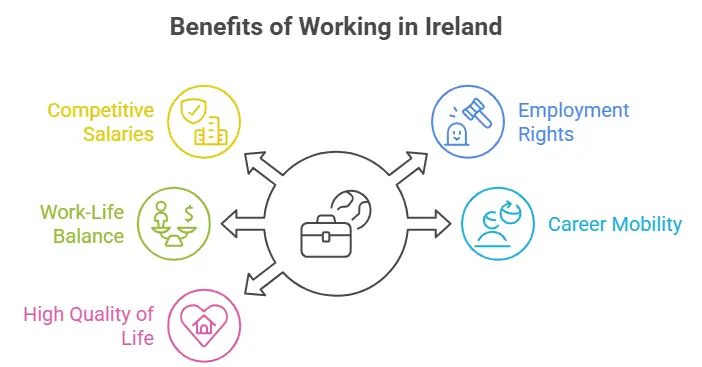
Key Benefits for Skilled Professionals working in Ireland include:
- Competitive salaries with strong labour protections
- Clear employment rights and regulated working hours
- Excellent work–life balance
- Career mobility across industries and the wider EU market
- High quality of life with access to healthcare and social benefits
Top Cities in to Work in Ireland for Skilled Professionals
Ireland’s employment opportunities are concentrated in key urban centres, each known for specific industries and employer clusters. Choosing the right city can significantly improve job prospects based on your skills and experience.
- Dublin: Technology, finance, business services, healthcare, sales, and marketing; largest job market with global employers.
- Cork: IT, engineering, pharmaceuticals, healthcare, and life sciences; strong opportunities with a lower cost of living.
- Galway: Medical devices, healthcare technology, engineering, and software roles; known for quality of life.
- Limerick: Engineering, construction, education, and public-sector jobs supported by regional growth.
- Waterford: Technology services, tourism, education, and manufacturing with growing demand for skilled professionals.
Job Outlook in Ireland for the Next 10 Years
The job outlook in Ireland remains positive and stable over the next decade, supported by long-term skills shortages, workforce replacement demand, and sustained public and private investment. Growth will be strongest in technology, healthcare, engineering, construction, renewable energy, finance, and education.
An ageing workforce is expected to create significant replacement hiring, while digital transformation and the green transition continue to generate new roles. Government-led initiatives in housing delivery, healthcare expansion, and clean energy projects are also strengthening employment prospects. Overall, skilled professionals with in-demand capabilities can expect strong job security, competitive salaries, and long-term career opportunities across Ireland.
*Looking for jobs in Ireland? Avail Y-Axis Resume Marketing Services to find the right job faster.
FAQs
What are the most in-demand jobs in Ireland for the next 10 years?
The most in-demand jobs in Ireland over the next 10 years will be in IT, healthcare, engineering, renewable energy, construction, finance, education, and business services. Roles such as software developers, data and AI specialists, cybersecurity experts, nurses, engineers, construction managers, accountants, and renewable energy professionals will continue to see strong demand due to skills shortages, workforce ageing, and long-term economic investment.
Why is Ireland facing high demand for skilled jobs?
Ireland faces high demand for skilled jobs due to an ageing workforce, low replacement supply, and rapid digital transformation. Many workers are approaching retirement, creating replacement demand across healthcare, engineering, and education. At the same time, investment in technology, housing, infrastructure, and green energy is creating new roles, making skilled professionals essential for sustained economic growth and productivity.
Which IT and technology jobs are most in demand in Ireland?
IT and technology jobs remain among the most in-demand careers in Ireland. Employers actively hire software developers, cloud engineers, data scientists, AI specialists, cybersecurity professionals, systems analysts, and IT project managers. Ongoing digital transformation, cloud adoption, and AI integration across industries continue to drive strong hiring demand, making technology roles highly secure and well paid.
Are healthcare jobs in long-term demand in Ireland?
Healthcare jobs are expected to remain in very high demand in Ireland over the next decade. Nurses, doctors, allied health professionals, healthcare assistants, and medical technicians are particularly sought after. Population ageing, increasing healthcare needs, and staff retirements are driving sustained demand across hospitals, clinics, and community care, offering strong job security and long-term career stability.
What engineering and construction jobs are in demand in Ireland?
Engineering and construction jobs are in strong demand due to housing shortages, infrastructure expansion, and energy projects. In-demand roles include civil, electrical, and mechanical engineers, construction managers, quantity surveyors, site engineers, and skilled trades. Continued public and private investment in housing, transport, and utilities is expected to support long-term employment growth in these sectors.
How strong is demand for renewable energy jobs in Ireland?
Demand for renewable energy jobs in Ireland is growing steadily as the country expands clean energy capacity. Roles such as renewable energy engineers, environmental engineers, sustainability consultants, energy analysts, and wind and solar technicians are increasingly required. Climate targets and green investment are creating long-term job opportunities for professionals with skills in sustainability and energy systems.
Are finance and accounting jobs in demand in Ireland?
Finance and accounting jobs remain in steady demand across Ireland, particularly in business services and multinational organisations. Employers seek accountants, financial analysts, auditors, compliance specialists, and risk managers. Growing regulatory requirements, corporate expansion, and financial oversight needs continue to support strong demand for qualified finance professionals with analytical and compliance expertise.
What skills are most important for in-demand jobs in Ireland?
The most important skills for in-demand jobs in Ireland include digital and technical expertise, sector-specific knowledge, and strong professional capabilities. Employers value skills in software development, data analytics, AI, cybersecurity, engineering, healthcare, finance, and sustainability. Communication, adaptability, teamwork, and problem-solving skills also play a key role in securing long-term employment.
Which cities offer the best job opportunities in Ireland?
Ireland’s best job opportunities are concentrated in major cities such as Dublin, Cork, Galway, Limerick, and Waterford. Dublin offers the largest job market across technology, finance, healthcare, and business services. Cork and Galway are strong in engineering, healthcare technology, and IT, while Limerick and Waterford provide growing opportunities in construction, education, and regional development.
Is Ireland good for long-term career growth?
Ireland is considered a strong destination for long-term career growth due to competitive salaries, strong labour protections, and clear employment rights. Continued demand across technology, healthcare, engineering, and renewable energy provides job stability. Professionals benefit from work–life balance, career mobility across industries, and access to long-term opportunities supported by sustained economic investment.
Tags:
Ireland jobs
In-demand jobs
Job outlook Ireland
Skilled professionals
High paying careers
Ireland employment
Future jobs
Share
Latest Article
Popular Post
Trending Article

Posted On March 07 2026
Top 10 Countries for Chefs: Salary, Demand & PR Opportunities Compared