


Posted on December 02 2025
Top 10 Scholarships to Study in Germany for International Students

By , Editor
Updated December 02 2025
Top 10 Scholarships to study in Germany
Germany offers some of the top scholarships for international students, including DAAD, Heinrich Böll Foundation, Konrad-Adenauer-Stiftung (KAS), and the prestigious Humboldt Research Fellowship, along with programmes like Deutschlandstipendium and the Erasmus+ programme. These scholarships significantly reduce the cost of studying by covering living expenses, health insurance, travel, and academic costs.
With funding ranging from €300 to over €3,600 per month, Germany makes world-class education more accessible for students seeking a globally recognised degree without heavy financial pressure.
|
Scholarship |
Amount Awarded |
|
DAAD Scholarships |
€992 – €1,400 |
|
Heinrich Böll Foundation Scholarship |
€812 – €1,450 |
|
Konrad-Adenauer-Stiftung (KAS) Scholarship |
€992 – €1,400 |
|
Rosa Luxemburg Foundation Scholarship |
€934 – €1,520 |
|
Humboldt Research Fellowship |
€3,000 – €3,600 |
|
Erasmus+ Programme |
€292 – €900+ |
|
Deutschlandstipendium |
€300 |
|
Bayer Foundation Scientific Fellowships |
Up to €10,000 (one-time grant) |
|
Baden-Württemberg-STIPENDIUM |
€600 – €1,400 |
|
Friedrich Ebert Stiftung (FES) Scholarship |
€934 – €1,200 |
*Planning to study in Germany? Let Y-Axis help through the process.
Top Universities Offering Scholarships for International Students in Germany
Germany is home to several prestigious universities that actively support international students through merit-based and need-based scholarships. These institutions not only offer world-class education but also provide financial assistance to help reduce the cost of studying in Germany.
- Technical University of Munich (TUM): A globally ranked university offering merit-based and need-based scholarships for international students in engineering, technology, and management.
- Ludwig Maximilian University of Munich (LMU): Provides DAAD-supported and university-funded scholarships for high-performing international students across multiple disciplines.
- Heidelberg University: Offers research and postgraduate scholarships for international students in medicine, life sciences, and humanities.
- RWTH Aachen University: Known for engineering excellence, provides financial aid and scholarships for international STEM students.
- Humboldt University of Berlin: Supports international students through foundation-backed and government-funded scholarship programmes.
- Free University of Berlin: Offers grants and mobility scholarships for international students pursuing social sciences and global studies.
- Karlsruhe Institute of Technology (KIT): Provides scholarships for international students in science, technology, and sustainability fields.
- University of Bonn: Offers research-based scholarships and funding opportunities for international postgraduate students.
Who Can Apply for Scholarships in Germany as an International Student?
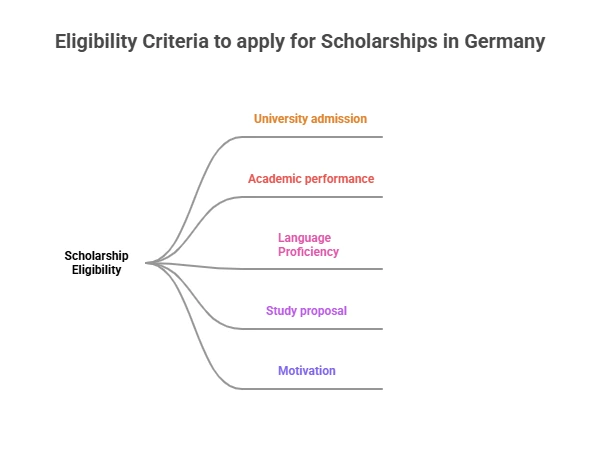
International students can apply for scholarships in Germany if they meet the basic requirements set by German universities and funding bodies. Most scholarships are open to students with admission to a recognised institution, a strong academic record, and proof of English or German language proficiency. A clear study plan and motivation to study in Germany further improve the chances of securing financial support.
International students applying for scholarships must have:
- Admission or offer letter from a recognised German university
- Strong academic record and relevant qualifications
- Proof of English or German language proficiency
- Clear study or research proposal especially for Master’s and PhD
- Demonstrated leadership, social engagement, or motivation (for foundation scholarships)
- Relevant work or research experience for advanced programmes
How to Apply for Scholarships in Germany as an International Student?
International students can apply for scholarships in Germany by choosing suitable funding programmes, preparing the required documents, and submitting applications before the deadline. Most applications require university admission, a strong motivation letter, and proof of academic and language proficiency. Following the correct steps increases your chances of securing financial support to study in Germany.
Step 1: Shortlist scholarships that match your study level, course, and eligibility requirements.
Step 2: Apply for admission to a recognised German university or secure an offer letter.
Step 3: Gather all required documents such as academic transcripts, certificates, and CV.
Step 4: Prepare a strong motivation letter and a clear study or research plan.
Step 5: Complete the scholarship application form carefully and accurately.
Step 6: Submit your application before the deadline and keep copies for reference.
Step 7: Track your application and respond promptly to any additional requests.
*Need guidance on scholarships and applications? Get expert help from Y-Axis.
Benefits of Studying in Germany for International Students
Studying in Germany gives international students access to high-quality education with relatively low overall costs, especially when combined with scholarships.
Key benefits of studying in Germany include:
- Low or no tuition fees
- World-class education
- Strong scholarship support
- High-demand courses
- Post-study work options
- Safe and student-friendly environment
Best Courses in Germany with Scholarship Opportunities
Germany offers scholarships for a wide range of high-demand courses that align with its strong academic and industrial sectors. These programmes not only provide quality education but also improve career prospects for international students.
- Engineering & Technology: Mechanical, Automotive, Electrical, Civil, and Robotics Engineering are highly supported through DAAD and university scholarships.
- Computer Science & IT: Artificial Intelligence, Data Science, Cybersecurity, and Software Engineering receive strong funding support.
- Business & Management: MBA, International Business, Finance, and Supply Chain Management are popular among scholarship applicants.
- Medical & Health Sciences: Public Health, Biomedical Sciences, and Health Management attract research-based funding.
- Natural Sciences: Physics, Chemistry, Environmental Science, and Biotechnology are well-supported by research grants.
- Architecture & Urban Planning: Sustainability-focused design programmes often qualify for specialised scholarships.
- Social Sciences & Humanities: International Relations, Political Science, and Development Studies are supported by foundation scholarships.
Can International Students Get Scholarships in Germany?
Yes, international students can get scholarships in Germany at all study levels, including Bachelor’s, Master’s, and PhD programmes. Germany offers a wide range of government-funded, university-specific, and private foundation scholarships designed to support international students based on academic merit, financial need, or research excellence.
Popular options include DAAD scholarships, foundation grants like Heinrich Böll and Konrad-Adenauer-Stiftung, as well as programmes such as Deutschlandstipendium and Erasmus+. These scholarships help cover living expenses, health insurance, travel costs, and research funding, making studying in Germany more accessible and affordable for international students.
What documents are required to apply for Scholarships in Germany?
To apply for scholarships in Germany, international students need to submit essential documents that support their academic profile and eligibility. Providing complete and accurate paperwork is crucial, as scholarship providers rely on these details to assess applications effectively.
Key documents typically include:
- Academic transcripts and degree certificates
- Offer letter or admission proof from a German university
- Curriculum Vitae (CV)
- Motivation letter or Statement of Purpose
- Study or research proposal (for Master’s and PhD)
- Proof of English or German language proficiency
- Letters of recommendation
- Valid passport copy
How much funding can you get through Germany Scholarships?
The funding amount for scholarships in Germany varies based on the programme and level of study. International students can receive financial support ranging from €300 to over €3,600 per month. Common benefits include monthly living stipends, health insurance coverage, travel allowances, and research grants. For example, DAAD scholarships offer around €992 per month for Master’s students and up to €1,400 or more for PhD candidates, while research fellowships may provide higher support.
When is the best time to apply for Scholarships in Germany?
The best time to apply for scholarships in Germany depends on the intake and the scholarship provider. Most major scholarships, including DAAD and foundation programmes, open applications between October and March for the next academic year.
Winter intake deadlines usually fall between December and February, while summer intake deadlines are typically between May and July. Applying early helps you prepare documents in time and improve your chances of securing funding.
Tips to Increase Your Chances of Getting a Scholarship in Germany
Securing a scholarship in Germany is highly competitive, but a strong application can make a real difference. By focusing on preparation, clarity, and relevance, you can significantly improve your chances of success.
Key tips to strengthen your application:
- Apply early and track all scholarship deadlines
- Choose scholarships that closely match your academic profile
- Write a clear, personalised motivation letter
- Highlight academic achievements and relevant experience
- Ensure your study or research plan is well-structured
- Gather strong recommendation letters from credible sources
- Double-check all documents for accuracy and completeness
- Demonstrate genuine interest in studying in Germany
*Looking to study in Germany with a scholarship? Talk to Y-Axis, the world’s no. 1 overseas immigration company, for personalized support on scholarship search, university admission, and visa guidance.
FAQs
What are the top 10 scholarships to study in Germany for international students?
The top 10 scholarships to study in Germany for international students include DAAD Scholarships, Deutschlandstipendium, Heinrich Böll Foundation Scholarships, Friedrich Ebert Stiftung, Konrad Adenauer Stiftung, Erasmus+, Humboldt Research Fellowship, Rosa Luxemburg Foundation Scholarships, Bayer Foundation Scholarships, and various university-specific scholarships. These German scholarships support bachelor’s, master’s, and PhD students by covering tuition fees, living costs, health insurance, and sometimes travel expenses.
How can international students apply for scholarships to study in Germany?
International students can apply for German scholarships by first choosing a recognised university in Germany and securing admission. Next, they must review eligibility criteria and prepare essential documents such as academic transcripts, CV, Statement of Purpose, and recommendation letters. Applications are submitted through official scholarship portals or university websites. Applying early and submitting strong academic profiles and motivation letters improves chances of receiving scholarships in Germany.
Are there fully funded scholarships in Germany for international students?
Yes, many fully funded scholarships in Germany are available for international students. Popular options include DAAD Scholarships, Heinrich Böll Foundation Scholarships, and Friedrich Ebert Stiftung. These scholarships cover tuition fees, accommodation, living expenses, health insurance, and travel allowances. Fully funded German scholarships make studying in Germany affordable for students from Canada and other countries.
Who is eligible for scholarships in Germany for international students?
Eligibility for German scholarships typically includes strong academic performance, confirmed admission to a German university, language proficiency in English or German, and a clear motivation letter. Many scholarships also consider leadership qualities, volunteer work, or research background. Students who meet these requirements can successfully apply for scholarships to study in Germany.
Can students from Canada apply for the top scholarships in Germany?
Yes, students from Canada can apply for top scholarships in Germany. Most German scholarship programs, including DAAD and Deutschlandstipendium, welcome applications from Canadian students. These programs help reduce education costs and support international learners pursuing high-quality academic opportunities in Germany.
What documents are required to apply for scholarships in Germany?
Required documents include academic transcripts, degree certificates, proof of admission to a German university, Statement of Purpose, CV, recommendation letters, passport copy, and language proficiency test scores such as IELTS or TestDaF. Research-based scholarships may also require a detailed study or research proposal. Providing complete and accurate documentation improves your chances of receiving a German scholarship.
Which universities in Germany offer the best scholarship opportunities?
Top German universities offering strong scholarship opportunities include the Technical University of Munich, Heidelberg University, RWTH Aachen University, Ludwig Maximilian University of Munich (LMU), and Karlsruhe Institute of Technology (KIT). These universities collaborate with national and private organizations to provide scholarships for international students across various fields.
What courses are most likely to receive scholarships in Germany?
Courses in engineering, computer science, renewable energy, environmental studies, business management, and health sciences are among the most scholarship-supported programs in Germany. These fields align with Germany’s academic strengths and economic priorities, increasing the likelihood of receiving funding for international students.
Is it hard to get a German scholarship for international students?
German scholarships can be competitive due to high demand, especially fully funded options. However, students with strong academic achievements, clearly defined goals, and compelling motivation letters have a higher chance of success. Applying early and selecting scholarships that match your profile significantly increases the likelihood of being selected.
When should I apply for scholarships to study in Germany?
Students should apply for scholarships to study in Germany 6 to 12 months before the program start date. Most German scholarships follow strict application timelines, and early applications allow sufficient time for document preparation. Planning ahead increases your chances of securing scholarships in Germany for international students.
Tags:
scholarships in Germany
Germany scholarship for international students
scholarships to study in Germany
German scholarship
study in Germany for international students
scholarships in Germany
daad scholarships
Germany education
international studen
Share
Latest Article
Popular Post
Trending Article

Posted On March 07 2026
Top 10 Countries for Chefs: Salary, Demand & PR Opportunities Compared