


Posted on June 05 2026
PGWP Changes in Canada: What International Students Need to Know This Spring

By , Editor & Director
Updated June 23 2026
The Post-Graduation Work Permit (PGWP) allows international graduates to work in Canada for up to three years after completing an eligible program. It is one of the most direct pathways to gaining Canadian work experience and applying for permanent residence.
Recent PGWP changes in Canada have introduced new eligibility rules for non-degree graduates, mandatory language requirements, and updated transfer rules for students changing institutions. International students graduating this spring should review these changes before applying for a PGWP.
*Want to apply for PGWP? Let Y-Axis help you through every step of the process.
Key PGWP Changes for International Students This Spring
Canada has introduced important changes to the Post-Graduation Work Permit (PGWP) program that may affect international students graduating this spring. The latest updates include new field-of-study requirements for non-degree graduates, mandatory language test requirements, and revised transfer rules for students changing designated learning institutions (DLIs).
New Field-of-Study Requirements for Non-Degree Graduates
International students in diploma, certificate, and other non-degree programs must now graduate from an approved field of study linked to Canada’s labour market needs. Degree graduates, including bachelor’s, master’s, and doctoral students, are not affected by this requirement.
Mandatory Language Test Requirements
All PGWP applicants must submit valid English or French language test scores. Degree graduates must meet a minimum of CLB/NCLC 7, while diploma and non-degree graduates need at least CLB/NCLC 5 in all four language skills.
New Rules for Changing Institutions
Students transferring to a new designated learning institution (DLI) must apply for and receive approval for a new study permit before starting classes. A new Provincial or Territorial Attestation Letter (PAL/TAL) is also required.
Stable Eligible Program List
IRCC has expanded the number of PGWP-eligible programs and confirmed that the approved list will remain stable throughout 2026, helping students plan their studies with greater certainty.
PGWP Field of Study Requirements for Non-Degree Graduates
International students in diploma, certificate, and other non-degree programs must meet field-of-study requirements to qualify for a PGWP. Your program must fall within an approved field aligned with Canada’s labour market needs and classified under a Classification of Instructional Programs (CIP) code.
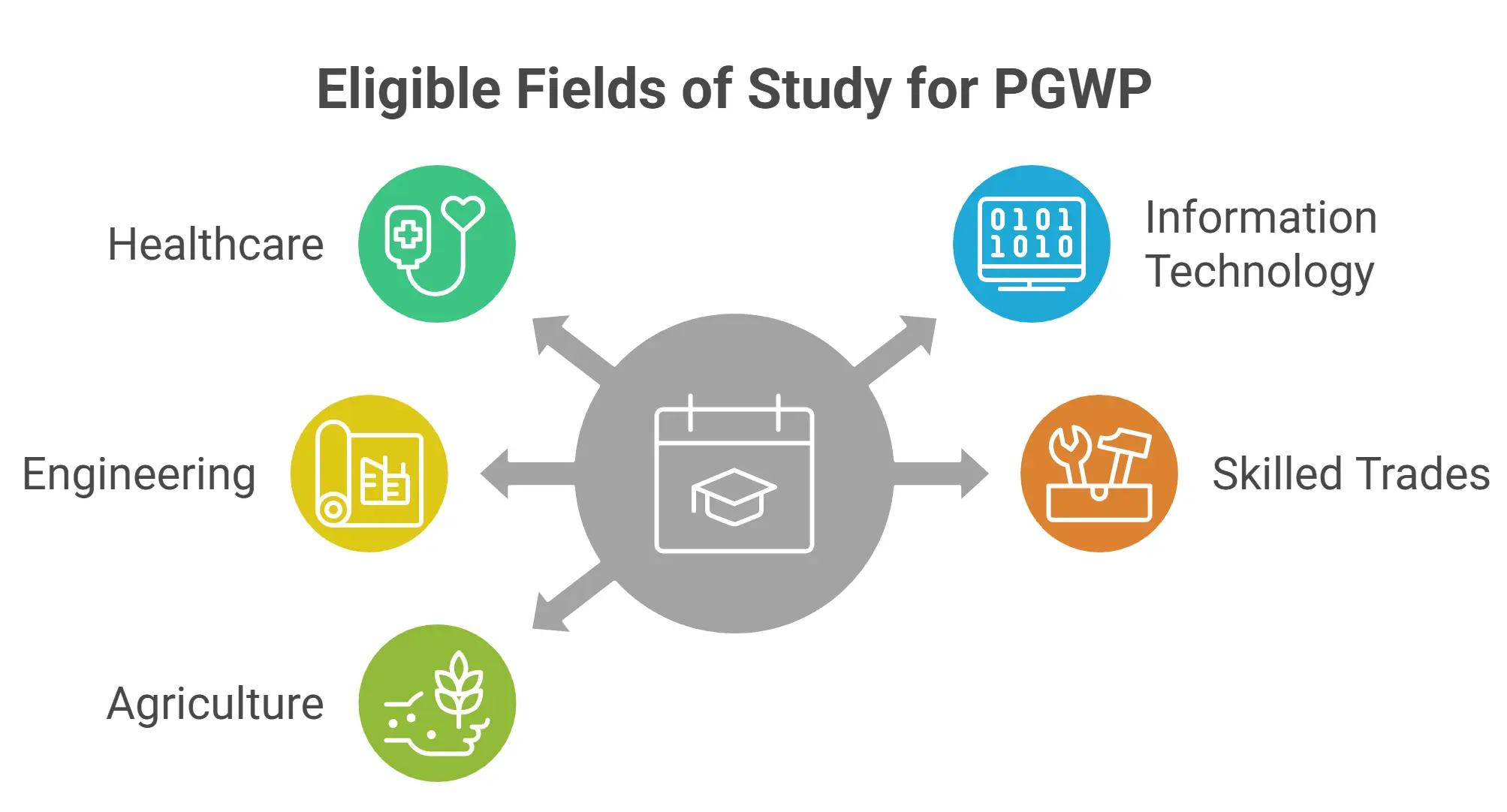
Fields currently on the eligible list include:
- Healthcare and medical sciences: Nursing, pharmacy, medical laboratory sciences, and related programs
- Information technology: Software development, cybersecurity, data science, and computer science
- Engineering: Civil, mechanical, electrical, and related engineering disciplines
- Skilled trades: Carpentry, plumbing, electrical trades, and construction management
- Agriculture and environment: Agri-food, environmental management, and related programs
Language Requirements for PGWP
All PGWP applicants must submit a valid English or French language test score as part of their application. The minimum language requirement depends on your program level.
|
Program Type |
Minimum Language Requirement |
|
Bachelor's, master's, or doctoral degree |
CLB/NCLC 7 in all four language skills |
|
College, diploma, or non-degree program |
CLB/NCLC 5 in all four language skills |
Accepted English language tests include IELTS General Training, CELPIP-General, and PTE Core, while accepted French tests include TEF Canada and TCF Canada.
New Study Permit Rules for Changing Your Designated Learning Institution
International students who transfer to a new designated learning institution (DLI) must apply for a new study permit and receive approval before starting classes at their new institution. A new Provincial or Territorial Attestation Letter (PAL/TAL) is also required.
Steps to follow when changing institutions:
Step 1: Obtain an offer letter from your new institution
Step 2: Request a new Provincial or Territorial Attestation Letter (PAL/TAL)
Step 3: Apply for a new study permit through your IRCC online account
Step 4: Wait for approval before starting classes at your new institution
Step 5: Confirm that your new program is PGWP-eligible before transferring
How Long Is a PGWP Valid in Canada?
The Post-Graduation Work Permit (PGWP) can be valid for up to three years, depending on the length and level of your study program. In general, graduates who complete longer eligible programs may qualify for a longer work permit.
|
Program Type |
PGWP Validity |
|
8 months to under 2 years |
Equal to program length |
|
2 years or longer |
Up to 3 years |
|
Master's degree |
Up to 3 years |
|
Doctoral degree |
Up to 3 years |
How to Apply for a PGWP in Canada?
To apply for a Post-Graduation Work Permit (PGWP) in Canada, international students must complete an eligible study program at a designated learning institution and apply within 180 days of receiving their official letter of completion and final transcripts.
Follow these steps to apply for a PGWP in Canada:
Step 1: Confirm your PGWP eligibility
Ensure your study program and institution meet PGWP eligibility requirements before applying.
Step 2: Receive your letter of completion and final transcripts
Obtain your official letter of completion and final transcripts after meeting all program requirements.
Step 3: Prepare your language test results
Ensure you have valid English or French language test results, if required, and that they meet the minimum score for your program level.
Step 4: Gather your required documents
Prepare all required documents, including your passport, study permit, proof of program completion, language test results, and application forms.
Step 5: Submit your PGWP application online
Apply through your IRCC online account within 180 days of receiving your letter of completion and pay the application fee of CAD $255.
Step 6: Track your application status
PGWP processing times currently range from 80 to 180 days. Monitor your application status through your IRCC online account.
*Want to apply for PGWP? Let Y-Axis help you through entire process.
Pathway to Canadian Permanent Residence After PGWP
Canadian work experience gained through a Post-Graduation Work Permit (PGWP) can improve your eligibility for permanent residence through Express Entry. For most international graduates, the PGWP serves as an important pathway to building a long-term future in Canada.
Graduates working on a PGWP may qualify for the Canadian Experience Class (CEC) under Express Entry after gaining at least one year of skilled work experience in a TEER 0, 1, 2, or 3 occupation.
Key factors that can strengthen your Express Entry profile:
- Canadian work experience: At least one year of skilled work experience in a TEER 0, 1, 2, or 3 occupation
- Language scores: Strong English or French language scores can improve your CRS score
- Canadian education: A Canadian degree or diploma can add additional CRS points
- Provincial Nominee Program (PNP): A provincial nomination adds 600 CRS points to your profile
*Want to apply for Canada PR? Let Y-Axis guide you through application process.
Tips for a Successful PGWP Application
- Verify your program and institution are PGWP-eligible before enrolling
- Book your language test early to avoid delays in your application
- Apply within 180 days of receiving your completion letter and final transcripts
- Keep important documents such as your study permit, transcripts, and completion letter organised
- Follow the correct process and obtain a new study permit before changing institutions
- Start planning your permanent residence pathway and Express Entry options early
How Can Y-Axis Help You?
Y-Axis provides end-to-end immigration support for international students in Canada, covering everything from PGWP eligibility checks and document preparation to Express Entry profile building and permanent residence applications.
- Check whether your program and institution qualify for a PGWP
- Gather and organise all required documents for your application
- Find out which language test suits your profile and the score you need
- Submit a complete and accurate PGWP application with expert guidance
- Plan your pathway from PGWP to Canadian permanent residence
Ready to get started? Book a free consultation with Y-Axis today.
Apply Now
FAQs
What is a Post-Graduation Work Permit (PGWP) in Canada?
The PGWP is an open work permit that allows eligible international graduates from Canadian designated learning institutions to work for any employer in Canada after graduation. It is valid for up to three years and is one of the most direct pathways to gaining Canadian work experience and applying for permanent residence.
Who is eligible for a PGWP in Canada?
International graduates from an eligible program at an IRCC-approved designated learning institution are eligible for a PGWP. Applicants must meet the program length requirement, hold a valid study permit throughout their studies, submit a language test score, and meet the field-of-study requirement if they graduated from a non-degree program.
Is the PGWP a one-time permit in Canada?
Yes. The PGWP is issued only once in a lifetime. Graduates cannot apply for a second PGWP after the first one expires. This makes it important to use the PGWP period strategically to build the Canadian work experience needed to qualify for permanent residence through Express Entry or a Provincial Nominee Program.
How long is the PGWP valid in Canada?
PGWP validity depends on the level and duration of your program. Programs under eight months do not qualify. Programs between eight months and two years receive a PGWP equal to the program length. Programs of two years or longer, as well as master's and doctoral degrees, qualify for a PGWP of up to three years.
How long can I stay in Canada after my PGWP expires?
After your PGWP expires, you must have applied for another immigration status to remain in Canada legally. Most graduates apply for permanent residence through Express Entry or a Provincial Nominee Program before their PGWP expires. Y-Axis Canada immigration experts can help you plan your transition from PGWP to permanent residence well in advance.
Which programs are eligible for a PGWP in Canada?
Programs at IRCC-approved designated learning institutions that are at least eight months long are generally eligible for a PGWP. Non-degree programs must also fall within an approved field of study based on their CIP code. IRCC has confirmed the eligible programs list will remain stable throughout 2026, giving students a reliable year to plan their studies.
What is the field-of-study requirement for a PGWP?
The field-of-study requirement applies to non-degree graduates in diploma and certificate programs. Your program must fall within an approved field linked to Canada's labour market needs, classified using a CIP code. Degree graduates from bachelor's, master's, and doctoral programs are not subject to this requirement and can qualify for a PGWP regardless of their field.
Does the field-of-study requirement apply to degree graduates?
No. The field-of-study requirement applies only to non-degree graduates in diploma, certificate, and similar programs. Bachelor's, master's, and doctoral degree graduates are not affected by this rule and can qualify for a PGWP based on their program length and institution eligibility, provided they meet the language requirement and hold a valid study permit.
How do I check if my program qualifies for a PGWP?
You can check your program's eligibility by finding its CIP code through your institution's registrar and verifying it against the IRCC list of eligible fields of study on canada.ca. Degree graduates do not need to check CIP codes as the field-of-study requirement does not apply to them. Y-Axis Canada experts can help you verify your eligibility quickly.
What is a CIP code and how do I find mine?
A CIP code is a six-digit Classification of Instructional Programs code assigned to your program. It is used by IRCC to determine whether your program falls within an approved field of study for PGWP eligibility. You can find your program's CIP code through your institution's registrar, program webpage, or by contacting your academic department directly.
Does part-time study affect my PGWP eligibility?
Periods of part-time study can affect the length of your PGWP. IRCC reviews your full study history when assessing your application. Extended periods of part-time enrolment may reduce your eligible PGWP duration. International students are generally required to study full-time for most of their program to qualify for the full PGWP length available to their program level.
Do I need a language test to apply for a PGWP?
Yes. All PGWP applicants must submit a valid English or French language test score as part of their application. Degree graduates must meet CLB 7 in all four skills and non-degree graduates must meet CLB 5 in all four skills. Accepted tests include IELTS General Training, CELPIP-General, PTE Core, TEF Canada, and TCF Canada.
What language score do I need for a PGWP application?
Degree graduates from bachelor's, master's, and doctoral programs must achieve CLB or NCLC 7 in all four language skills. College, diploma, and non-degree graduates must achieve CLB or NCLC 5 in all four skills. Scores are assessed individually across reading, writing, listening, and speaking and must meet the minimum level in each skill separately.
Which language tests are accepted for a PGWP application?
Accepted English language tests include IELTS General Training, CELPIP-General, and PTE Core. Accepted French language tests include TEF Canada and TCF Canada. IELTS Academic is not accepted for PGWP applications. Your test results must be less than two years old at the time of your PGWP application and must meet the required CLB level in all four skills.
Can I apply for a PGWP if I changed my designated learning institution?
Yes, provided you followed the correct process when changing institutions. You must have applied for and received approval for a new study permit before transferring and submitted a new Provincial or Territorial Attestation Letter as part of your application. Graduates who followed the correct transfer process remain eligible to apply for a PGWP after graduation.
When should I apply for a PGWP after graduation?
You should apply for a PGWP as soon as you receive your official letter of completion from your institution. The application window is 180 days from the date of your letter of completion. Applying early gives you the best chance of receiving your PGWP before your study permit expires and allows you to start working in Canada sooner.
What documents do I need to apply for a PGWP?
You will need a valid passport, copy of your study permit, official letter of completion, final transcripts, language test results, completed IMM 5710 application form, a passport-style photograph, and the application fee of CAD $255. Having all documents prepared before you apply helps ensure a smooth and complete application with no delays to processing.
Can I work full time on a PGWP in Canada?
Yes. The PGWP is an open work permit with no restrictions on employer, industry, hours, or location. Graduates can work full time for any employer anywhere in Canada. There is no requirement for a job offer, employer sponsorship, or Labour Market Impact Assessment to work on a PGWP, making it one of the most flexible work permits available.
Can I work in Canada while my PGWP application is being processed?
Yes. If your study permit is still valid when you submit your PGWP application, you can continue working under implied status while your application is being processed. Current PGWP processing times in Canada are approximately 80 to 180 days. It is important to apply as early as possible within the 180-day window to maintain continuous work authorisation.
Can my PGWP lead to permanent residence in Canada?
Yes. Work experience gained on a PGWP in TEER 0 to 3 occupations counts toward Canadian Experience Class eligibility under Express Entry. With at least one year of skilled Canadian work experience, strong language scores, and a Canadian education, PGWP holders are well positioned to receive an Invitation to Apply for Canadian permanent residence through Express Entry.
Tags:
PGWP
Post-Graduation Work Permit
International Students Canada
Study Permit Canada
Canada Work Permit
PGWP Eligibility
Canada Immigration
Express Entry
Canadian Permanent Residence
Share
Latest Article
Popular Post
Trending Article
Posted On September 16 2026
Top 10 Countries for Environmentalists to Work Abroad: Salary, Demand & PR Opportunities Compared