


Editors Pick
Latest Article
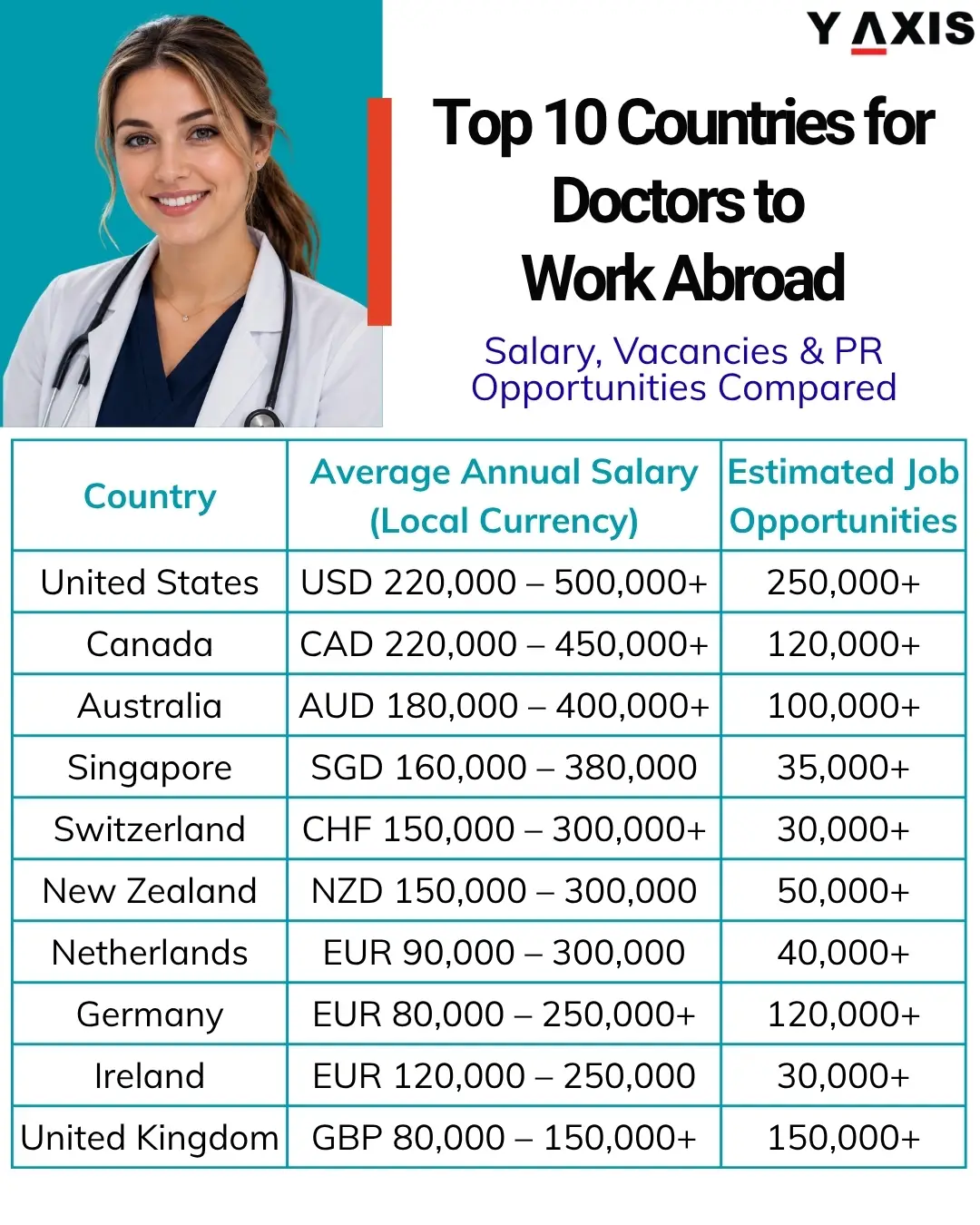
Top 10 Countries for Doctors to Work Abroad: Salary, Demand & PR Opportunities Compared
Top 10 Countries for Doctors to Work Abroad: Salary, Demand & PR Opportunities Compared
The top 10 countries for doctors to work abroad are the United States, Canada, Australia, the United Kingdom, New Zealand, Ireland, Germany, Switzerland, Singapore, and the Netherlands. These countries offer competitive salaries, high demand for doctors, advanced healthcare systems and pathways to permanent residence.
Global demand for doctors is increasing due to ageing populations, growing healthcare needs, and workforce shortages. The global health workforce shortage is projected to reach 11 million by 2030, while many countries continue to recruit internationally trained doctors to fill critical healthcare roles, creating strong career opportunities for doctors seeking to work abroad.
*Want to work abroad? Sign up with Y-Axis Resume Marketing Services to find right job faster.
Benefits of Working Abroad as a Doctor
Doctors working abroad can benefit from higher salaries, better career opportunities, advanced medical training, and international clinical experience. Many countries also offer opportunities to work in high-demand specialties and qualify for permanent residence.
- OECD countries employ 600,000+ foreign-trained doctors
- Specialists earn about 40% more than GPs across OECD countries
- Access to advanced medical technology and training
- Opportunities in high-demand medical specialties
- International clinical experience
- PR pathways in major immigration destinations
How to Choose the Right Country for Doctor Jobs Abroad?
The right country for doctor jobs abroad depends on salary, demand for your specialization, medical licensing requirements, work visa options, and permanent residence pathways. Comparing these factors can help identify countries that match your qualifications and career goals.
- Salary: Compare doctor salaries, taxes, and living costs.
- Job demand: Check vacancies for your medical specialization.
- Licensing: Review qualification recognition, exams, and registration.
- Language: Check medical and immigration language requirements.
- Work visa: Compare visa eligibility and employer requirements.
- Permanent residence: Review PR eligibility and required work experience.
Top 10 Countries for Doctors to Work Abroad
Doctors have strong career opportunities in countries such as the United States, Canada, Australia, the United Kingdom, and New Zealand, driven by demand across primary and specialist care. Annual salaries can range from around CAD 90,000 to over CAD 400,000, with opportunities for family doctors, general practitioners, psychiatrists, radiologists, anaesthesiologists, and emergency medicine doctors. Many of these countries also offer work visa and permanent residence pathways for doctors.
|
Country |
Average Annual Salary |
Estimated Doctor |
|
Canada |
CAD 220,000 – 450,000+ |
120,000+ |
|
United States |
USD 220,000 – 500,000+ |
250,000+ |
|
Australia |
AUD 180,000 – 400,000+ |
100,000+ |
|
United Kingdom |
GBP 80,000 – 150,000+ |
150,000+ |
|
New Zealand |
NZD 150,000 – 300,000 |
50,000+ |
|
Ireland |
EUR 120,000 – 250,000 |
30,000+ |
|
Germany |
EUR 80,000 – 250,000+ |
120,000+ |
|
Switzerland |
CHF 150,000 – 300,000+ |
30,000+ |
|
Singapore |
SGD 160,000 – 380,000 |
35,000+ |
|
Netherlands |
EUR 90,000 – 300,000 |
40,000+ |
*Want to work abroad? Sign up with Y-Axis Resume Marketing Services to find right job faster.
Best Countries for Doctors to Work and Settle Abroad
Canada, Australia, New Zealand, the United Kingdom, and Germany are among the leading countries for doctors to work and settle abroad. These countries offer high demand for doctors, competitive salaries, work visa options, and pathways to permanent residence across a range of medical specialties.
Doctor Jobs in Canada
Canada has sustained demand for family doctors, general practitioners, psychiatrists, surgeons, anaesthesiologists, and other medical specialists across hospitals, clinics, and primary care services. Internationally trained doctors already have a significant presence in the workforce, accounting for 31% of family physicians in Canada. Job prospects for doctors range from good to very good across most provinces and territories.
Canada also has a dedicated Express Entry category for medical doctors with Canadian work experience, alongside Provincial Nominee Program pathways. These immigration routes provide doctors with options to pursue permanent residence while building long-term careers within Canada’s healthcare system.
|
Factor |
Details |
|
Doctor Job Market & Job Vacancies for the Next Decade |
Canada continues to see strong demand for doctors, with over 120,000 job vacancies expected over the next decade across hospitals, long-term care facilities, and community healthcare services nationwide. |
|
Investment in Healthcare Sector |
Canada is investing up to $14.3 million to address labour shortages in the health sector and nearly $200 billion over 10 years, supporting demand for doctors across hospitals, primary care, and community health services. |
|
In-Demand Doctor Roles & Skills |
General practitioners, specialist doctors, and hospital doctors; key skills include clinical care, diagnostics, and patient management. |
|
Work Visa Options for Doctors |
Employer-specific work permits, Express Entry-linked work permits, and Provincial Nominee Programs (PNPs). |
|
Fast-Track Hiring Options |
Category based Express Entry draws, Provincial healthcare recruitment streams, and priority processing for in-demand healthcare occupations, including doctors. |
|
PR / Long-Term Residence Opportunities |
Permanent residence through Express Entry and Provincial Nominee Programs, with healthcare roles often receiving priority. |
|
Licensing & Registration Requirements |
Mandatory registration with provincial regulatory bodies, such as the provincial College of Physicians and Surgeons, based on the province of employment. |
|
Language Requirements |
English or French language proficiency demonstrated through approved language tests. |
|
Eligibility for Dependents |
Spouses and dependent children can accompany the primary applicant. |
|
Benefits for Family Members |
Spouse work rights, access to public healthcare, and public education for children. |
*Want to work in Canada? Get expert assistance from Y-Axis to find the right job faster.
Doctor Jobs in the United States
The United States has one of the world’s largest healthcare job markets, with around 23,600 openings for physicians and surgeons projected each year. Family medicine, internal medicine, psychiatry, anaesthesiology, radiology, surgery, and paediatrics provide opportunities across hospitals, physician practices, outpatient centres, and academic medical centres.
International medical graduates already form an important part of the US physician workforce. Doctors can pursue employment-based immigration through EB-2 and EB-3 routes, which can lead to a US Green Card. The country also provides extensive opportunities for specialist practice, medical research, teaching, and advanced clinical careers.
|
Factor |
Details |
|
Doctor Job Market & Job Vacancies for the Next Decade |
The US is expected to remain one of the largest employment markets for doctors, with over 250,000 job vacancies projected over the next decade across hospitals, clinics, and specialised healthcare services. |
|
Investment in Healthcare Sector |
The US is increasing healthcare investment toward 2030, with healthcare spending projected to exceed $5 trillion by the early 2030s. Investment in digital transformation, AI, value-based care, preventive health, telehealth, remote monitoring, and data-driven care models is supporting demand for doctors. |
|
In-Demand Doctor Roles & Skills |
General physicians, specialist doctors, surgeons, and hospital doctors; key skills include clinical care, diagnostics, patient management, and specialised treatments. |
|
Work Visa Options for Doctors |
H-1B Visa, H-1C (limited), O-1 Visa, and employer-sponsored work visas. |
|
Fast-Track Hiring Options |
H-1B and EB-3 sponsorship for healthcare shortage occupations, including doctors. |
|
PR / Long-Term Residence Opportunities |
Employment-based Green Cards through EB-2 and EB-3. |
|
Licensing & Registration Requirements |
Mandatory state-level medical licensing and professional certification before practising as a doctor. |
|
Language Requirements |
English language proficiency for medical practice in the United States. |
|
Eligibility for Dependents |
Spouses and dependent children can accompany the primary applicant. |
|
Benefits for Family Members |
Dependent visas are available, with spouse work rights based on the visa category and approval. |
*Want to work in the USA? Avail Y-Axis Resume Marketing Services to shortlist the job faster.
Doctor Jobs in Australia
Australia relies significantly on internationally trained doctors to support its healthcare workforce across general practice and specialist medical services. Doctor jobs are available in emergency medicine, psychiatry, anaesthesiology, surgery, internal medicine, general practice, and other specialties across public hospitals, private hospitals, clinics, and community healthcare services.
Overseas doctors can obtain medical registration through pathways administered by the Medical Board of Australia and AHPRA. Australia also has skilled migration and employer-sponsored visa routes for medical practitioners, including pathways to permanent residence. These routes allow doctors to combine healthcare employment with long-term settlement in Australia.
|
Factor |
Details |
|
Doctor Job Market & Job Vacancies for the Next Decade |
Australia has steady demand for doctors, with over 100,000 job vacancies expected over the next decade across hospitals, regional healthcare services, and aged care facilities. |
|
Investment in Healthcare Sector |
Australia is making record healthcare investments, with funding rising to $140 billion and $537 billion committed over four years, supporting demand for doctors across Medicare, public hospitals, digital health, medical research, and aged care services. |
|
In-Demand Doctor Roles & Skills |
General practitioners (GPs), specialist doctors, and hospital doctors; key skills include clinical care, diagnostics, patient management, and rehabilitation. |
|
Work Visa Options for Doctors |
Skills in Demand Visa (Subclass 482), Skilled Independent (189), Skilled Nominated (190), Employer Nomination Scheme (186), Skilled Work Regional (491). |
|
Fast-Track Hiring Options |
Employer-sponsored visas and state or territory nomination pathways for priority healthcare occupations, including doctors. |
|
PR / Long-Term Residence Opportunities |
Points-based PR pathways (189/190), employer-sponsored PR (186), and regional pathways (491 → PR). |
|
Licensing & Registration Requirements |
Mandatory registration with the Australian Health Practitioner Regulation Agency (AHPRA) before practising as a doctor in Australia. |
|
Language Requirements |
English language proficiency, typically demonstrated through IELTS or an equivalent approved language test. |
|
Eligibility for Dependents |
Spouses and dependent children can accompany the primary applicant. |
|
Benefits for Family Members |
Spouse work rights, access to public education, and Medicare access (subject to visa conditions). |
Doctor Jobs in the United Kingdom
The United Kingdom recruits doctors internationally to work across the NHS, GP practices, specialist centres, community healthcare services, and private hospitals. General practice, psychiatry, emergency medicine, anaesthetics, radiology, surgery, paediatrics, and internal medicine provide a broad range of career options. International medical graduates already represent a substantial share of doctors working in the country.
Doctors with an approved healthcare job can use the Health and Care Worker visa to live and work in the UK. The visa can lead to Indefinite Leave to Remain after five years, providing a defined route from medical employment to long-term settlement.
|
Factor |
Details |
|
Doctor Job Market & Job Vacancies for the Next Decade |
The UK is projected to see continued recruitment of doctors, with over 150,000 job vacancies expected over the next decade across the NHS and private healthcare sector. |
|
Investment in Healthcare Sector |
The UK invests over £200 billion annually in the NHS, supporting hospitals, community healthcare services, workforce expansion, and digital health initiatives that drive demand for doctors across the country. |
|
In-Demand Doctor Roles & Skills |
General practitioners (GPs), specialist doctors, and hospital doctors; key skills include clinical care, diagnostics, patient management, and healthcare services. |
|
Work Visa Options for Doctors |
Skilled Worker Visa, Health and Care Worker Visa, Global Talent Visa, Scale-Up Visa, and UK employer-sponsored work visas. |
|
Fast-Track Hiring Options |
Health and Care Worker Visa with priority processing and reduced visa fees. |
|
PR / Long-Term Residence Opportunities |
Indefinite Leave to Remain (ILR) after completing the required residence period. |
|
Licensing & Registration Requirements |
Mandatory registration with the General Medical Council (GMC) before practising as a doctor in the UK. |
|
Language Requirements |
English language proficiency demonstrated through approved tests such as IELTS or recognised UK qualifications. |
|
Eligibility for Dependents |
Spouses and dependent children can accompany the primary applicant. |
|
Benefits for Family Members |
Spouse work rights, access to public education, and NHS healthcare (subject to visa conditions). |
*Want to work in the UK? Avail Y-Axis Resume Marketing Services to find the right job faster.
Doctor Jobs in New Zealand
New Zealand gives doctors access to one of the most direct residence pathways among the countries compared in this article. Medical doctor occupations are included on the Green List under the Straight to Residence pathway. Doctors with a Tier 1 Green List job or job offer from an accredited employer can apply for residence.
Employment opportunities span general practice, emergency medicine, psychiatry, radiology, anaesthesiology, surgery, and internal medicine across hospitals and primary care services. Internationally trained doctors already form a significant part of the medical workforce, strengthening New Zealand’s position as a destination for doctors seeking both employment and residence.
|
Factor |
Details |
|
Doctor Job Market & Job Vacancies for the Next Decade |
New Zealand continues to have strong employment prospects for doctors, with over 50,000 job vacancies expected over the next decade across hospitals, primary care, mental health services, and aged care facilities. |
|
Investment in Healthcare Sector |
New Zealand is increasing healthcare investment, with over $5.5 billion in funding increases for digital health, hospital infrastructure, and workforce development. A further $14 billion is required for hospital upgrades over the next decade, alongside growing investment in AI and integrated care. |
|
In-Demand Doctor Roles & Skills |
General practitioners (GPs), specialist doctors, and hospital doctors; key skills include clinical care, diagnostics, and patient management. |
|
Work Visa Options for Doctors |
Accredited Employer Work Visa (AEWV), employer-sponsored work visas, and sector-specific recruitment pathways. |
|
Fast-Track Hiring Options |
Green List roles with priority processing and fast-track residence options. |
|
PR / Long-Term Residence Opportunities |
Residence pathways through the Green List and Skilled Migrant Category. |
|
Licensing & Registration Requirements |
Mandatory registration with the Medical Council of New Zealand before practising as a doctor. |
|
Language Requirements |
English language proficiency demonstrated through approved tests or recognised qualifications. |
|
Eligibility for Dependents |
Spouses and dependent children can accompany the primary applicant. |
|
Benefits for Family Members |
Spouse work rights, access to public education, and public healthcare services (subject to visa conditions). |
Doctor Jobs in Ireland
Ireland includes medical practitioners on its Critical Skills Occupations List, creating a direct employment and immigration route for doctors from overseas. General practitioners, consultants, psychiatrists, anaesthesiologists, radiologists, surgeons, and emergency medicine doctors work across public hospitals, private hospitals, primary care services, and specialist facilities.
Internationally trained doctors already make up a significant part of Ireland’s medical workforce. Doctor roles covered by the Critical Skills system can access the Critical Skills Employment Permit, which supports long-term residence. Ireland therefore combines healthcare recruitment with a structured pathway for doctors planning to establish their careers and settle in the country.
|
Factor |
Details |
|
Doctor Job Market & Job Vacancies for the Next Decade |
Ireland is expected to see continued demand for doctors, with over 30,000 job vacancies projected over the next decade across hospitals, primary care services, and aged care facilities. |
|
Investment in Healthcare Sector |
Ireland is making its largest-ever healthcare investment, with €9.25 billion under the National Development Plan and a record €27.4 billion health budget. Funding for digital health, new hospital capacity, community care, and workforce expansion is supporting demand for doctors. |
|
In-Demand Doctor Roles & Skills |
General practitioners (GPs), specialist doctors, and hospital doctors; key skills include clinical care, diagnostics, and patient management. |
|
Work Visa Options for Doctors |
Critical Skills Employment Permit, General Employment Permit, and employer-sponsored work permits. |
|
Fast-Track Hiring Options |
Critical Skills Employment Permit for priority healthcare occupations, including doctors. |
|
PR / Long-Term Residence Opportunities |
Stamp 4 (long-term residence) after completing the required residence and employment period. |
|
Licensing & Registration Requirements |
Mandatory registration with the Medical Council of Ireland before practising as a doctor. |
|
Language Requirements |
English language proficiency demonstrated through approved tests or recognised qualifications. |
|
Eligibility for Dependents |
Spouses and dependent children can accompany the primary applicant. |
|
Benefits for Family Members |
Spouse work rights, access to public education, and public healthcare services (subject to visa conditions). |
Doctor Jobs in Germany
Germany has one of Europe’s largest healthcare systems, creating doctor jobs across hospitals, university medical centres, medical practices, rehabilitation centres, and specialist facilities. General practice, internal medicine, psychiatry, anaesthesiology, surgery, and radiology are among the major fields for medical employment. Foreign-trained doctors already form an important part of Germany’s medical workforce.
Overseas doctors can obtain an Approbation licence after completing medical qualification recognition and language requirements. Germany also provides employment-based residence routes, including the EU Blue Card for doctor jobs reaching the specified salary threshold, along with pathways to permanent residence for long-term settlement.
|
Factor |
Details |
|
Doctor Job Market & Job Vacancies for the Next Decade |
Germany is seeing growing demand for doctors, with over 120,000 job vacancies expected over the next decade across hospitals, elderly care services, and specialised medical facilities. |
|
Investment in Healthcare Sector |
Germany’s healthcare spending exceeds €538 billion, alongside a €50 billion Hospital Transformation Fund to modernise hospitals by 2030. Investment in digital health, AI, telemedicine, and workforce expansion is supporting continued demand for doctors. |
|
In-Demand Doctor Roles & Skills |
General practitioners (GPs), specialist doctors, and hospital doctors; key skills include clinical care, diagnostics, and patient management. |
|
Work Visa Options for Doctors |
EU Blue Card, Skilled Worker Visa, and employer-sponsored work visas. |
|
Fast-Track Hiring Options |
Accelerated Skilled Worker Procedure (ASVP) with expedited visa processing and qualification checks for healthcare occupations, including doctors. |
|
PR / Long-Term Residence Opportunities |
Permanent residence after completing the required residence period and German language requirements. |
|
Licensing & Registration Requirements |
Doctors must secure qualification recognition (Anerkennung) and obtain licensing from the State Medical Association (Ärztekammer) before practising in Germany. |
|
Language Requirements |
German language proficiency, typically at B1–B2 level, depending on the role. |
|
Eligibility for Dependents |
Spouses and dependent children can accompany the primary applicant. |
|
Benefits for Family Members |
Spouse work rights, access to public education, and comprehensive public healthcare coverage. |
Doctor Jobs in Switzerland
Switzerland combines high earning potential for doctors with careers in university hospitals, cantonal hospitals, private clinics, specialist practices, and primary care services. Employment spans internal medicine, psychiatry, anaesthesiology, radiology, surgery, general practice, and other medical specialties. Internationally trained doctors already represent a substantial share of Switzerland’s medical workforce.
The country is also known for advanced hospital infrastructure, specialist treatment, medical research, and high healthcare investment. Foreign doctors can have their medical qualifications recognised through the Swiss medical recognition system and pursue clinical careers across the healthcare sector, with residence pathways supporting longer-term settlement in Switzerland.
|
Factor |
Details |
|
Doctor Job Market & Job Vacancies for the Next Decade |
Switzerland has steady demand for doctors, with over 30,000 job opportunities expected over the next decade across hospitals, specialist clinics, medical practices, and healthcare services. |
|
Investment in Healthcare Sector |
Switzerland’s healthcare expenditure is projected to reach CHF 109.6 billion by 2027, while the Health2030 Strategy supports continued investment in digital healthcare, medical technologies, health data, and healthcare system development through 2030. |
|
In-Demand Doctor Roles & Skills |
General practitioners (GPs), specialist doctors, and hospital doctors; key skills include clinical care, diagnostics, patient management, and specialised treatments. |
|
Work Visa Options for Doctors |
L Permit, B Permit, and employer-sponsored Swiss work permits. |
|
Fast-Track Hiring Options |
Employer-led recruitment and cantonal work permit processing for doctor positions. |
|
PR / Long-Term Residence Opportunities |
C Permit (settlement permit) provides permanent residence after the required period of residence in Switzerland. |
|
Licensing & Registration Requirements |
Medical qualification recognition or registration through MEBEKO and entry in the MedReg register before practising as a doctor in Switzerland. |
|
Language Requirements |
Language proficiency in German, French, or Italian, based on the canton and language used for medical practice. |
|
Eligibility for Dependents |
Spouses and dependent children can accompany the primary applicant through family reunification provisions. |
|
Benefits for Family Members |
Access to education and healthcare, with spouse work rights based on the residence permit. |
Doctor Jobs in Singapore
Singapore is a major Asian medical hub for specialist care, clinical research, medical education, and advanced healthcare services. Doctors work across public hospitals, national specialist centres, polyclinics, teaching institutions, private hospitals, and specialist medical groups. Career options include family medicine, internal medicine, surgery, anaesthesiology, psychiatry, emergency medicine, oncology, and other specialties.
Overseas-trained doctors can enter medical practice through Singapore Medical Council registration pathways. Conditional registration allows supervised practice in approved healthcare institutions, while full registration permits independent practice. Singapore provides particularly strong career options for doctors interested in specialist medicine, clinical research, teaching, and advanced hospital care.
|
Factor |
Details |
|
Doctor Job Market & Job Vacancies for the Next Decade |
Singapore is experiencing expanding demand for doctors, with over 35,000 job vacancies expected over the next decade across hospitals, specialised medical centres, and community healthcare services. |
|
Investment in Healthcare Sector |
Singapore is increasing healthcare investment, with over SGD 13 billion allocated to expand and strengthen the healthcare system through new hospitals, digital health infrastructure, AI-driven healthcare, and biomedical research, supporting demand for doctors. |
|
In-Demand Doctor Roles & Skills |
General practitioners (GPs), specialist doctors, and hospital doctors; key skills include clinical care, diagnostics, patient management, and specialised treatments. |
|
Work Visa Options for Doctors |
Employment Pass (EP), S Pass, and employer-sponsored work visas. |
|
Fast-Track Hiring Options |
Employment Pass with streamlined processing for doctors. |
|
PR / Long-Term Residence Opportunities |
Permanent Residence (PR) through Singapore’s immigration pathways based on employment and residency. |
|
Licensing & Registration Requirements |
Mandatory registration with the Singapore Medical Council (SMC) before practising as a doctor in Singapore. |
|
Language Requirements |
English language proficiency, as English is the primary language used in Singapore’s healthcare system. |
|
Eligibility for Dependents |
Spouses and dependent children can accompany the primary applicant. |
|
Benefits for Family Members |
Dependent Pass, access to education, and healthcare services in Singapore. |
Doctor Jobs in the Netherlands
The Netherlands has a healthcare system where general practitioners play a central role in primary care, alongside extensive hospital and specialist services. Doctor jobs are also available for psychiatrists, anaesthesiologists, radiologists, surgeons, internal medicine doctors, and other specialists across hospitals, university medical centres, mental healthcare services, and specialist clinics.
International doctors can enter medical practice after completing qualification recognition, Dutch-language requirements, and BIG registration. Doctors from outside the EU can use employment-based residence routes to work in the country. After five consecutive years of legal residence, doctors can apply for permanent residence and establish long-term careers in the Netherlands.
|
Factor |
Details |
|
Doctor Job Market & Job Vacancies for the Next Decade |
The Netherlands is projected to have steady demand for doctors, with over 40,000 job vacancies expected over the next decade across hospitals, nursing homes, and community healthcare services. |
|
Investment in Healthcare Sector |
Healthcare spending in the Netherlands stands at nearly €155 billion, with major investment across pharma and MedTech, including $3 billion from Eli Lilly. Investment in AI, data-driven care, and sustainability is further strengthening the healthcare system and supporting demand for doctors. |
|
In-Demand Doctor Roles & Skills |
General practitioners (GPs), specialist doctors, and hospital doctors; key skills include clinical care, patient management, and rehabilitation. |
|
Work Visa Options for Doctors |
Highly Skilled Migrant Visa, EU Blue Card, employer-sponsored work permits. |
|
Fast-Track Hiring Options |
Highly Skilled Migrant Scheme with expedited processing for healthcare roles, including doctors. |
|
PR / Long-Term Residence Opportunities |
Permanent residence after completing the required legal residence period. |
|
Licensing & Registration Requirements |
Mandatory registration in the BIG Register before practising as a doctor in the Netherlands. |
|
Language Requirements |
Dutch language proficiency, particularly for patient-facing roles. |
|
Eligibility for Dependents |
Spouses and dependent children can accompany the primary applicant. |
|
Benefits for Family Members |
Spouse work rights, access to public education, and healthcare benefits under the Dutch healthcare system. |
Job Outlook for Doctors over the Next Decade
The job outlook for doctors over the next decade remains strong, with employment in several medical roles projected to grow by up to 6%. Canada, the United States, Australia, the UK, Germany, and other major healthcare markets are expected to continue recruiting doctors across hospitals, primary care, specialist medicine, and community healthcare. Rising healthcare investment, ageing populations, expanding hospital capacity, and increasing demand for medical services are supporting long-term job opportunities.
Growth in digital health, AI-assisted diagnostics, telemedicine, medical research, and preventive care is also transforming healthcare delivery. General practitioners, specialist doctors, surgeons, psychiatrists, and hospital doctors are expected to remain in demand over the next decade.
*Want to work abroad? Sign up with Y-Axis Resume Marketing Services to find right job faster.
Apply Now
FAQs
Which country is best for doctors to work abroad?
Canada, the United States, Australia, the UK, Germany, New Zealand, Switzerland, Ireland, Singapore, and the Netherlands are leading countries for doctors to work abroad. Canada and Australia stand out for combining doctor demand with permanent residence pathways, while the United States and Switzerland offer some of the highest earning potential for medical roles.
Which country pays doctors the highest salary?
The United States is among the highest-paying countries for doctors, with annual earnings ranging from approximately USD 220,000 to USD 500,000 or more. Switzerland, Canada, Australia, and Singapore also offer high earning potential. Actual income varies by medical specialty, experience, location, healthcare setting, and whether the doctor works in salaried or private practice.
Which countries have the highest demand for doctors?
The United States, Canada, the UK, Germany, Australia, and New Zealand have substantial demand for doctors. Recruitment is particularly important across general practice, family medicine, specialist care, hospitals, mental health, aged care, and community healthcare. Demand is expected to continue as countries expand healthcare capacity and replace retiring medical workers.
Which country is best for doctors to work and settle permanently?
Canada and Australia are among the strongest choices for doctors seeking both employment and permanent settlement. Canada provides Express Entry and Provincial Nominee Program pathways, while Australia provides skilled, state-nominated, regional, and employer-sponsored permanent residence routes. New Zealand and Germany are also attractive options for doctors planning long-term residence abroad.
Which countries are best for international medical graduates?
Canada, the UK, Australia, New Zealand, Ireland, Germany, and the United States are major destinations for international medical graduates. Each has a defined process for recognising overseas medical qualifications. IMGs generally complete credential verification, medical examinations or assessments, language requirements, professional registration, and country-specific licensing before beginning independent medical practice.
Which country is easiest for foreign doctors to work in?
The UK, Australia, New Zealand, and Ireland are among the easier countries for foreign doctors to work in because they have established pathways for overseas-trained doctors. The UK provides GMC registration routes and NHS recruitment, while Australia and New Zealand have structured medical registration and employer-sponsored pathways. The easiest option depends on the doctor’s qualifications, specialty, training, and country of medical education.
Which countries offer permanent residency for doctors?
Canada, Australia, New Zealand, Germany, and Ireland provide established permanent or long-term residence routes for doctors. Canada offers Express Entry and PNPs, Australia has skilled and employer-sponsored PR pathways, New Zealand provides skilled residence routes, while Germany and Ireland provide long-term residence options after completing their respective employment and residence conditions.
Is Canada a good country for foreign doctors?
Yes. Canada is a leading destination for foreign-trained doctors because healthcare systems across the provinces continue to recruit physicians. Opportunities exist in family medicine, hospitals, specialist care, and community healthcare. International doctors can also pursue permanent residence through Express Entry or Provincial Nominee Programs while completing the medical licensing process required by their province.
How can a foreign doctor work in Canada?
A foreign doctor must first complete the required medical credential verification and licensing process for the province or territory where they intend to practise. Depending on their background, this can involve examinations, assessment of postgraduate training, language requirements, and registration with the provincial medical regulator. They must also have valid authorization to work in Canada.
What is the average salary of a doctor in Canada?
Doctors in Canada can earn approximately CAD 220,000 to CAD 450,000 or more annually across the broad profession. Earnings differ substantially between family physicians, medical specialists, and surgical specialists and can also vary by province, experience, practice setting, billing arrangement, patient volume, and working hours.
Which doctor specialties are most in demand in Canada?
Canada has notable demand for family physicians, general practitioners, psychiatrists, anesthesiologists, emergency physicians, internal medicine specialists, and pediatricians. The specific specialties being recruited vary across provinces and health regions according to population needs, hospital staffing requirements, retirement patterns, and availability of specialist medical services.
Which Canadian province has the highest demand for doctors?
Doctor demand is significant across Ontario, British Columbia, Alberta, Saskatchewan, Manitoba, and Atlantic Canada, but no single province has the highest demand for every specialty. Family physicians may be heavily recruited in one region while another requires psychiatrists, anesthesiologists, emergency physicians, or other specialists. Provincial healthcare recruitment priorities therefore provide a better measure than one national ranking.
Do foreign doctors need a licence to work in Canada?
Yes. Foreign-trained doctors must obtain medical registration or licensing from the regulator in the province or territory where they intend to practise. The process can include verification of medical qualifications, examinations, assessment of postgraduate training, language proficiency, and registration requirements. A foreign medical degree alone does not automatically provide authorization to practise medicine in Canada.
How can international medical graduates get licensed in Canada?
International medical graduates generally begin by verifying their medical credentials, followed by the examinations, assessments, postgraduate training recognition, or practice-ready assessment required for their pathway. They then apply to the medical regulatory authority in their destination province or territory. The exact licensing process differs according to medical education, specialty, training history, and province.
Can doctors immigrate to Canada through Express Entry?
Yes. Doctors can obtain Canadian permanent residence through Express Entry when they qualify under one of its immigration programs. Physicians are included within the healthcare and social services category used for category-based Express Entry selection, giving qualifying doctors an additional opportunity to receive an invitation for permanent residence.
Can doctors get Canada PR through a Provincial Nominee Program?
Yes. Doctors can pursue Canadian permanent residence through Provincial Nominee Programs (PNPs). Provinces and territories can nominate physicians through applicable healthcare, skilled worker, employer-supported, or regional immigration streams. The available pathway depends on the province, employment arrangement, immigration criteria, and healthcare recruitment requirements at the time of application.
Can doctors bring their spouse and children when moving abroad?
Yes. Major destinations including Canada, Australia, the UK, New Zealand, Germany, and Ireland provide routes for doctors to bring spouses and dependent children. Depending on the country and immigration status, spouses may receive work rights while children can access schools and healthcare services. Family provisions vary according to the specific visa or residence pathway.
Is Canada or Australia better for doctors?
Canada and Australia are both strong options for doctors, but their pathways differ. Canada provides Express Entry, PNPs, and provincial healthcare recruitment, while Australia offers skilled, state-nominated, regional, and employer-sponsored visas. Canada may suit doctors prioritising Canadian PR pathways, while Australia provides several structured skilled migration options alongside its medical registration system.
Is Canada or the UK better for doctors?
Canada and the UK both recruit internationally trained doctors. Canada combines physician demand with Express Entry and provincial immigration pathways, while the UK provides extensive NHS recruitment and the Health and Care Worker Visa. Doctors in Canada require licensing from the relevant provincial regulator, while UK doctors generally require registration with the General Medical Council (GMC).
What is the job outlook for doctors over the next decade?
The job outlook for doctors over the next decade remains strong, with employment in several medical roles projected to grow by up to 6%. Recruitment is expected across family medicine, specialist care, hospitals, mental health, aged care, and community healthcare as countries expand medical services, invest in healthcare infrastructure, and respond to changing population healthcare needs.
Posted on July 22 2026
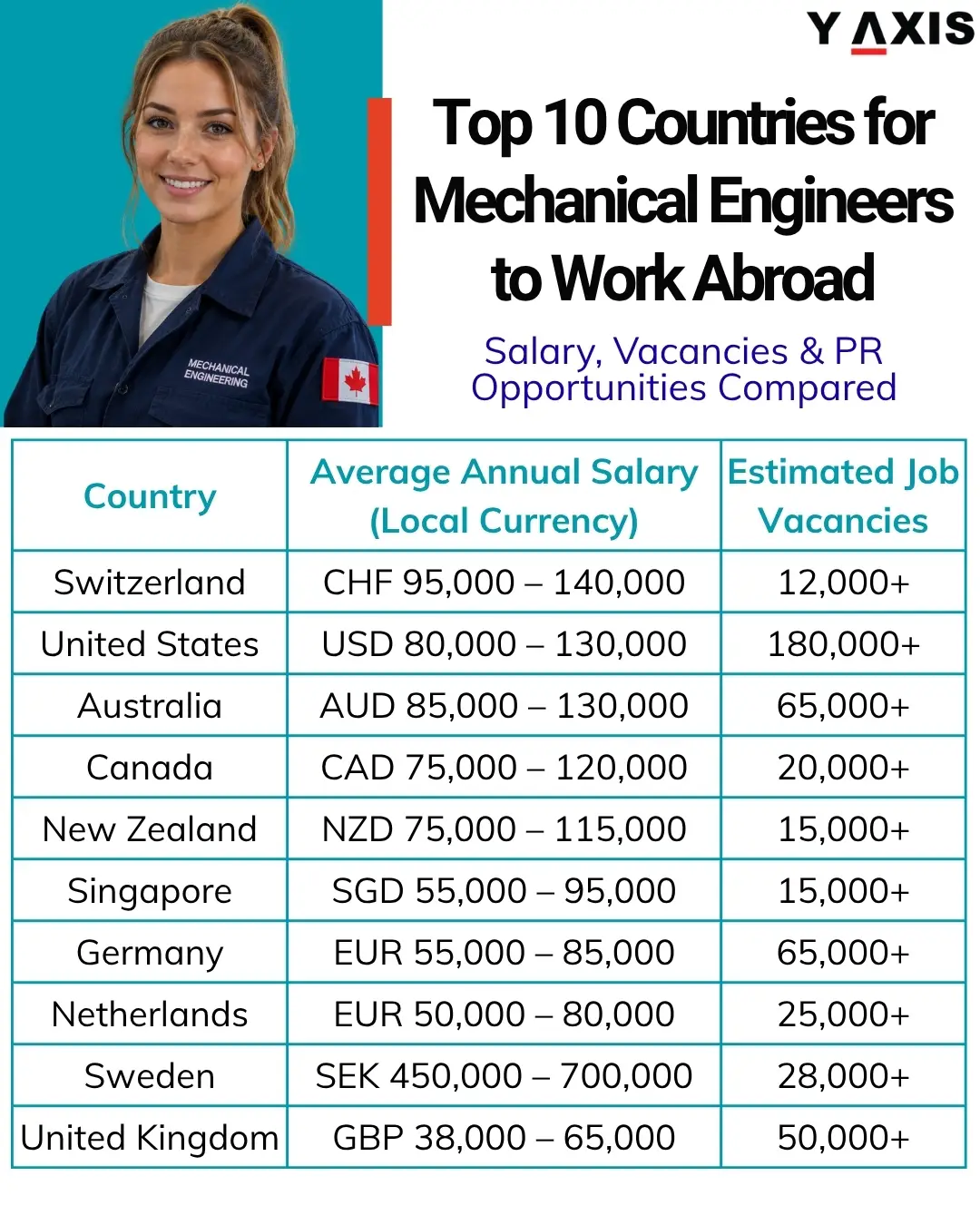
Top 10 Countries for Mechanical Engineers to Work Abroad: Salary, Demand & PR Opportunities Compared
Top 10 Countries for Mechanical Engineers to Work Abroad: Salary, Demand & PR Opportunities Compared
The best countries for mechanical engineer jobs abroad include Canada, Australia, Germany, the United Kingdom, Switzerland, the Netherlands, New Zealand, the United States, Denmark, and Singapore. These countries offer competitive salaries, strong demand for mechanical engineers, work visa options, and pathways to permanent residency. Demand for mechanical engineers remains strong across manufacturing, clean energy, infrastructure, robotics, and automation. According to the World Economic Forum, around 170 million new jobs are projected to be created globally by 2030. Mechanical engineer employment is also projected to grow by 9% over the next decade, creating more opportunities for mechanical engineers to work abroad.
*Want to work abroad? Sign up with Y-Axis Resume Marketing Services to find right job faster.
Why Is Demand for Mechanical Engineers Increasing Globally?
Mechanical engineers are in high demand worldwide due to increasing investments in manufacturing, clean energy, automation, and transportation. According to the International Energy Agency (IEA), global renewable energy capacity is projected to grow 2.7 times by 2030, creating long-term opportunities for mechanical engineers across multiple industries.
- Rising manufacturing production
- Growth in renewable energy projects
- Expansion of electric vehicle and battery manufacturing
- Investment in transport and infrastructure
- Replacement hiring due to an ageing workforce
- Adoption of automation and smart manufacturing
How to Choose the Right Country for Mechanical Engineer Jobs Abroad?
The right country for a mechanical engineer depends on career opportunities, salary, visa options, and long-term settlement prospects. Comparing these factors will help you choose a destination that aligns with your qualifications, career goals, and preferred lifestyle abroad.
- Demand for mechanical engineers
- Average salary and cost of living
- Work visa and permanent residency pathways
- Engineering licensing or registration requirements
- Long-term job outlook and career growth
- Major industries hiring mechanical engineers
Top 10 Countries for Mechanical Engineers to Work Abroad
Mechanical engineers are among the highest-paid engineering professionals in several countries, earning more than CAD 110,000 annually. Canada, Australia, Germany, Switzerland, the United Kingdom, and the United States continue to recruit mechanical engineers for roles in manufacturing, automotive, aerospace, energy, and infrastructure, supporting both industrial development and large-scale engineering projects.
|
Country |
Average Annual Salary |
Estimated Mechanical Engineer |
|
Canada |
CAD 75,000 – CAD 120,000 |
20,000+ |
|
United States |
USD 80,000 – USD 130,000 |
180,000+ |
|
Germany |
EUR 55,000 – EUR 85,000 |
65,000+ |
|
Australia |
AUD 85,000 – AUD 130,000 |
65,000+ |
|
United Kingdom |
GBP 38,000 – GBP 65,000 |
50,000+ |
|
Switzerland |
CHF 95,000 – CHF 140,000 |
12,000+ |
|
Netherlands |
EUR 50,000 – EUR 80,000 |
25,000+ |
|
Sweden |
SEK 450,000 – SEK 700,000 |
28,000+ |
|
Singapore |
SGD 55,000 – SGD 95,000 |
15,000+ |
|
New Zealand |
NZD 75,000 – NZD 115,000 |
15,000+ |
*Want to work abroad? Sign up with Y-Axis Resume Marketing Services to find right job faster.
Best Countries for Mechanical Engineer Jobs Abroad and Permanent Residency
Many countries are facing a shortage of mechanical engineers, creating strong career opportunities and clear pathways to permanent residency. Canada, Australia, Germany, New Zealand, the Netherlands, Sweden, and the United Kingdom offer immigration programs that support long-term settlement for mechanical engineers. The best country depends on factors such as PR pathways, eligibility requirements, processing times, work experience, and settlement benefits.
Mechanical Engineer Jobs in Canada
Canada offers mechanical engineer jobs with competitive salaries, strong demand, and multiple pathways to work and settle permanently. Mechanical engineers are employed across manufacturing, construction, aerospace, automotive, energy, mining, and infrastructure industries. Many Canadian employers recruit international talent through employer-sponsored positions, creating opportunities for work permits and visa sponsorship. Mechanical engineers can also apply for permanent residency through Express Entry and Provincial Nominee Programs (PNPs). Continued investment in infrastructure, clean energy, advanced manufacturing, and industrial projects supports demand for mechanical engineers across Canada.
|
Factor |
Details |
|
Mechanical Engineering Job Market & Job Vacancies for the Next Decade |
Canada’s mechanical engineering sector is projected to generate around 20,000 job openings over the next decade, supported by infrastructure projects, energy development, manufacturing expansion, and workforce replacement needs. |
|
Workforce Expansion & Growing Industries |
Canada is planning nearly CAD 1 trillion in investments across infrastructure, clean energy, transportation, and industrial development. With over 2 million jobs expected over the next decade, demand for mechanical engineers is expected to increase across multiple sectors. |
|
Mechanical Engineering Trends & Workforce Changes |
Mechanical engineers are seeing growing opportunities in automation, advanced manufacturing, renewable energy systems, industrial design, and sustainable engineering projects. |
|
Top Companies Hiring Mechanical Engineers |
Major employers include AtkinsRéalis (SNC-Lavalin), Bombardier, Magna International, Canadian Natural Resources, Suncor, and other engineering and manufacturing companies. |
|
Top Cities with Mechanical Engineering Jobs |
Toronto, Vancouver, Calgary, Montreal, Ottawa, and Edmonton offer mechanical engineering roles across manufacturing, engineering services, industrial operations, and infrastructure projects. |
|
In-Demand Mechanical Engineering Roles & Skills |
High-demand roles include Mechanical Design Engineer, Manufacturing Engineer, Maintenance Engineer, HVAC Engineer, and Project Engineer. Skills in CAD, automation, and industrial systems are highly sought after. |
|
Work Visa Options |
Mechanical engineers can apply through employer-sponsored work permits, LMIA-based work visas, and the Global Talent Stream for relevant job roles. |
|
Fast-Track Hiring Options |
The Global Talent Stream supports faster processing for employers hiring mechanical engineers in high-demand occupations. |
|
PR / Long-Term Residence Options |
Mechanical engineers can explore permanent residency pathways through Express Entry and Provincial Nominee Programs (PNPs). |
|
Eligibility for Dependents |
The spouse and dependent children can accompany the main applicant under applicable immigration rules. |
|
Benefits for Family Members |
Family members may receive spouse work rights, access to public education, and public healthcare coverage. |
*Want to work in Canada? Get expert assistance from Y-Axis to find the right job faster.
Mechanical Engineer Jobs in the United States
The United States has one of the world's largest employment markets for mechanical engineers, creating opportunities across industries ranging from aerospace and automotive to robotics, medical devices, energy, and advanced manufacturing. Mechanical engineers contribute to product design, research and development, production, testing, and automation, with roles available in both established companies and technology-driven businesses. The country's broad industrial base and continuous investment in innovation support long-term demand for engineering talent. International mechanical engineers can also access employment through employer-sponsored work visa programs, depending on job eligibility and employer requirements.
|
Factor |
Details |
|
Mechanical Engineering Job Market & Job Vacancies for the Next Decade |
The United States has one of the largest job markets for mechanical engineers, with around 180,000 job openings over the next decade. Demand is supported by manufacturing expansion, infrastructure projects, energy development, and workforce replacement needs. |
|
Workforce Expansion & Growing Industries |
The US is investing over USD 1 trillion in infrastructure and industrial development, increasing opportunities for mechanical engineers across manufacturing, aerospace, automotive, energy, and construction sectors. |
|
Mechanical Engineering Trends & Workforce Changes |
Mechanical engineering roles are evolving with rising demand in advanced manufacturing, automation, robotics, clean energy systems, electric vehicles, and AI-driven industrial processes. |
|
Top Companies Hiring Mechanical Engineers |
Major employers include Tesla, Boeing, General Electric (GE), Ford, Lockheed Martin, Caterpillar, SpaceX, and leading engineering firms. |
|
Top Cities with Mechanical Engineering Jobs |
Houston, Detroit, San Jose, New York, Los Angeles, and Chicago, along with major industrial hubs, offer opportunities across engineering, manufacturing, aerospace, and technology sectors. |
|
In-Demand Mechanical Engineering Roles & Skills |
High-demand roles include Mechanical Design Engineer, Manufacturing Engineer, Maintenance Engineer, HVAC Engineer, and Aerospace Engineer. Skills in CAD, robotics, and systems engineering are highly valued. |
|
Work Visa Options |
Mechanical engineers can explore H-1B Visa, L-1 Visa, and employer-sponsored work visas for US employment opportunities. |
|
Fast-Track Hiring Options |
Hiring is mainly employer-sponsored, with limited fast-track options available through the H-1B process and visa selection system. |
|
PR / Long-Term Residence Options |
Mechanical engineers may pursue long-term residence through employment-based Green Card pathways (EB categories). |
|
Eligibility for Dependents |
The spouse and dependent children can accompany the primary applicant based on visa conditions. |
|
Benefits for Family Members |
Family members may access spouse work eligibility (for certain visa categories), education opportunities, and employer-provided healthcare benefits. |
*Want to work in the USA? Avail Y-Axis Resume Marketing Services to shortlist the job faster.
Mechanical Engineer Jobs in Germany
Germany has a strong demand for mechanical engineers, driven by its globally recognised manufacturing sector and engineering-led industries. Mechanical engineers play a key role in automotive production, industrial machinery, automation, renewable energy, and precision engineering, supporting the country's focus on innovation and high-quality manufacturing. Employers recruit mechanical engineers for design, production, research, maintenance, and process improvement roles across both large multinational companies and specialised engineering firms. With a well-established industrial economy, competitive salaries, and opportunities across multiple engineering sectors, Germany remains a preferred destination for mechanical engineers seeking international work experience.
|
Factor |
Details |
|
Mechanical Engineering Job Market & Job Vacancies for the Next Decade |
Germany’s mechanical engineering sector is projected to have around 65,000 job openings over the next decade, driven by workforce ageing, industrial growth, and replacement hiring across manufacturing and automotive industries. |
|
Workforce Expansion & Growing Industries |
Germany is investing close to €1 trillion in infrastructure, energy transition (Energiewende), digitalisation, and industrial modernisation, increasing demand for mechanical engineers in manufacturing, production, and energy systems. |
|
Mechanical Engineering Trends & Workforce Changes |
Mechanical engineering roles are evolving with increased demand for Industry 4.0, automation, robotics, smart manufacturing, AI integration, and green technologies. |
|
Top Companies Hiring Mechanical Engineers |
Leading employers include Siemens, Volkswagen Group, BMW, Bosch, BASF, Infineon, and major German engineering and manufacturing firms. |
|
Top Cities with Mechanical Engineering Jobs |
Berlin, Munich, Frankfurt, Hamburg, Stuttgart, Cologne, and Düsseldorf, along with major industrial regions, provide opportunities in automotive, manufacturing, engineering services, and technology sectors. |
|
In-Demand Mechanical Engineering Roles & Skills |
Key roles include Mechanical Engineer, Automotive Engineer, Manufacturing Engineer, Maintenance Engineer, and Robotics Engineer. Skills in automation, CAD, and industrial systems are highly valued. |
|
Work Visa Options |
Mechanical engineers can apply through the EU Blue Card, German Skilled Worker Visa, Opportunity Card (Chancenkarte), and employer-sponsored work permits. |
|
Fast-Track Hiring Options |
The Accelerated Skilled Worker Procedure and priority processing through the EU Blue Card support faster recruitment processes for mechanical engineering roles. |
|
PR / Long-Term Residence Options |
Mechanical engineers can apply for permanent residence after meeting the required work and residence conditions in Germany. |
|
Eligibility for Dependents |
The spouse and dependent children may accompany the primary applicant under Germany’s family immigration rules. |
|
Benefits for Family Members |
Family members may access spouse work rights, public education, and Germany’s public healthcare system. |
Mechanical Engineer Jobs in Australia
Mechanical engineers are needed across Australia's expanding infrastructure, mining, renewable energy, transport, and advanced manufacturing sectors. Ongoing investment in major engineering projects continues to create demand for engineers with expertise in design, maintenance, production, automation, and project delivery. Many employers recruit overseas talent to address workforce needs, while mechanical engineering remains listed on Australia's Skilled Occupation List, supporting both employer-sponsored and skilled migration pathways. With strong demand across metropolitan and regional areas, Australia offers diverse career opportunities for mechanical engineers looking to work abroad.
|
Factor |
Details |
|
Mechanical Engineering Job Market & Future Demand |
Australia is projected to have around 65,000 mechanical engineering job openings over the next decade, supported by demand across mining, infrastructure, manufacturing, and energy sectors. |
|
Workforce Expansion & Growing Industries |
Australia is investing close to AUD 1 trillion in infrastructure and economic development, creating more opportunities for mechanical engineers in transport, renewable energy, mining, defence, and advanced manufacturing projects. |
|
Key Industries Hiring Mechanical Engineers |
Major hiring sectors include mining, oil and gas, renewable energy, manufacturing plants, HVAC systems, and infrastructure projects. |
|
Mechanical Engineering Trends |
Mechanical engineering roles are evolving with growing demand for expertise in automation, robotics, advanced manufacturing, plant optimisation, and renewable energy systems. |
|
Top Companies Hiring Mechanical Engineers |
Leading employers include BHP, Rio Tinto, Woodside Energy, Worley, AECOM, CIMIC Group, and Downer Group. |
|
Top Cities for Mechanical Engineering Jobs |
Perth offers opportunities in mining and energy, Brisbane in infrastructure and construction, Sydney and Melbourne in engineering design and consulting, and Adelaide in defence manufacturing. |
|
In-Demand Mechanical Engineering Roles |
Key roles include Mechanical Design Engineer, Maintenance Engineer, HVAC Engineer, Project Engineer, and Manufacturing Engineer. |
|
Licensing & Skill Requirements |
Mechanical engineers generally require a skills assessment through Engineers Australia, along with experience in CAD software, plant systems, and project execution. |
|
Work Visa Options for Mechanical Engineers |
Mechanical engineers can explore Subclass 482, Subclass 186, Subclass 189, Subclass 190, and Subclass 491 visa pathways. |
|
PR Pathways for Mechanical Engineers |
Permanent residency pathways are available through skilled migration and employer-sponsored pathways after meeting the required immigration criteria. |
|
Family Eligibility |
The spouse and dependent children can be included in the visa application. |
|
Benefits for Family Members |
Family members may access spouse work rights, public education, and Medicare healthcare. |
Mechanical Engineer Jobs in the United Kingdom
Mechanical engineers are recruited across the United Kingdom to support manufacturing, energy, aerospace, defence, rail, construction, and industrial engineering projects. Employers hire mechanical engineers for product development, maintenance, production, systems design, and project engineering roles in both the public and private sectors. Many positions are available through the Skilled Worker visa, allowing eligible international applicants to work for licensed sponsor employers. Ongoing investment in infrastructure, clean energy, transport, and advanced manufacturing continues to support employment opportunities for mechanical engineers across the UK.
|
Factor |
Details |
|
Mechanical Engineering Job Market & Number of Job Vacancies for Next Decade |
The UK mechanical engineering sector is projected to have around 50,000 job openings over the next decade, supported by infrastructure development, renewable energy expansion, defence programmes, and workforce replacement needs. |
|
Workforce Expansion & Growing Industries for Mechanical Engineering Jobs |
The UK is investing over £1.5 trillion in infrastructure, housing, clean energy, transport, and defence projects over the next decade, increasing opportunities for mechanical engineers in energy systems, manufacturing, and major engineering projects. |
|
Mechanical Engineering Trends & Industry Changes |
Mechanical engineering roles are evolving with growing demand in offshore wind energy, net-zero projects, advanced manufacturing, automation, and digital engineering systems. |
|
Top Companies Hiring Mechanical Engineers |
Leading employers include Rolls-Royce, BAE Systems, Siemens UK, National Grid, Jaguar Land Rover, and major infrastructure and engineering consultancies. |
|
Top Cities with Mechanical Engineering Jobs |
London, Manchester, Birmingham, Leeds, Bristol, Glasgow, and Edinburgh offer mechanical engineering opportunities across manufacturing, energy, transport, and engineering sectors. |
|
In-Demand Mechanical Engineering Roles & Skills |
Key roles include Mechanical Design Engineer, Maintenance Engineer, HVAC Engineer, Project Engineer, and Manufacturing Engineer. Skills in CAD, automation, and energy systems are highly valued. |
|
Work Visa Options for Mechanical Engineers |
Mechanical engineers can explore the Skilled Worker Visa, Global Talent Visa, Scale-Up Visa, and employer-sponsored UK work visas. |
|
Fast-Track Hiring Options |
Priority processing may be available through the Skilled Worker Visa route for engineering occupations that meet the required criteria. |
|
PR / Long-Term Residence Opportunities |
Mechanical engineers may apply for Indefinite Leave to Remain (ILR) after meeting the required residence and visa conditions. |
|
Eligibility for Dependents |
The spouse and dependent children can accompany the primary applicant under UK immigration rules. |
|
Benefits for Family Members |
Family members may access spouse work rights, public education, and NHS healthcare, subject to visa conditions and immigration health surcharge requirements. |
*Want to work in the UK? Avail Y-Axis Resume Marketing Services to find the right job faster.
Mechanical Engineer Jobs in Switzerland
Switzerland offers some of the highest salaries for mechanical engineers, supported by a strong economy and a global reputation for precision engineering. Mechanical engineers work in high-value industries such as advanced manufacturing, machinery, medical technology, automation, aerospace, and industrial equipment, where technical expertise and innovation are highly valued. International companies and specialised engineering firms recruit mechanical engineers for product development, design, quality engineering, and research roles. Combined with a stable employment market and a focus on high-quality manufacturing, Switzerland remains a preferred destination for experienced mechanical engineers seeking international careers.
|
Factor |
Details |
|
Mechanical Engineering Job Market & Job Vacancies for the Next Decade |
Switzerland’s mechanical engineering sector is projected to have around 10,000 job openings over the next decade, supported by growth in advanced manufacturing, robotics, precision engineering, and industrial systems. |
|
Workforce Expansion & Growing Industries |
Switzerland is investing over CHF 30 billion in transport infrastructure, clean energy, digitalisation, and industrial innovation, increasing opportunities for mechanical engineers in precision manufacturing, automation, pharmaceuticals, and industrial production systems. |
|
Mechanical Engineering Trends & Workforce Changes |
Mechanical engineering roles are evolving with rising demand in robotics, smart manufacturing, automation, precision engineering, sustainable technologies, and digital industrial systems. |
|
Top Companies Hiring Mechanical Engineers |
Leading employers include ABB, Nestlé Engineering, Sulzer, GE Switzerland, Bühler Group, and major precision engineering and manufacturing firms. |
|
Top Cities with Mechanical Engineering Jobs |
Zurich, Geneva, Basel, Lausanne, and Bern offer mechanical engineering opportunities, particularly in manufacturing, robotics, automation, and industrial technology sectors. |
|
In-Demand Mechanical Engineering Roles & Skills |
Key roles include Mechanical Engineer, Design Engineer, Manufacturing Engineer, Automation Engineer, and Maintenance Engineer. Skills in CAD, robotics, industrial systems, and precision manufacturing are highly valued. |
|
Work Visa Options |
Mechanical engineers can explore the Swiss Work Permit (L Permit and B Permit) and employer-sponsored work authorisation pathways. |
|
Fast-Track Hiring Options |
Hiring is mainly employer-sponsored, with simplified procedures available for highly skilled mechanical engineers in shortage occupations. |
|
PR / Long-Term Residence Options |
Mechanical engineers may apply for long-term residence permits after meeting the required employment and residency conditions. |
|
Eligibility for Dependents |
The spouse and dependent children may accompany the primary applicant under Swiss immigration rules. |
|
Benefits for Family Members |
Family members may access spouse work eligibility, public education, and high-quality healthcare services. |
*Want to work in Switzerland? Get expert assistance from Y-Axis to find right job faster.
Mechanical Engineer Jobs in the Netherlands
The Netherlands has a growing demand for mechanical engineers, supported by advanced manufacturing, high-tech industries, semiconductor technology, maritime engineering, and sustainable energy projects. Mechanical engineers contribute to the design, development, automation, and optimisation of products and industrial systems across globally recognised engineering companies. The country's focus on innovation, smart manufacturing, and research-driven industries continues to create opportunities for engineers with technical expertise. International applicants can also find opportunities through employers that recruit skilled engineering talent to support the Netherlands' expanding industrial and technology sectors.
|
Factor |
Details |
|
Mechanical Engineering Job Market & Job Vacancies for the Next Decade |
The Netherlands’ mechanical engineering sector is projected to have around 25,000 job openings over the next decade, supported by growth in high-tech manufacturing, semiconductor production, and industrial systems. |
|
Workforce Expansion & Growing Industries |
The Dutch government is investing over €28 billion in sustainable energy and infrastructure, along with continued growth in semiconductor and technology sectors, increasing demand for mechanical engineers in advanced manufacturing and energy systems. |
|
Mechanical Engineering Trends & Workforce Changes |
Mechanical engineering roles are evolving with increasing demand in semiconductor manufacturing, automation, robotics, digital engineering, and sustainability-focused technologies. |
|
Top Companies Hiring Mechanical Engineers |
Leading employers include ASML, Shell, Philips, Siemens Netherlands, Unilever, and major engineering and technology companies. |
|
Top Cities with Mechanical Engineering Jobs |
Amsterdam, Rotterdam, Utrecht, Eindhoven, and The Hague, along with key innovation hubs, provide opportunities for mechanical engineers across technology, manufacturing, and industrial sectors. |
|
In-Demand Mechanical Engineering Roles & Skills |
Key roles include Mechanical Engineer, Manufacturing Engineer, Semiconductor Equipment Engineer, Maintenance Engineer, and Automation Specialist. Skills in CAD, systems design, and industrial processes are highly valued. |
|
Work Visa Options |
Mechanical engineers can explore the Highly Skilled Migrant Visa, EU Blue Card, and Orientation Year Visa pathways. |
|
Fast-Track Hiring Options |
Faster processing is available through the Highly Skilled Migrant programme and employer-sponsored permits. |
|
PR / Long-Term Residence Options |
Mechanical engineers may apply for long-term EU residence after meeting the required work and residence conditions. |
|
Eligibility for Dependents |
The spouse and dependent children may accompany the primary applicant under Dutch immigration rules. |
|
Benefits for Family Members |
Family members may access spouse work rights, public education, and public healthcare coverage. |
Mechanical Engineer Jobs in Sweden
Sweden continues to create opportunities for mechanical engineers through its leadership in sustainable manufacturing, industrial automation, automotive engineering, and clean technology. Mechanical engineers are employed to develop efficient production systems, improve manufacturing processes, design advanced machinery, and support research and product innovation. Global engineering companies and manufacturing businesses actively recruit engineering talent to strengthen Sweden's technology-driven industries. With a strong focus on innovation, digitalisation, and environmentally sustainable industrial development, Sweden offers a dynamic work environment for mechanical engineers seeking international career growth.
|
Factor |
Details |
|
Mechanical Engineering Job Market & Job Vacancies for the Next Decade |
Sweden’s mechanical engineering sector is expected to have around 28,000 job openings over the next decade, supported by demand in manufacturing, automotive, and clean energy industries. |
|
Workforce Expansion & Growing Industries |
Sweden is investing over SEK 700 billion in infrastructure, transport, and green energy transition by 2030, creating more opportunities for mechanical engineers in automotive, industrial manufacturing, and renewable energy systems. |
|
Mechanical Engineering Trends & Workforce Changes |
Mechanical engineering roles are evolving with growth in electric vehicles, automation, advanced manufacturing, robotics, and sustainable engineering solutions. |
|
Top Companies Hiring Mechanical Engineers |
Leading employers include Volvo Group, Scania, Ericsson, ABB, SKF, and major engineering and manufacturing companies. |
|
Top Cities with Mechanical Engineering Jobs |
Stockholm, Gothenburg, Malmö, Uppsala, and Västerås offer opportunities for mechanical engineers across automotive, manufacturing, technology, and industrial sectors. |
|
In-Demand Mechanical Engineering Roles & Skills |
Key roles include Mechanical Engineer, Automotive Engineer, Manufacturing Engineer, Maintenance Engineer, and Robotics Engineer. Skills in CAD, automation, and industrial systems are highly valued. |
|
Work Visa Options |
Mechanical engineers can explore the Swedish Work Permit, EU Blue Card, and employer-sponsored work visas. |
|
Fast-Track Hiring Options |
Fast-track processing is available for certified employers hiring mechanical engineers and other engineering roles. |
|
PR / Long-Term Residence Options |
Mechanical engineers may apply for permanent residence after meeting the required residence and employment conditions. |
|
Eligibility for Dependents |
The spouse and dependent children can accompany the primary applicant under Swedish immigration rules. |
|
Benefits for Family Members |
Family members may access spouse work rights, public education, and Sweden’s public healthcare system. |
Mechanical Engineer Jobs in Singapore
Singapore is a leading engineering and manufacturing hub in Asia, creating steady demand for mechanical engineers across precision engineering, aerospace, electronics, biomedical manufacturing, marine engineering, and semiconductor industries. Mechanical engineers support the design, production, maintenance, and optimisation of advanced manufacturing systems used by global companies operating in the country. Singapore's business-friendly environment, strong industrial infrastructure, and continued investment in high-value manufacturing and technology sectors help sustain employment opportunities. These strengths make Singapore an attractive choice for mechanical engineers seeking international experience in a fast-paced engineering environment.
|
Factor |
Details |
|
Mechanical Engineering Job Market & Job Vacancies for the Next Decade |
Singapore’s mechanical engineering sector is projected to have around 10,000 job openings over the next decade, supported by growth in advanced manufacturing, aerospace, electronics, industrial automation, and precision engineering. |
|
Workforce Expansion & Growing Industries |
Singapore is investing over SGD 25 billion in advanced manufacturing, digital transformation, sustainability, and industrial innovation, increasing opportunities for mechanical engineers in aerospace, semiconductors, automation, and smart manufacturing sectors. |
|
Mechanical Engineering Trends & Workforce Changes |
Mechanical engineering roles are evolving with rising demand in automation, robotics, precision engineering, digital manufacturing, Industry 4.0 technologies, and sustainable industrial systems. |
|
Top Companies Hiring Mechanical Engineers |
Major employers include Rolls-Royce Singapore, ST Engineering, Dyson, Micron Technology, ExxonMobil, Siemens Singapore, and leading industrial and manufacturing firms. |
|
Top Cities with Mechanical Engineering Jobs |
Singapore City, Jurong, Tuas, and Changi offer mechanical engineering opportunities, particularly in aerospace, manufacturing, precision engineering, and industrial technology sectors. |
|
In-Demand Mechanical Engineering Roles & Skills |
Key roles include Mechanical Engineer, Manufacturing Engineer, Automation Engineer, Maintenance Engineer, and Precision Engineering Specialist. Skills in CAD, robotics, industrial systems, and manufacturing processes are highly valued. |
|
Work Visa Options |
Mechanical engineers can explore the Employment Pass (EP), S Pass, and employer-sponsored work permits for Singapore employment opportunities. |
|
Fast-Track Hiring Options |
Faster processing may be available through employer-sponsored Employment Pass applications for high-demand engineering roles. |
|
PR / Long-Term Residence Options |
Mechanical engineers may apply for Permanent Residency (PR) after meeting the required employment and residency conditions. |
|
Eligibility for Dependents |
The spouse and dependent children may accompany the primary applicant, subject to visa conditions. |
|
Benefits for Family Members |
Family members may access spouse work eligibility, education opportunities, and high-quality healthcare services. |
Mechanical Engineer Jobs in New Zealand
Mechanical engineer jobs in New Zealand are driven by ongoing infrastructure development, manufacturing, food processing, renewable energy, utilities, and agricultural industries. Employers recruit mechanical engineers to design equipment, improve production systems, manage engineering projects, and maintain industrial operations across both urban and regional areas. The country's steady investment in public infrastructure and sustainable industries continues to support demand for engineering talent. Combined with a balanced work environment and recognised skilled migration pathways, New Zealand remains a popular destination for mechanical engineers planning to build an international career.
|
Factor |
Details |
|
Mechanical Engineering Job Market & Job Vacancies for the Next Decade |
New Zealand’s mechanical engineering sector is projected to have around 15,000 job openings over the next decade, supported by infrastructure upgrades, housing development, and energy projects. |
|
Workforce Expansion & Growing Industries |
The government has committed over NZD 70 billion in infrastructure investment across transport, water systems, housing, and energy projects, increasing opportunities for mechanical engineers in construction systems, utilities, and industrial projects. |
|
Mechanical Engineering Trends & Workforce Changes |
Mechanical engineering roles are evolving with growing demand in sustainable systems, HVAC engineering, renewable energy technologies, and digital design tools. |
|
Top Companies Hiring Mechanical Engineers |
Leading employers include Fletcher Building, Downer Group, Beca Group, Transpower, Meridian Energy, and major engineering consultancies. |
|
Top Cities with Mechanical Engineering Jobs |
Auckland, Wellington, Christchurch, and Hamilton, along with key regional centres, offer opportunities for mechanical engineers across construction, energy, manufacturing, and engineering services. |
|
In-Demand Mechanical Engineering Roles & Skills |
Key roles include Mechanical Engineer, HVAC Engineer, Maintenance Engineer, Project Engineer, and Manufacturing Engineer. Skills in plant systems, engineering design, and project delivery are highly valued. |
|
Work Visa Options |
Mechanical engineers can explore the Accredited Employer Work Visa (AEWV), Skilled Migrant Category Visa, and employer-sponsored work permits. |
|
Fast-Track Hiring Options |
Priority processing is available through Accredited Employer schemes for high-demand mechanical engineering occupations. |
|
PR / Long-Term Residence Options |
Mechanical engineers may apply for permanent residency through the Skilled Migrant Category after meeting the required immigration criteria. |
|
Eligibility for Dependents |
The spouse and dependent children may accompany the primary applicant under New Zealand immigration rules. |
|
Benefits for Family Members |
Family members may access spouse work rights, public education, and public healthcare services. |
Job Outlook for Mechanical Engineers over the Next Decade
The job outlook for mechanical engineers is expected to remain strong over the next decade, with demand increasing across manufacturing, renewable energy, automation, robotics, electric vehicles, aerospace, and infrastructure sectors. According to the U.S. Bureau of Labour Statistics, mechanical engineer employment is projected to grow by 9% over the next decade.
Many top companies worldwide are investing in advanced manufacturing, smart technologies, and sustainable engineering solutions, creating opportunities for mechanical engineers with skills in CAD, automation, robotics, and digital engineering. The growing focus on efficient systems and industrial innovation will continue to support mechanical engineering careers globally.
*Want to work abroad? Sign up with Y-Axis Resume Marketing Services to find right job faster.
Apply Now
FAQs
Are mechanical engineers in demand in Canada?
Yes, mechanical engineers are in demand in Canada across manufacturing, automotive, aerospace, energy, mining, construction, and industrial sectors. Employers hire mechanical engineers for roles such as Mechanical Design Engineer, Manufacturing Engineer, Maintenance Engineer, HVAC Engineer, and Project Engineer in provinces including Ontario, Alberta, British Columbia, and Quebec.
How much does a mechanical engineer earn in Canada?
Mechanical engineers in Canada earn around CAD 75,000 to CAD 120,000 annually, depending on experience, location, industry, and job role. Mechanical engineers working in aerospace, energy, automotive manufacturing, and advanced industrial projects may receive higher salaries.
How can mechanical engineers move to Canada?
Mechanical engineers can move to Canada through immigration pathways such as Express Entry, Provincial Nominee Programs (PNPs), and employer-sponsored work permits. The pathway depends on factors including engineering education, work experience, language ability, job offers, and immigration program requirements.
Is Canada a good country for mechanical engineers?
Yes, Canada offers mechanical engineering opportunities across manufacturing, aerospace, automotive, energy, mining, and infrastructure industries. Mechanical engineers can access employment opportunities, work permit options, and permanent residency pathways through Canada’s immigration programs.
Which provinces in Canada have the most mechanical engineering jobs?
Ontario, Alberta, British Columbia, Quebec, and Manitoba have strong demand for mechanical engineers. Ontario offers opportunities in automotive and manufacturing, Alberta in energy and industrial projects, British Columbia in infrastructure and engineering services, and Quebec in aerospace and production industries.
What are the requirements to work as a mechanical engineer in Canada?
Mechanical engineers generally need an engineering degree, relevant work experience, language proficiency, and a suitable job opportunity. Some positions require registration with a provincial engineering association, especially roles involving professional engineering practice.
Do mechanical engineers need a licence to work in Canada?
Mechanical engineers may need a licence from a provincial engineering association when their role involves practising engineering or approving engineering work. Licensing requirements vary by province and depend on job responsibilities.
Can mechanical engineers get permanent residency in Canada?
Yes, mechanical engineers can apply for Canadian permanent residency through programs such as Express Entry and Provincial Nominee Programs (PNPs). Requirements depend on factors such as education, work experience, language scores, employment history, and immigration criteria.
Which Canadian companies hire mechanical engineers?
Companies hiring mechanical engineers in Canada include AtkinsRéalis (SNC-Lavalin), Bombardier, Magna International, Canadian Natural Resources, and Suncor. These companies recruit mechanical engineers for design, manufacturing, maintenance, energy systems, project engineering, and industrial operations roles.
What mechanical engineering jobs are in demand in Canada?
Mechanical Design Engineer, Manufacturing Engineer, Maintenance Engineer, HVAC Engineer, Project Engineer, Automotive Engineer, and Automation Engineer are among the in-demand mechanical engineering roles in Canada.
Which industries hire mechanical engineers in Canada?
Mechanical engineers are hired in automotive manufacturing, aerospace, energy, mining, construction, renewable energy, industrial automation, HVAC systems, and advanced manufacturing industries across Canada.
Can foreign mechanical engineers work in Canada?
Yes, foreign mechanical engineers can work in Canada through employer-sponsored work permits, skilled immigration programs, and other work authorization pathways. Requirements depend on education, experience, job role, and immigration category.
Does Canada offer visa sponsorship for mechanical engineers?
Yes, Canadian employers can support mechanical engineers through employer-specific work permits. Some companies hire international mechanical engineers for roles in manufacturing, engineering design, energy, automotive, and industrial projects.
What is the job outlook for mechanical engineers in Canada?
The job outlook for mechanical engineers in Canada remains positive due to growth in manufacturing, clean energy, infrastructure development, automation, and advanced industrial technologies. Demand is expected to continue as companies expand production and adopt new engineering systems.
Can mechanical engineers apply for Express Entry in Canada?
Yes, mechanical engineers can apply through Express Entry if they meet the requirements of programs such as the Federal Skilled Worker Program. Factors considered include education, work experience, language ability, age, and other selection criteria.
Which Canadian cities have the most mechanical engineering jobs?
Toronto, Vancouver, Calgary, Montreal, Ottawa, and Edmonton offer mechanical engineering opportunities across manufacturing, energy, aerospace, construction, engineering consulting, and industrial sectors.
What skills are required for mechanical engineering jobs in Canada?
Mechanical engineers in Canada require skills in CAD software, SolidWorks, AutoCAD, automation systems, robotics, manufacturing processes, industrial systems, engineering design, and project management.
Can fresh mechanical engineers get jobs in Canada?
Fresh mechanical engineers can apply for entry-level engineering roles, internships, and graduate programs in Canada. Technical skills, engineering software knowledge, project experience, and practical training can improve employment opportunities.
Which countries compete with Canada for mechanical engineers?
The United States, Germany, Australia, the United Kingdom, Switzerland, the Netherlands, Sweden, Singapore, and New Zealand are major destinations for mechanical engineers. These countries offer opportunities across manufacturing, automotive, aerospace, energy, automation, and industrial engineering sectors.
What is the future demand for mechanical engineers in Canada?
Future demand for mechanical engineers in Canada will be supported by growth in automation, electric vehicles, renewable energy, advanced manufacturing, infrastructure projects, and industrial technologies. Mechanical engineers with skills in digital engineering and modern manufacturing systems will have more opportunities.
Posted on July 19 2026
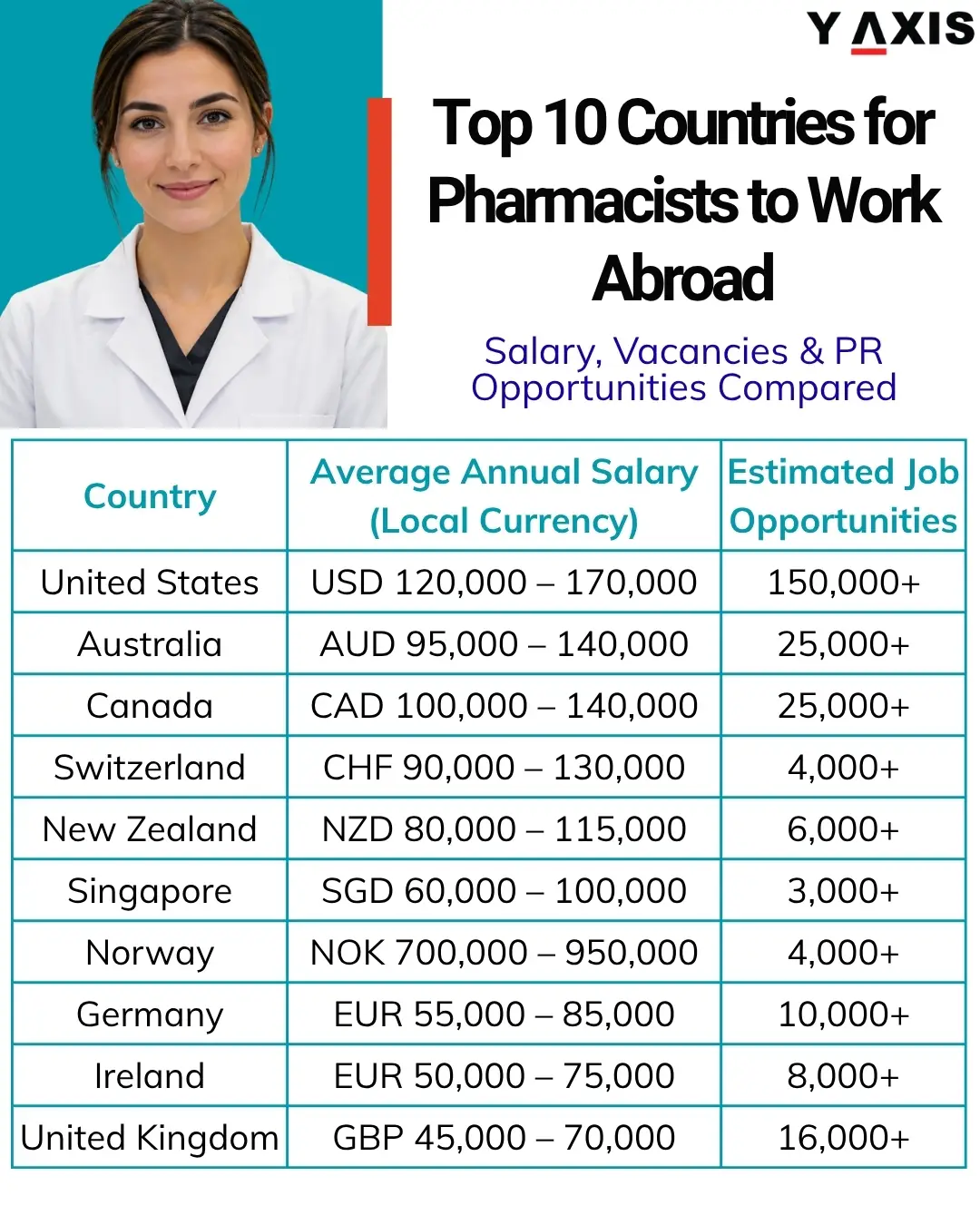
Top 10 Countries for Pharmacists to Work Abroad: Salary, Demand & PR Opportunities Compared
Top 10 Countries for Pharmacists to Work Abroad: Salary, Demand & PR Opportunities Compared
The best countries for pharmacists to work abroad are the United States, Australia, the United Kingdom, New Zealand, Ireland, Canada, Germany, Switzerland, Norway, and Singapore. These countries offer competitive salaries, strong demand for pharmacists, recognised licensing pathways, work visa options, and permanent residency (PR) opportunities. According to the World Health Organization (WHO), the global health workforce could face a shortage of around 11 million health workers by 2030. Rising healthcare needs, ageing populations, and expanding pharmacy services are increasing demand for pharmacists, prompting many countries to recruit pharmacists from overseas.
*Want to work abroad? Sign up with Y-Axis Resume Marketing Services to find right job faster.
Benefits of Working Abroad as a Pharmacist
Working abroad gives pharmacists access to higher salaries, strong job demand, and long-term career opportunities. Many countries also offer work visas, recognised licensing pathways, and permanent residency (PR) options for eligible pharmacists.
- Higher salaries with competitive pay and employment benefits.
- Strong job demand across hospitals, clinics, and community pharmacies.
- Work visa and PR pathways in several leading destinations.
- Career growth through advanced healthcare systems and specialised roles.
- Better quality of life with stable employment and work-life balance.
How to Choose the Right Country for Pharmacist Jobs Abroad?
Choosing the right country depends on your career goals, salary expectations, licensing requirements, and long-term immigration plans. Comparing these factors can help you identify the best destination for your pharmacy career.
- Job demand: Look for countries with strong demand for pharmacists and regular overseas recruitment.
- Salary and benefits: Compare average salaries, employment benefits, and the cost of living.
- Licensing requirements: Check the registration process, required exams, and language proficiency criteria.
- Work visa and PR options: Choose countries that offer clear work visa and permanent residency pathways.
- Career opportunities: Consider opportunities for specialisation, professional development, and career progression.
Top 10 Highest-Paying Countries for Pharmacists to Work Abroad
Pharmacists are among the most in-demand healthcare workers worldwide, creating strong career opportunities in countries with expanding healthcare systems. In leading destinations such as the United States, pharmacists can earn more than USD 120,000 annually, while countries including Australia, Canada, the United Kingdom, and Switzerland also offer competitive salaries. Along with attractive pay, these countries provide strong job demand, recognised licensing pathways, work visa options, and permanent residency (PR) opportunities.
|
Country |
Average Annual Salary (Local Currency) |
Estimated |
|
United States |
USD 120,000 – USD 170,000 |
150,000+ |
|
Australia |
AUD 95,000 – AUD 140,000 |
25,000+ |
|
Canada |
CAD 100,000 – CAD 140,000 |
25,000+ |
|
United Kingdom |
GBP 45,000 – GBP 70,000 |
16,000+ |
|
Germany |
EUR 55,000 – EUR 85,000 |
10,000+ |
|
Ireland |
EUR 50,000 – EUR 75,000 |
8,000+ |
|
New Zealand |
NZD 80,000 – NZD 115,000 |
6,000+ |
|
Switzerland |
CHF 90,000 – CHF 130,000 |
4,000+ |
|
Norway |
NOK 700,000 – NOK 950,000 |
4,000+ |
|
Singapore |
SGD 60,000 – SGD 100,000 |
3,000+ |
*Want to work abroad? Sign up with Y-Axis Resume Marketing Services to find right job faster.
Best Countries for Pharmacists to Work and Settle Abroad
Working and settling abroad as a pharmacist offers the opportunity to build a stable career and long-term future. Many countries provide competitive salaries, strong job demand, recognised licensing pathways, work visa options, and permanent residency (PR) opportunities for eligible pharmacists. Choosing the right destination depends on factors such as career growth, quality of life, and immigration pathways that align with your long-term goals.
Pharmacist Jobs in the United States
The United States offers some of the highest salaries for pharmacists, with annual earnings often exceeding USD 120,000. Pharmacists play a vital role in patient care by dispensing medications, managing drug therapies, administering vaccinations, and providing medication counselling. They work across community pharmacies, hospitals, specialty clinics, long-term care facilities, pharmaceutical companies, and research organisations.
The country's large healthcare sector and increasing demand for prescription and clinical pharmacy services continue to create employment across a wide range of practice settings. Pharmacists also build careers in clinical pharmacy, oncology, ambulatory care, infectious diseases, and research. High salaries, diverse career options, and advanced healthcare services make the United States a popular destination for pharmacists seeking international careers.
|
Factor |
Details |
|
Pharmacist Job Market & Estimated Opportunities for the Next Decade |
The US pharmacy sector is expected to generate more than 150,000 job openings over the next decade as healthcare demand grows, the population ages, and clinical pharmacy services continue to expand. |
|
Investment in Healthcare & Pharmacy Services |
The US Government and private sector invest more than USD 4.5 trillion annually in healthcare, supporting hospitals, pharmaceutical services, clinical care expansion, and workforce development across the country. |
|
In-Demand Pharmacist Roles & Skills |
Clinical, hospital, retail, and oncology pharmacists, along with pharmacists in the pharmaceutical industry, remain in high demand. Employers value skills such as medication therapy management, patient counselling, prescription review, and clinical support. |
|
Work Visa Options for Pharmacists |
Pharmacists can work in the United States through the H-1B Visa, employer-sponsored work visas, and EB-2 and EB-3 employment-based immigration pathways. |
|
Priority Hiring & Recruitment Pathways |
Employers recruit pharmacists through the H-1B Visa, employer-sponsored work visas, and EB-2 and EB-3 employment-based immigration pathways to address workforce shortages. |
|
PR / Long-Term Residence Opportunities |
Employment-based immigration pathways, including EB-2 and EB-3, offer overseas pharmacists a route to obtain a Green Card. |
|
Registration & Practice Requirements |
Overseas pharmacists must obtain FPGEC certification, pass the NAPLEX examination, and meet the licensing requirements set by the relevant state board before practising. |
|
Language Requirements |
Overseas pharmacists must meet English language requirements by completing TOEFL or another approved language assessment. |
|
Eligibility for Dependants |
Most work visas and employment-based immigration pathways allow spouses and dependent children to accompany the primary applicant. |
|
Benefits for Family Members |
Depending on the visa category, eligible family members may receive dependent visa status and access to education. |
*Want to work in the United States? Get expert guidance from Y-Axis professionals.
Pharmacist Jobs in Australia
Australia offers pharmacists a broad scope of practice within a modern and patient-focused healthcare system. Pharmacists contribute to medication management, preventive healthcare, chronic disease management, and vaccination services across community pharmacies, hospitals, aged care facilities, primary healthcare centres, and rural health services.
Growing healthcare needs and expanded pharmacy services continue to increase demand for pharmacists across the country. Australia also provides career pathways in clinical pharmacy, oncology, mental health, and aged care. Competitive salaries, strong employment demand, structured career progression, and a high quality of life have made Australia one of the most popular countries for pharmacists seeking to work and settle abroad.
|
Factor |
Details |
|
Pharmacist Job Market & Estimated Opportunities for the Next Decade |
Australia's pharmacy sector is expected to generate more than 25,000 job openings over the next decade, supported by workforce shortages, an ageing population, and rising demand for clinical and prescription pharmacy services. |
|
Investment in Healthcare & Pharmacy Services |
The Australian Government has committed more than AUD 140 billion to healthcare, supporting workforce expansion, aged care, pharmacy services, and improvements across the healthcare system. |
|
In-Demand Pharmacist Roles & Skills |
Clinical, hospital, retail, aged care, and community pharmacists remain in demand. Employers seek skills in medication management, patient counselling, prescription review, and clinical support. |
|
Work Visa Options for Pharmacists |
Pharmacists can apply through the Skilled Independent Visa (189), Skilled Nominated Visa (190), Employer Nomination Scheme (186), Skills in Demand Visa (482), and Skilled Work Regional Visa (491). |
|
Priority Hiring & Recruitment Pathways |
Pharmacists are recruited through skilled migration programs, employer-sponsored visas, and regional recruitment pathways to meet workforce demand across Australia. |
|
PR / Long-Term Residence Opportunities |
Permanent residency pathways include the Skilled Independent Visa (189), Skilled Nominated Visa (190), Employer Nomination Scheme (186), and the Skilled Work Regional Visa (491), which provides a pathway to permanent residency. |
|
Registration & Practice Requirements |
Overseas pharmacists must register with the Pharmacy Board of Australia and complete all required qualification assessment requirements before practising. |
|
Language Requirements |
Overseas pharmacists must demonstrate English language proficiency through IELTS, OET, or other approved English language tests. |
|
Eligibility for Dependants |
Skilled migration visas generally allow spouses and dependent children to accompany the primary applicant. |
|
Benefits for Family Members |
Depending on the visa conditions, eligible family members may receive work rights, access to education, and healthcare benefits. |
*Planning to Work in Australia? Let Y-Axis guide you through every step of the process.
Pharmacist Jobs in Canada
Canada has expanded the role of pharmacists, making them an important part of primary healthcare and patient care teams. In many provinces, pharmacists provide medication reviews, prescribe for minor ailments, administer vaccinations, and support chronic disease management. They work in community pharmacies, hospitals, primary care clinics, long-term care facilities, and the pharmaceutical industry.
Rising healthcare needs and an ageing population continue to increase demand for pharmacists across the country. Competitive salaries, a high standard of living, and permanent residency pathways have made Canada one of the most popular destinations for pharmacists looking to build a long-term career and settle abroad.
|
Factor |
Details |
|
Pharmacist Job Market & Estimated Opportunities for the Next Decade |
Canada's pharmacy sector is expected to create more than 25,000 job openings over the next decade, driven by healthcare workforce shortages, an ageing population, and growing demand across hospitals, community pharmacies, and long-term care facilities. |
|
Investment in Healthcare & Pharmacy Services |
The Canadian Government has committed nearly CAD 200 billion to healthcare funding over the next decade, supporting workforce development, patient care services, and the expansion of healthcare infrastructure. |
|
In-Demand Pharmacist Roles & Skills |
Clinical, hospital, community, retail, and long-term care pharmacists remain in demand. Employers seek skills in medication management, patient counselling, prescription review, and clinical support. |
|
Work Visa Options for Pharmacists |
Pharmacists can immigrate through Express Entry, Provincial Nominee Programs (PNPs), and employer-sponsored work permits. |
|
Priority Hiring & Recruitment Pathways |
Healthcare employers recruit pharmacists through Express Entry, Provincial Nominee Programs (PNPs), and employer-sponsored hiring to meet workforce needs across Canada. |
|
PR / Long-Term Residence Opportunities |
Express Entry and Provincial Nominee Programs (PNPs) provide permanent residency pathways, with healthcare occupations frequently prioritised in selection draws. |
|
Registration & Practice Requirements |
Overseas pharmacists must complete licensing and register with the pharmacy regulatory authority in the province or territory where they intend to practise. |
|
Language Requirements |
Overseas pharmacists must demonstrate English or French language proficiency through approved tests such as IELTS or TEF. |
|
Eligibility for Dependants |
Work permits and permanent residency pathways generally allow spouses and dependent children to accompany the primary applicant. |
|
Benefits for Family Members |
Depending on the visa or immigration pathway, eligible family members may receive work rights, access to public healthcare, and education benefits. |
*Want to work in Canada? Get expert guidance from Y-Axis professionals.
Pharmacist Jobs in the United Kingdom
The United Kingdom offers pharmacists a wide range of career options through the National Health Service (NHS) and the private healthcare sector. Pharmacists work in community pharmacies, hospitals, GP practices, care homes, and the pharmaceutical industry. The growing focus on primary care, medicines optimisation, and independent prescribing has expanded the role of pharmacists across the healthcare system.
Career pathways are available in clinical pharmacy, oncology, mental health, paediatrics, and other specialist areas. Competitive salaries, structured professional development, and a well-established healthcare system make the United Kingdom a popular destination for pharmacists seeking international career growth.
|
Factor |
Details |
|
Pharmacist Job Market & Estimated Opportunities for the Next Decade |
The UK pharmacy sector is projected to face more than 16,000 pharmacist shortages over the next decade, driven by rising healthcare demand and workforce gaps across NHS hospitals, community pharmacies, and clinical care services. |
|
Investment in Healthcare & Pharmacy Services |
The UK Government invests more than GBP 200 billion annually in the NHS and healthcare sector, supporting hospitals, community healthcare, digital health systems, and workforce expansion. |
|
In-Demand Pharmacist Roles & Skills |
Clinical, hospital, community, retail, and prescribing pharmacists remain in demand. Employers seek skills in medication management, prescription review, patient counselling, and clinical support. |
|
Work Visa Options for Pharmacists |
Pharmacists can work in the UK through the Skilled Worker Visa and Health and Care Worker Visa. |
|
Priority Hiring & Recruitment Pathways |
The NHS, community pharmacies, and healthcare employers recruit pharmacists through the Skilled Worker Visa and Health and Care Worker Visa to address workforce shortages. |
|
PR / Long-Term Residence Opportunities |
Overseas pharmacists may become eligible for Indefinite Leave to Remain (ILR) after completing the required residence period in the UK. |
|
Registration & Practice Requirements |
Overseas pharmacists must register with the General Pharmaceutical Council (GPhC) and meet all qualification and assessment requirements before practising. |
|
Language Requirements |
Overseas pharmacists must demonstrate English language proficiency through IELTS or other approved language tests. |
|
Eligibility for Dependants |
Skilled work visas generally allow spouses and dependent children to accompany the primary applicant. |
|
Benefits for Family Members |
Depending on the visa conditions, eligible family members may receive work rights, access to public education, and NHS healthcare. |
* Want to Work in the United Kingdom? Let Y-Axis guide you through the steps.
Pharmacist Jobs in Germany
Germany is home to one of Europe's largest pharmaceutical industries, offering pharmacists careers in both healthcare and life sciences. Pharmacists work in community pharmacies, hospitals, pharmaceutical manufacturing, research laboratories, quality assurance, and regulatory affairs.
The country's expanding healthcare services and strong pharmaceutical sector continue to drive demand for pharmacists across multiple practice areas. Germany also offers opportunities to contribute to drug development, clinical research, and pharmaceutical innovation. Competitive salaries, advanced healthcare infrastructure and a globally recognised pharmaceutical industry make Germany a strong choice for pharmacists seeking international career growth and long-term employment.
|
Factor |
Details |
|
Pharmacist Job Market & Estimated Opportunities for the Next Decade |
Germany's pharmacy sector is projected to face more than 10,000 pharmacist shortages over the next decade, driven by an ageing population and rising healthcare demand across hospitals, pharmacies, and elderly care services. |
|
Investment in Healthcare & Pharmacy Services |
The German Government invests more than EUR 500 billion annually in healthcare, supporting hospital modernisation, digital healthcare, and workforce expansion. |
|
In-Demand Pharmacist Roles & Skills |
Clinical, hospital, and community pharmacists, along with pharmacists in the pharmaceutical industry, remain in demand. Employers seek skills in medication management, prescription review, patient counselling, and clinical support. |
|
Work Visa Options for Pharmacists |
Pharmacists can work in Germany through the EU Blue Card, Skilled Worker Visa, and employer-sponsored work visas. |
|
Priority Hiring & Recruitment Pathways |
Employers recruit pharmacists through the EU Blue Card, Skilled Worker Visa, and employer-sponsored work visas to meet workforce needs across Germany. |
|
PR / Long-Term Residence Opportunities |
Overseas pharmacists may become eligible for permanent residence after completing the required residence period and meeting German language proficiency requirements. |
|
Registration & Practice Requirements |
Overseas pharmacists must complete formal qualification recognition (Anerkennung) and fulfil all licensing requirements before practising in Germany. |
|
Language Requirements |
Overseas pharmacists must demonstrate B2-level German language proficiency for registration and patient-facing employment. |
|
Eligibility for Dependants |
Skilled worker visas generally allow spouses and dependent children to accompany the primary applicant. |
|
Benefits for Family Members |
Eligible family members may receive work rights, access to public education, and comprehensive public healthcare coverage. |
Pharmacist Jobs in Ireland
Ireland is one of Europe's leading pharmaceutical and biotechnology hubs, creating diverse career paths for pharmacists in healthcare and the life sciences sector. Pharmacists work in community pharmacies, hospitals, primary care services, pharmaceutical manufacturing, quality assurance, and regulatory affairs. The country's strong pharmaceutical industry, growing healthcare investment, and increasing demand for pharmacy services continue to support employment across multiple sectors.
Ireland is home to many global pharmaceutical companies, offering opportunities beyond traditional pharmacy practice. Competitive salaries, English-speaking workplaces, and clear career progression make Ireland a popular destination for pharmacists seeking to work abroad.
|
Factor |
Details |
|
Pharmacist Job Market & Estimated Opportunities for the Next Decade |
Ireland's pharmacy sector is expected to create more than 8,000 job openings over the next decade, driven by healthcare workforce shortages and growing demand across hospitals, community pharmacies, and long-term care services. |
|
Investment in Healthcare & Pharmacy Services |
The Irish Government has committed more than EUR 27 billion to healthcare services, supporting long-term infrastructure development, workforce expansion, and improved access to healthcare. |
|
In-Demand Pharmacist Roles & Skills |
Clinical, hospital, community, and retail pharmacists remain in demand. Employers seek skills in medication management, prescription review, patient counselling, and clinical support. |
|
Work Visa Options for Pharmacists |
Pharmacists can work in Ireland through the Critical Skills Employment Permit, General Employment Permit, and employer-sponsored work permits. |
|
Priority Hiring & Recruitment Pathways |
Employers recruit pharmacists through the Critical Skills Employment Permit, General Employment Permit, and employer-sponsored work permits to meet workforce needs across Ireland. |
|
PR / Long-Term Residence Opportunities |
Overseas pharmacists may become eligible for Stamp 4 residence after meeting the required employment and residence requirements in Ireland. |
|
Registration & Practice Requirements |
Overseas pharmacists must register with the Pharmaceutical Society of Ireland (PSI) and complete all required qualification assessment requirements before practising. |
|
Language Requirements |
Overseas pharmacists must demonstrate English language proficiency through IELTS or other recognised language tests. |
|
Eligibility for Dependants |
Employment permits generally allow spouses and dependent children to accompany the primary applicant. |
|
Benefits for Family Members |
Depending on the employment permit conditions, eligible family members may receive work rights, access to public education, and healthcare services. |
Pharmacist Jobs in New Zealand
New Zealand offers pharmacists the opportunity to build rewarding careers in a healthcare system that emphasises accessible, community-based care. Pharmacists work in community pharmacies, public and private hospitals, primary healthcare services, aged care facilities, and rural health centres.
The country's focus on preventive healthcare, medication safety, and patient-centred services continues to increase demand for pharmacists across urban and regional areas. Pharmacists also collaborate closely with doctors, nurses, and other healthcare providers to improve patient outcomes. Competitive salaries, a healthy work-life balance, and a high standard of living make New Zealand an attractive country for pharmacists seeking international career growth.
|
Factor |
Details |
|
Pharmacist Job Market & Estimated Opportunities for the Next Decade |
New Zealand's pharmacy sector is expected to create more than 6,000 job openings over the next decade, driven by workforce shortages, an ageing population, and growing healthcare demand across hospitals and community services. |
|
Investment in Healthcare & Pharmacy Services |
The New Zealand Government has committed more than NZD 5.5 billion to healthcare system improvements, supporting workforce development, digital healthcare expansion, and patient care services. |
|
In-Demand Pharmacist Roles & Skills |
Clinical, hospital, community, and retail pharmacists remain in demand. Employers seek skills in medication management, patient counselling, prescription review, and clinical support. |
|
Work Visa Options for Pharmacists |
Pharmacists can work in New Zealand through the Accredited Employer Work Visa (AEWV), Skilled Migrant Category, and employer-sponsored work visas. |
|
Priority Hiring & Recruitment Pathways |
Employers recruit pharmacists through the Accredited Employer Work Visa (AEWV), Skilled Migrant Category, and employer-sponsored work visas to meet workforce needs across New Zealand. |
|
PR / Long-Term Residence Opportunities |
Residence pathways are available through the Green List and Skilled Migrant Category, based on qualifications and work experience. |
|
Registration & Practice Requirements |
Overseas pharmacists must register with the Pharmacy Council of New Zealand and complete all required qualification assessment requirements before practising. |
|
Language Requirements |
Overseas pharmacists must demonstrate English language proficiency through IELTS, OET, or other recognised language tests. |
|
Eligibility for Dependants |
Skilled work visas generally allow spouses and dependent children to accompany the primary applicant. |
|
Benefits for Family Members |
Depending on the visa conditions, eligible family members may receive work rights, access to public education, and healthcare services. |
Pharmacist Jobs in Switzerland
Switzerland offers some of the highest pharmacist salaries in Europe and is home to a globally recognised pharmaceutical industry. Pharmacists work in community pharmacies, hospitals, pharmaceutical companies, research institutions, and regulatory organisations.
The country's strong focus on pharmaceutical innovation, biotechnology, and precision medicine has created diverse career paths beyond traditional pharmacy practice. Switzerland is also home to several multinational pharmaceutical companies, providing opportunities in drug development, clinical research, and quality management. High salaries, world-class healthcare infrastructure, and a strong life sciences sector make Switzerland a top destination for pharmacists seeking international career advancement.
|
Factor |
Details |
|
Pharmacist Job Market & Estimated Opportunities for the Next Decade |
Switzerland's pharmacy sector is expected to create more than 4,000 job opportunities over the next decade, driven by growing healthcare demand, an ageing population, and increasing demand for pharmaceutical and patient care services. |
|
Investment in Healthcare & Pharmacy Services |
Switzerland invests more than CHF 90 billion annually in healthcare, supporting hospitals, pharmaceutical services, medical research, and workforce development. |
|
In-Demand Pharmacist Roles & Skills |
Clinical, hospital, community, retail, and pharmaceutical industry pharmacists remain in demand. Employers seek skills in medication management, patient counselling, prescription review, and clinical support. |
|
Work Visa Options for Pharmacists |
Pharmacists can work in Switzerland through an Employer-sponsored Swiss Work Permit, EU/EFTA Residence Permit, and skilled worker permits for non-EU nationals. |
|
Priority Hiring & Recruitment Pathways |
Employers recruit pharmacists through Employer-sponsored Swiss Work Permits, EU/EFTA Residence Permits, and skilled worker permits for non-EU nationals to meet workforce needs across Switzerland. |
|
PR / Long-Term Residence Opportunities |
Long-term residence opportunities are available after meeting the required residency period and integration requirements. |
|
Registration & Practice Requirements |
Overseas pharmacists must obtain qualification recognition through the relevant Swiss authority and meet all licensing requirements before practising. |
|
Language Requirements |
Applicants are generally required to demonstrate proficiency in German, French, or Italian, depending on the canton and workplace requirements. |
|
Eligibility for Dependants |
Eligible work permit holders may sponsor spouses and dependent children. |
|
Benefits for Family Members |
Depending on the permit conditions, eligible family members may receive access to education, healthcare, and residence benefits. |
Pharmacist Jobs in Norway
Norway offers pharmacists rewarding careers within a well-developed public healthcare system that prioritises medication safety and patient care. Pharmacists work in community pharmacies, hospitals, primary healthcare services, and medication management programmes across the country.
The growing demand for healthcare services and an ageing population continue to increase the need for pharmacists in both urban and regional areas. Pharmacists also contribute to public health initiatives, patient counselling, and chronic disease management. Competitive salaries, comprehensive employee benefits, a strong work-life balance, and a high standard of living make Norway an attractive country for pharmacists seeking to work abroad.
|
Factor |
Details |
|
Pharmacist Job Market & Estimated Opportunities for the Next Decade |
Norway's pharmacy sector is expected to create more than 4,000 job opportunities over the next decade, driven by an ageing population, increasing healthcare demand, pharmacist retirements, and the expanding role of pharmacists in clinical and community healthcare. |
|
Investment in Healthcare & Pharmacy Services |
The Norwegian Government invests more than NOK 260 billion annually in healthcare, supporting hospitals, primary healthcare, digital health services, pharmaceutical care, and workforce development. |
|
In-Demand Pharmacist Roles & Skills |
Clinical, hospital, community, retail, and primary care pharmacists are in demand. Employers seek skills in medication management, patient counselling, prescription review, clinical pharmacy, and pharmaceutical care. |
|
Work Visa Options for Pharmacists |
Skilled Worker Residence Permit, employer-sponsored residence permits. |
|
Priority Hiring & Recruitment Pathways |
Pharmacists are recruited through the Skilled Worker Residence Permit and employer-sponsored recruitment to support workforce needs across hospitals, community pharmacies, and healthcare services in Norway. |
|
PR / Long-Term Residence Opportunities |
Overseas pharmacists may become eligible for permanent residence after meeting the required residence period and other immigration requirements in Norway. |
|
Registration & Practice Requirements |
Overseas pharmacists must obtain authorisation from the Norwegian Directorate of Health and meet all qualification recognition requirements before practising. |
|
Language Requirements |
Overseas pharmacists must demonstrate B2-level Norwegian language proficiency to obtain authorisation and work in patient-facing roles. |
|
Eligibility for Dependants |
Eligible residence permit holders may sponsor spouses and dependent children. |
|
Benefits for Family Members |
Eligible family members may receive work rights, access to public education, and healthcare services, depending on the residence permit conditions. |
Pharmacist Jobs in Singapore
Singapore has established itself as one of Asia's leading healthcare and pharmaceutical hubs, offering pharmacists diverse career opportunities across healthcare and the life sciences sector. Pharmacists work in public and private hospitals, community pharmacies, specialty clinics, pharmaceutical companies, biotechnology firms, and biomedical research centres.
Continued investment in healthcare, pharmaceutical manufacturing, and biomedical innovation has strengthened demand for pharmacists across multiple industries. Pharmacists also contribute to clinical pharmacy, regulatory affairs, medication safety, and research. Competitive salaries, advanced healthcare facilities, and a globally connected pharmaceutical sector make Singapore a popular destination for pharmacists seeking international career growth.
|
Factor |
Details |
|
Pharmacist Job Market & Estimated Opportunities for the Next Decade |
Singapore's pharmacy sector is expected to create more than 3,000 job openings over the next decade, driven by healthcare expansion, an ageing population, and rising demand for clinical pharmacy services. |
|
Investment in Healthcare & Pharmacy Services |
The Singapore Government invests more than SGD 18 billion annually in healthcare, supporting hospitals, digital health systems, pharmaceutical services, and workforce development. |
|
In-Demand Pharmacist Roles & Skills |
Clinical, hospital, retail, and community pharmacists remain in demand. Employers seek skills in medication management, prescription review, patient counselling, and clinical support. |
|
Work Visa Options for Pharmacists |
Pharmacists can work in Singapore through the Employment Pass, S Pass, and employer-sponsored work permits. |
|
Priority Hiring & Recruitment Pathways |
Employers recruit pharmacists through the Employment Pass, S Pass, and employer-sponsored work permits to support Singapore's expanding healthcare sector. |
|
PR / Long-Term Residence Opportunities |
Overseas pharmacists may apply for Permanent Residency (PR) after meeting the required work and residency criteria in Singapore. |
|
Registration & Practice Requirements |
Overseas pharmacists must register with the Singapore Pharmacy Council (SPC) before practising in Singapore. |
|
Language Requirements |
Overseas pharmacists must demonstrate English language proficiency for registration and healthcare employment. |
|
Eligibility for Dependants |
Eligible work pass holders may sponsor spouses and dependent children, depending on the work pass type and salary requirements. |
|
Benefits for Family Members |
Depending on the applicable visa conditions, eligible family members may receive access to education and healthcare services. |
Job Outlook for Pharmacists over the Next 10 Years
The job outlook for pharmacists over the next 10 years is highly positive, with strong demand expected across hospitals, community pharmacies, primary healthcare, aged care, and the pharmaceutical industry. Ageing populations, rising rates of chronic diseases, expanding healthcare services, and greater access to medicines are increasing the need for pharmacy services worldwide.
Pharmacists are also taking on expanded clinical responsibilities, including medication management, patient counselling, vaccination services, and chronic disease support. Countries such as the United States, Canada, Australia, the United Kingdom, Germany, Ireland, and New Zealand are expected to continue recruiting pharmacists, creating excellent long-term career opportunities with competitive salaries and permanent residency pathways.
*Want to work abroad? Sign up with Y-Axis Resume Marketing Services to find right job faster.
Apply Now
FAQs
Which country is best for pharmacists to work abroad?
The best countries for pharmacists to work abroad include the United States, Canada, Australia, the United Kingdom, Germany, Ireland, New Zealand, Switzerland, Norway, and Singapore. These countries offer competitive salaries, strong demand for pharmacists, excellent healthcare systems, and long-term career growth. Many also provide work visa options and permanent residency pathways for eligible overseas pharmacists.
Which country pays the highest salary to pharmacists?
The United States offers some of the highest pharmacist salaries, with annual earnings ranging from USD 120,000 to USD 170,000. Switzerland, Canada, Australia, Germany, and New Zealand also offer competitive salaries. Actual earnings depend on experience, qualifications, employer, location, and the pharmacy sector, such as hospital, community, retail, or clinical pharmacy.
Which countries have the highest demand for pharmacists?
The United States, Canada, Australia, the United Kingdom, Germany, Ireland, New Zealand, Switzerland, Norway, and Singapore have strong demand for pharmacists. Healthcare workforce shortages, ageing populations, expanding clinical pharmacy services, and increasing demand for medication management continue to create employment opportunities across hospitals, community pharmacies, and pharmaceutical companies.
How can I work abroad as a pharmacist?
To work abroad as a pharmacist, you generally need a recognised pharmacy degree, professional registration or licence, language proficiency, and an approved work visa. Many countries also require qualification assessments or licensing examinations before overseas pharmacists can practise. Requirements vary depending on the destination country's pharmacy regulatory authority.
Can pharmacists immigrate to Canada?
Yes. Pharmacists can immigrate to Canada through Express Entry, Provincial Nominee Programs (PNPs), or employer-sponsored work permits. After meeting immigration requirements, overseas pharmacists must complete the required licensing process and register with the pharmacy regulatory authority in the province or territory where they plan to practise.
Are pharmacists in demand in Canada?
Yes. Pharmacists are in demand across many Canadian provinces because of healthcare workforce shortages, an ageing population, and growing demand for healthcare services. Employment opportunities are available in hospitals, community pharmacies, retail pharmacies, long-term care facilities, and specialised healthcare settings, with demand expected to remain strong over the next decade.
Do pharmacists need a licence to work abroad?
Yes. Most countries require overseas pharmacists to obtain professional registration or a licence before practising. The licensing process may include qualification assessment, language proficiency, document verification, and professional examinations. Requirements vary according to the destination country's pharmacy council or regulatory authority.
Which countries offer permanent residency for pharmacists?
Canada, Australia, New Zealand, Ireland, Germany, Norway, and the United Kingdom offer permanent residency or long-term residence pathways for eligible pharmacists. These pathways are available through skilled migration programs, employer-sponsored visas, or employment-based immigration, depending on the country's immigration policies and eligibility requirements.
Is IELTS required for pharmacists to work abroad?
Many countries require pharmacists to demonstrate language proficiency before registration or visa approval. Depending on the destination, accepted language tests may include IELTS, OET, TOEFL, TEF, or other recognised examinations. Language requirements vary based on the country's pharmacy regulatory authority and immigration rules.
What is the job outlook for pharmacists over the next 10 years?
The job outlook for pharmacists remains positive over the next decade. Rising healthcare demand, ageing populations, increasing chronic diseases, and expanding clinical pharmacy services are expected to create strong employment opportunities. Countries such as Canada, Australia, the United States, Germany, Ireland, and the United Kingdom are expected to continue recruiting pharmacists across multiple healthcare sectors.
Can overseas pharmacists work in Canada?
Yes. Overseas pharmacists can work in Canada after completing the required licensing process and registering with the pharmacy regulatory authority in the province or territory where they intend to practise. Canada offers opportunities in hospitals, community pharmacies, retail pharmacies, long-term care facilities, and the pharmaceutical industry for internationally qualified pharmacists who meet eligibility requirements.
What qualifications are required to work abroad as a pharmacist?
Most countries require a recognised pharmacy degree, professional registration, language proficiency, and successful completion of qualification assessments or licensing examinations. Some countries may also require relevant work experience before granting registration. Requirements vary according to the destination country's pharmacy regulatory authority and immigration rules.
Which pharmacist jobs are most in demand abroad?
Clinical pharmacists, hospital pharmacists, community pharmacists, retail pharmacists, oncology pharmacists, aged care pharmacists, and pharmacists in the pharmaceutical industry are among the most in-demand roles. Growing healthcare needs, medication management services, and expanding clinical pharmacy responsibilities continue to increase demand for these pharmacist specialisations worldwide.
What is the average salary of pharmacists abroad?
Pharmacist salaries vary by country, experience, employer, and job role. The United States offers annual salaries of USD 120,000–170,000, Canada CAD 100,000–140,000, Australia AUD 95,000–140,000, and the United Kingdom GBP 45,000–70,000. Countries such as Germany, Ireland, Switzerland, and New Zealand also offer competitive salaries and attractive employment benefits.
Can pharmacists move abroad with their family?
Yes. Many countries allow pharmacists to include spouses and dependent children in their work visa or permanent residency applications. Depending on the immigration program, eligible family members may receive work rights, access to public education, and healthcare benefits after moving to the destination country.
Which visa is best for pharmacists to work abroad?
The best visa depends on your destination country. Popular options include Express Entry and Provincial Nominee Programs (PNPs) in Canada, the Skilled Independent Visa (189) in Australia, the Skilled Worker Visa in the United Kingdom, the EU Blue Card in Germany, and employment-based visas in the United States.
Which skills are important for pharmacist jobs abroad?
Employers value skills in medication management, patient counselling, prescription review, clinical pharmacy, pharmaceutical care, communication, teamwork, and regulatory compliance. Knowledge of healthcare systems, patient safety, and evidence-based medication practices can also improve employment opportunities and career growth in international healthcare settings.
How long does it take to become a licensed pharmacist abroad?
The time required depends on the destination country and its licensing process. Qualification assessments, language tests, licensing examinations, and professional registration may take several months to over a year. Processing times vary according to the pharmacy regulatory authority and immigration requirements of each country.
Which countries are easiest for pharmacists to immigrate to?
Canada, Australia, New Zealand, Ireland, Germany, and the United Kingdom are among the most popular destinations for pharmacists seeking overseas employment. These countries offer skilled migration pathways, employer-sponsored visas, competitive salaries, and ongoing demand for pharmacists across multiple healthcare settings.
How can Y-Axis help pharmacists work abroad?
Y-Axis provides end-to-end support for pharmacists planning to work abroad. Services include profile evaluation, immigration guidance, visa application assistance, documentation support, job search guidance, and application management. Y-Axis also helps applicants understand country-specific requirements for working and settling abroad.
Posted on July 16 2026
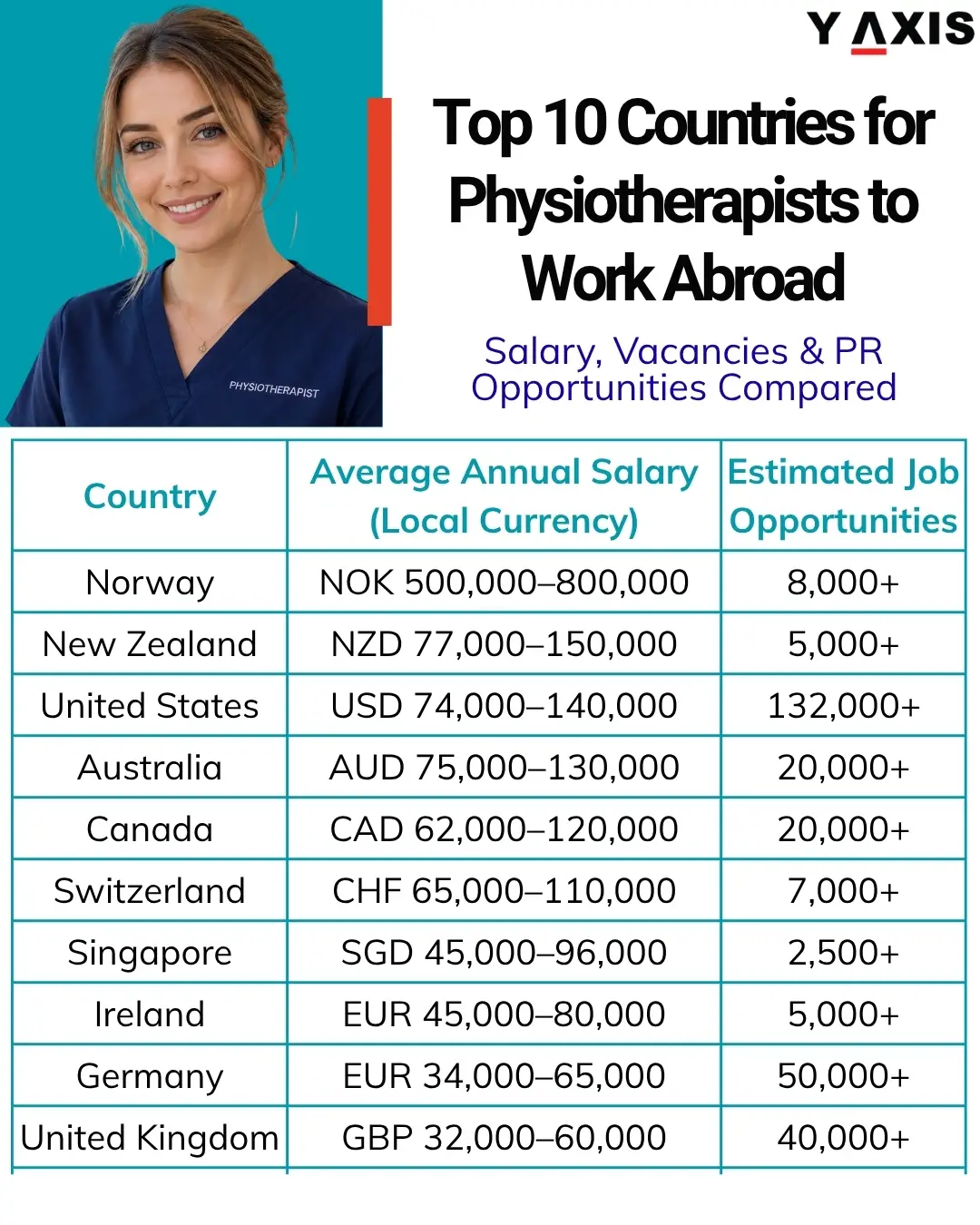
Top 10 Countries for Physiotherapists to Work Abroad: Salary, Demand & PR Opportunities Compared
Top 10 Countries for Physiotherapists to Work Abroad: Salary, Demand & PR Opportunities Compared
The top 10 countries for Physiotherapists to work abroad are Australia, the United States, New Zealand, the United Kingdom, Canada, Ireland, Germany, Switzerland, Norway, and Singapore. Physiotherapists can find high-paying jobs, strong healthcare demand, skilled migration pathways, and long-term settlement opportunities across these destinations.
The global physiotherapy services market is projected to reach USD 90.79 billion by 2033, driven by ageing populations, chronic conditions, sports injuries, and growing rehabilitation and mobility care needs. This growth is expected to create career opportunities for Physiotherapists across hospitals, rehabilitation centres, private clinics, long-term care facilities, community health services, and other major healthcare settings worldwide.
*Want to work abroad? Sign up with Y-Axis Resume Marketing Services to find right job faster.
Benefits of Working Abroad as a Physiotherapist
Working abroad as a Physiotherapist offers higher salaries, strong job demand, better career growth, and opportunities for long-term settlement. Physiotherapists can work across hospitals, rehabilitation centres, private clinics, aged care, and community health services.
- Higher salaries: Earn competitive pay in countries with strong demand for Physiotherapists.
- Growing job opportunities: Access more roles as rehabilitation and mobility care needs increase.
- Better career growth: Build experience in specialised and advanced healthcare settings.
- International work experience: Gain exposure to different healthcare systems and treatment practices.
- PR opportunities: Access skilled migration and permanent residence pathways in eligible countries.
How to Choose the Best Country for Physiotherapist Jobs Abroad?
Choosing the best country for Physiotherapist jobs abroad depends on salary, job demand, licensing requirements, visa options, and long-term settlement opportunities. Physiotherapists should compare these factors before selecting a destination:
- Salary and living costs: Compare expected earnings with housing, taxes, healthcare, and daily expenses.
- Job demand: Check current vacancies and future demand for Physiotherapists.
- Licensing requirements: Review qualification recognition, registration, exams, and language requirements.
- Work visa options: Choose countries with clear employment and skilled migration pathways.
- PR opportunities: Consider eligibility for permanent residence and long-term settlement.
Top 10 Countries for Physiotherapists to Work Abroad
Physiotherapists are in demand across hospitals, rehabilitation centres, aged care, private clinics, and community health services in countries such as Australia, the United States, Canada, New Zealand, and the United Kingdom. Salaries range from around USD 40,000 to more than USD 130,000 annually across major destinations. Healthcare workforce shortages also support work visa, skilled migration, and permanent residence pathways, while professional licensing remains a key requirement for working abroad.
|
Country |
Average Annual Salary (Local Currency) |
Estimated Physiotherapist |
|
Australia |
AUD 75,000–130,000 |
20,000+ |
|
United States |
USD 74,000–140,000 |
132,000+ |
|
New Zealand |
NZD 77,000–150,000 |
5,000+ |
|
United Kingdom |
GBP 32,000–60,000 |
40,000+ |
|
Canada |
CAD 62,000–120,000 |
20,000+ |
|
Ireland |
EUR 45,000–80,000 |
5,000+ |
|
Germany |
EUR 34,000–65,000 |
50,000+ |
|
Switzerland |
CHF 65,000–110,000 |
7,000+ |
|
Norway |
NOK 500,000–800,000 |
8,000+ |
|
Singapore |
SGD 45,000–96,000 |
2,500+ |
*Want to work abroad? Sign up with Y-Axis Resume Marketing Services to find right job faster.
Best Countries for Physiotherapists to Work and Settle Abroad
Physiotherapists planning a long-term career abroad should compare job demand, salaries, licensing requirements, work visa options, and pathways to permanent residence. Canada, Australia, and New Zealand offer skilled migration routes, while the United Kingdom and Ireland provide pathways from employment to long-term residence. Choosing the right country depends on both immediate career opportunities and long-term settlement prospects.
Physiotherapist Jobs in Australia
Physiotherapy is a skilled occupation in Australia, giving overseas Physiotherapists access to several work and migration pathways. Demand comes from aged care, disability services, rehabilitation, hospitals, private practices, community health, and regional healthcare. Australia allows Physiotherapists to apply through points-tested skilled visas, state nomination, regional migration, or employer sponsorship. Skills assessment and professional registration are required before starting clinical practice. Regional employment can provide additional migration opportunities, while some skilled and employer-sponsored routes lead directly to permanent residence and others provide a pathway to PR after working in the country. This range of options supports both long-term healthcare careers and settlement in Australia.
|
Factor |
Details |
|
Physiotherapist Job Market & Estimated Job Opportunities for the Next Decade |
Australia is projected to offer more than 20,000 Physiotherapist job opportunities over the next decade. Demand is expected across aged care, disability services, rehabilitation, hospitals, private clinics, community health, and regional healthcare. |
|
Investment in Healthcare, Aged Care & Disability Services |
Australia spends more than AUD 270 billion annually on healthcare, with funding directed towards public hospitals, aged care, disability support, rehabilitation, and allied health services. The NDIS also supports demand for physiotherapy through disability, mobility, and rehabilitation care. |
|
In-Demand Physiotherapy Roles & Skills |
Demand is high for musculoskeletal, sports, paediatric, neurological rehabilitation, and aged-care Physiotherapists. Key skills include rehabilitation planning, exercise therapy, mobility assessment, pain management, and patient care. |
|
Work Visa Options for Physiotherapists |
Visa options include the Skills in Demand (SID) Visa (Subclass 482), Skilled Independent Visa (Subclass 189), Skilled Nominated Visa (Subclass 190), and Skilled Work Regional Visa (Subclass 491). |
|
Priority Hiring & Recruitment Pathways |
Hospitals, aged-care providers, rehabilitation centres, disability services, and private healthcare organisations recruit Physiotherapists from abroad. Regional and underserved areas provide additional recruitment opportunities. |
|
PR / Long-Term Residence Opportunities |
Physiotherapists can pursue PR through the Subclass 189 and 190 skilled migration routes, employer-sponsored Subclass 186, or the Subclass 491 regional pathway leading to permanent residence. |
|
Registration & Practice Requirements |
Registration with the Australian Health Practitioner Regulation Agency (AHPRA) is required before working as a Physiotherapist in Australia. |
|
Language Requirements |
Physiotherapists must meet the English-language requirements for professional registration and clinical practice. |
|
Eligibility for Dependents |
Skilled visa applicants can include a spouse or partner and dependent children in the visa application, subject to visa requirements. |
|
Benefits for Family Members |
Depending on the visa, family members can receive work rights and access to education and healthcare in Australia. |
*Planning to Work in Australia? Let Y-Axis guide you through every step of the process.
Physiotherapist Jobs in the United States
The United States has a large physiotherapy job market with opportunities in hospitals, outpatient clinics, rehabilitation centres, home healthcare, nursing facilities, and sports medicine. Physiotherapists can also specialise in orthopaedics, neurology, paediatrics, geriatrics, and sports rehabilitation. Internationally trained Physiotherapists complete credential evaluation and obtain a licence in the state where they plan to practise. Healthcare employers can sponsor foreign Physiotherapists through qualifying work visa routes. Employment-based immigration also provides pathways to a Green Card. The size of the US healthcare market, range of clinical specialisations, employer sponsorship, and permanent residence options support long-term career development.
|
Factor |
Details |
|
Physiotherapist Job Market & Estimated Job Opportunities for the Next Decade |
The United States is projected to offer more than 132,000 Physiotherapist job opportunities over the next decade. Demand is expected across outpatient care, home healthcare, hospitals, rehabilitation centres, nursing facilities, and services supporting mobility and recovery for an ageing population. |
|
Investment in Healthcare Sector |
The United States spends more than USD 5 trillion annually on healthcare, supporting hospitals, rehabilitation services, home-based care, digital health, and healthcare workforce development. This investment continues to expand the settings in which Physiotherapists work. |
|
In-Demand Physiotherapy Roles & Skills |
Demand is high for Physiotherapists in orthopaedic rehabilitation, sports therapy, neurological care, geriatric rehabilitation, paediatric care, and home healthcare. Key skills include clinical assessment, exercise therapy, mobility training, and patient rehabilitation. |
|
Work Visa Options for Physiotherapists |
Work options include employer-sponsored visa routes and employment-based immigration pathways available through qualifying healthcare employers. |
|
Priority Hiring & Recruitment Pathways |
Hospitals, outpatient rehabilitation centres, nursing facilities, home healthcare providers, and sports medicine clinics recruit Physiotherapists. Hiring opportunities are also available in areas facing healthcare workforce shortages. |
|
PR / Long-Term Residence Opportunities |
Employer-sponsored employment-based immigration can provide a pathway to a Green Card, depending on the job, immigration category, and sponsorship route. |
|
Registration & Practice Requirements |
Internationally trained Physiotherapists must meet US education and credential requirements, pass the National Physical Therapy Examination (NPTE), and obtain a licence in the state where they plan to practise. |
|
Language Requirements |
English proficiency is required for education, licensing examinations, and clinical practice in the United States. |
|
Eligibility for Dependents |
Spouses and dependent children can accompany the primary visa holder under qualifying visa categories. |
|
Benefits for Family Members |
Depending on the immigration category, family members can access education, healthcare, and work rights in the United States. |
*Want to work in the United States? Get expert guidance from Y-Axis professionals.
Physiotherapist Jobs in New Zealand
Physiotherapists are needed across New Zealand’s public hospitals, private practices, rehabilitation services, aged care, community health, and rural healthcare. Workforce needs outside major cities also create opportunities in regional areas. Overseas-trained Physiotherapists must register with the Physiotherapy Board and obtain an Annual Practising Certificate before working. A job with an accredited employer can support the required work visa, connecting healthcare recruitment with the immigration process. Skilled residence pathways also provide options for long-term settlement. New Zealand combines healthcare demand, accredited employer recruitment, regional job opportunities, and residence pathways for Physiotherapists planning to build a career and settle abroad.
|
Factor |
Details |
|
Physiotherapist Job Market & Estimated Job Opportunities for the Next Decade |
New Zealand is projected to offer more than 5,000 Physiotherapist job opportunities over the next decade. Demand is expected across rehabilitation, injury recovery, aged care, community health, sports rehabilitation, and regional healthcare services. |
|
Investment in Healthcare Sector |
Healthcare investment supports hospitals, rehabilitation, disability services, digital health, and workforce development, with funding focused on improving access to care across cities and regional communities. |
|
In-Demand Physiotherapy Roles & Skills |
Demand is high for Physiotherapists in musculoskeletal therapy, sports rehabilitation, neurological care, injury recovery, paediatric care, and aged-care rehabilitation. Key skills include exercise therapy, mobility assessment, rehabilitation planning, and patient management. |
|
Work Visa Options for Physiotherapists |
The Accredited Employer Work Visa (AEWV) is a key route for Physiotherapists with a qualifying job offer. Other skilled migration pathways may also support work and residence in New Zealand. |
|
Priority Hiring & Recruitment Pathways |
Hospitals, rehabilitation centres, private practices, and community health organisations recruit Physiotherapists from abroad. Accredited employers provide a direct recruitment route, with additional opportunities in regional healthcare. |
|
PR / Long-Term Residence Opportunities |
Physiotherapists can access residence pathways through the Green List and Skilled Migrant Category after meeting the relevant employment, registration, and immigration requirements. |
|
Registration & Practice Requirements |
Registration with the Physiotherapy Board of New Zealand is required before practising as a Physiotherapist in the country. |
|
Language Requirements |
Physiotherapists must meet the English-language requirements for professional registration through accepted tests or recognised qualifications. |
|
Eligibility for Dependents |
Spouses or partners and dependent children can accompany the primary applicant through qualifying visa pathways. |
|
Benefits for Family Members |
Depending on the visa, family members can access work rights, education, and healthcare services in New Zealand. |
Physiotherapist Jobs in the United Kingdom
NHS recruitment is one of the main employment routes for overseas Physiotherapists in the United Kingdom. Jobs are also available in private healthcare, rehabilitation services, community care, sports clinics, and care homes. HCPC registration is required before practising, after which NHS trusts and other licensed healthcare employers can provide visa sponsorship. The Health and Care Worker visa allows sponsored Physiotherapists to live and work in the UK and can lead to Indefinite Leave to Remain after the required period. Access to a large public healthcare system, licensed employer sponsorship, and a defined settlement route support long-term physiotherapy careers in the UK.
|
Factor |
Details |
|
Physiotherapist Job Market & Estimated Job Opportunities for the Next Decade |
The UK is projected to offer more than 40,000 Physiotherapist job opportunities over the next decade. Demand is expected across NHS services, private healthcare, rehabilitation, community care, and services supporting mobility and recovery for an ageing population. |
|
Investment in Healthcare Sector |
The UK invests more than GBP 200 billion annually in the NHS, supporting hospitals, community healthcare, rehabilitation, workforce development, and healthcare modernisation. This funding continues to support demand for Physiotherapists and other allied health roles. |
|
In-Demand Physiotherapy Roles & Skills |
Demand is high for musculoskeletal, neurological rehabilitation, respiratory, paediatric, sports, and geriatric Physiotherapists. Key skills include rehabilitation planning, exercise therapy, mobility assessment, and patient management. |
|
Work Visa Options for Physiotherapists |
The Health and Care Worker Visa is the main route for sponsored healthcare employment. The Skilled Worker Visa and other qualifying employer-sponsored routes may also be available. |
|
Priority Hiring & Recruitment Pathways |
NHS trusts, private hospitals, rehabilitation providers, and community healthcare organisations recruit Physiotherapists from abroad through international recruitment and licensed employer sponsorship. |
|
PR / Long-Term Residence Opportunities |
Physiotherapists can progress towards Indefinite Leave to Remain after completing the required period under a qualifying visa route. |
|
Registration & Practice Requirements |
Registration with the Health and Care Professions Council (HCPC) is required before practising as a Physiotherapist in the UK. |
|
Language Requirements |
Physiotherapists must meet the English-language requirements for HCPC registration through accepted tests or recognised qualifications. |
|
Eligibility for Dependents |
Spouses or partners and dependent children can accompany the primary applicant under qualifying visa routes. |
|
Benefits for Family Members |
Depending on the visa, family members can access work rights, education, and NHS healthcare services in the UK. |
*Want to Work in the United Kingdom? Let Y-Axis guide you through the steps.
Physiotherapist Jobs in Canada
Canada provides Physiotherapists with several routes to combine healthcare employment and permanent residence. Jobs are available in hospitals, rehabilitation centres, long-term care, private clinics, home care, and community health services across the provinces. As physiotherapy is a regulated occupation, internationally trained Physiotherapists must complete credential assessment and meet provincial licensing requirements before practising. Immigration options include Express Entry and Provincial Nominee Programs, while a qualifying job offer can support an employer-specific work permit. Provinces can also nominate Physiotherapists based on local healthcare needs, creating multiple routes to work, obtain permanent residence, and settle in Canada.
|
Factor |
Details |
|
Physiotherapist Job Market & Estimated Job Opportunities for the Next Decade |
Canada is projected to offer more than 20,000 Physiotherapist job opportunities over the next decade. Demand is expected across rehabilitation, long-term care, home healthcare, hospitals, private clinics, and community health, with workforce needs varying by province. |
|
Investment in Healthcare Sector |
Canada has committed nearly CAD 200 billion over 10 years through agreements with provinces and territories to strengthen healthcare delivery, improve access to services, and support healthcare workforce growth. |
|
In-Demand Physiotherapy Roles & Skills |
Demand is high for Physiotherapists in musculoskeletal care, neurological rehabilitation, sports injuries, geriatric rehabilitation, paediatric care, and post-surgical recovery. Key skills include mobility assessment, exercise therapy, rehabilitation planning, and patient care. |
|
Work Visa Options for Physiotherapists |
Work options include employer-specific work permits and provincial healthcare recruitment routes. Express Entry and Provincial Nominee Programs provide immigration pathways that can also support long-term employment and settlement. |
|
Priority Hiring & Recruitment Pathways |
Provincial healthcare recruitment initiatives, employer hiring programmes, and targeted immigration pathways support Physiotherapist recruitment, particularly in provinces facing healthcare workforce shortages. |
|
PR / Long-Term Residence Opportunities |
Physiotherapists can pursue permanent residence through Express Entry and Provincial Nominee Programs, including category-based selection and provincial streams that prioritise healthcare occupations. |
|
Registration & Practice Requirements |
Physiotherapists must register with the regulatory authority in the province or territory where they plan to practise. |
|
Language Requirements |
English or French proficiency may be required through approved tests for professional registration and immigration. |
|
Eligibility for Dependents |
Spouses or partners and dependent children can accompany the primary applicant through qualifying immigration pathways. |
|
Benefits for Family Members |
Depending on immigration status and provincial rules, family members can access work rights, education, and public healthcare coverage in Canada. |
*Want to work in Canada? Get expert guidance from Y-Axis professionals.
Physiotherapist Jobs in Ireland
Ireland has a growing need for Physiotherapists across public healthcare, disability services, rehabilitation, community care, and private healthcare. CORU registration is required for internationally trained Physiotherapists before they can practise in the country. After securing a qualifying job, they can apply through the appropriate employment permit route, with healthcare employers recruiting from abroad for suitable roles. The Critical Skills Employment Permit provides an important route for qualifying applicants and can support a later move to permission to work without an employment permit. Continued legal residence can also lead to long-term residency and citizenship, giving Physiotherapists a structured path from healthcare employment to settlement in Ireland.
|
Factor |
Details |
|
Physiotherapist Job Market & Estimated Job Opportunities for the Next Decade |
Ireland is projected to offer more than 5,000 Physiotherapist job opportunities over the next decade. Demand is expected across public hospitals, community healthcare, rehabilitation, disability services, and private clinics. |
|
Investment in Healthcare Sector |
Ireland allocates more than EUR 27 billion annually to healthcare, supporting hospitals, community care, rehabilitation services, digital health, and healthcare workforce growth. |
|
In-Demand Physiotherapy Roles & Skills |
Demand is high for Physiotherapists in musculoskeletal care, neurological rehabilitation, respiratory therapy, paediatric care, sports injuries, and elderly care. Key skills include rehabilitation planning, mobility assessment, exercise therapy, and patient management. |
|
Work Visa Options for Physiotherapists |
Employment routes include the Critical Skills Employment Permit and General Employment Permit, supported by a qualifying job offer from an Irish employer. |
|
Priority Hiring & Recruitment Pathways |
The Health Service Executive (HSE), hospitals, rehabilitation providers, disability services, and private healthcare organisations recruit Physiotherapists for clinical and community-based roles. |
|
PR / Long-Term Residence Opportunities |
Physiotherapists can progress from qualifying employment permission to long-term residence after meeting the required conditions. Continued legal residence can also support eligibility for Irish citizenship. |
|
Registration & Practice Requirements |
Registration with CORU, Ireland’s regulator for health and social care professionals, is required before practising as a Physiotherapist. |
|
Language Requirements |
Physiotherapists must meet the English-language requirements for professional registration and clinical practice. |
|
Eligibility for Dependents |
Spouses or partners and dependent children can accompany the primary applicant through qualifying employment and residence routes. |
|
Benefits for Family Members |
Depending on their residence permission, family members can access work rights, education, and healthcare services in Ireland. |
Physiotherapist Jobs in Germany
Germany needs Physiotherapists across rehabilitation, elderly care, outpatient treatment, and post-operative recovery as its ageing population increases demand for healthcare services. Jobs are available in hospitals, rehabilitation clinics, care facilities, and private physiotherapy practices. Internationally trained Physiotherapists first complete qualification recognition and meet the German-language requirements for clinical work. Once recognised, they can use a qualifying job to apply for a skilled worker visa and residence permit. Healthcare employers can also recruit Physiotherapists from abroad for suitable roles. After working and living in Germany for the required period, Physiotherapists can progress towards permanent settlement and continue their careers in the country.
|
Factor |
Details |
|
Physiotherapist Job Market & Estimated Job Opportunities for the Next Decade |
Germany is projected to offer more than 50,000 Physiotherapist job opportunities over the next decade. Demand is expected across rehabilitation clinics, outpatient therapy practices, hospitals, elderly care facilities, and services supporting recovery and mobility for an ageing population. |
|
Investment in Healthcare Sector |
Germany spends more than EUR 500 billion annually on healthcare, supporting hospitals, rehabilitation, digital health, healthcare infrastructure, and workforce expansion. This investment continues to support demand for Physiotherapists and other allied health roles. |
|
In-Demand Physiotherapy Roles & Skills |
Demand is high for Physiotherapists in orthopaedic rehabilitation, neurological therapy, sports rehabilitation, geriatric care, post-surgical recovery, and mobility treatment. Key skills include manual therapy, exercise programmes, rehabilitation planning, and patient care. |
|
Work Visa Options for Physiotherapists |
Internationally trained Physiotherapists can use skilled worker residence permits and other employment-based residence routes after meeting professional recognition and job requirements. |
|
Priority Hiring & Recruitment Pathways |
Rehabilitation clinics, hospitals, outpatient therapy centres, and elderly care providers recruit Physiotherapists from abroad, particularly for rehabilitation and patient recovery roles. |
|
PR / Long-Term Residence Opportunities |
Physiotherapists can progress towards permanent residence after meeting the required employment, residence, language, and integration conditions. |
|
Registration & Practice Requirements |
Overseas-trained Physiotherapists must obtain recognition of their professional qualification from the relevant German authority before practising. |
|
Language Requirements |
German-language proficiency is required for professional recognition and patient care, with the required level depending on the state and recognition process. |
|
Eligibility for Dependents |
Spouses or partners and dependent children can accompany the primary applicant through qualifying residence routes. |
|
Benefits for Family Members |
Depending on residence status, family members can access work rights, education, and healthcare coverage in Germany. |
*Want to work in Germany? Get expert guidance from Y-Axis professionals.
Physiotherapist Jobs in Switzerland
Switzerland provides Physiotherapists with opportunities in specialised rehabilitation, private healthcare, sports medicine, hospitals, and elderly care. Its multilingual healthcare system also allows Physiotherapists to work across German-, French-, and Italian-speaking regions. Internationally trained Physiotherapists must complete qualification recognition and meet the language requirements of the canton where they plan to practise. A confirmed job supports the work and residence permit process, with employers involved in international recruitment where applicable. Physiotherapists who continue working and living in Switzerland can later progress towards permanent settlement. The country also provides career opportunities in specialised treatment, advanced rehabilitation, and private healthcare.
|
Factor |
Details |
|
Physiotherapist Job Market & Estimated Job Opportunities for the Next Decade |
Switzerland is projected to offer more than 7,000 Physiotherapist job opportunities over the next decade. Demand is expected across rehabilitation, outpatient therapy, hospitals, sports medicine, elderly care, and post-surgical recovery. |
|
Investment in Healthcare Sector |
Switzerland spends around CHF 90 billion annually on healthcare, supporting hospitals, rehabilitation centres, digital health, medical innovation, and advanced patient care. |
|
In-Demand Physiotherapy Roles & Skills |
Demand is high for Physiotherapists in musculoskeletal rehabilitation, sports injuries, neurological therapy, geriatric care, post-surgical recovery, and mobility treatment. Key skills include manual therapy, exercise programmes, rehabilitation planning, and patient assessment. |
|
Work Visa Options for Physiotherapists |
Work routes include employer-supported permits and residence options such as L and B permits for qualifying foreign workers. |
|
Priority Hiring & Recruitment Pathways |
Hospitals, rehabilitation clinics, private practices, sports medicine centres, and elderly care facilities recruit Physiotherapists, with hiring needs differing across cantons and language regions. |
|
PR / Long-Term Residence Opportunities |
Physiotherapists can progress towards permanent residence through the C Permit after meeting the required residence and integration conditions. |
|
Registration & Practice Requirements |
Internationally trained Physiotherapists must obtain recognition of their professional qualification and meet the applicable practice requirements before working in Switzerland. |
|
Language Requirements |
Physiotherapists must meet the German, French, or Italian language requirements of the canton and workplace where they plan to practise. |
|
Eligibility for Dependents |
Spouses or partners and dependent children can accompany the primary applicant through qualifying residence routes. |
|
Benefits for Family Members |
Depending on residence status, family members can access work rights, education, and healthcare coverage in Switzerland. |
Physiotherapist Jobs in Norway
Norway needs Physiotherapists across hospitals, rehabilitation, elderly care, municipal health services, private clinics, and regional healthcare. Employment opportunities extend beyond major cities, as local healthcare systems provide rehabilitation and patient care across the country. Internationally trained Physiotherapists must obtain professional authorisation and meet the language requirements for clinical work. A qualifying job can support a skilled worker residence permit, allowing them to live and work in Norway. Healthcare organisations can also recruit Physiotherapists from abroad for suitable positions. After meeting the required residence conditions, Physiotherapists can apply for permanent residence and continue building a long-term healthcare career in Norway.
|
Factor |
Details |
|
Physiotherapist Job Market & Estimated Job Opportunities for the Next Decade |
Norway is projected to offer more than 8,000 Physiotherapist job opportunities over the next decade. Demand is expected across municipal healthcare, rehabilitation centres, hospitals, private practices, elderly care, and regional health services. |
|
Investment in Healthcare Sector |
Norway continues to invest in its public healthcare system, supporting municipal health services, rehabilitation, elderly care, digital health, and access to treatment across cities and smaller communities. |
|
In-Demand Physiotherapy Roles & Skills |
Demand is high for Physiotherapists in post-injury and post-surgical rehabilitation, neurological therapy, elderly mobility care, musculoskeletal treatment, and sports rehabilitation. Key skills include exercise therapy, functional assessment, mobility support, and recovery planning. |
|
Work Visa Options for Physiotherapists |
The Skilled Worker Residence Permit is the main employment route for Physiotherapists with a recognised qualification and a qualifying job offer from a Norwegian employer. |
|
Priority Hiring & Recruitment Pathways |
Municipalities, hospitals, rehabilitation centres, and private clinics recruit Physiotherapists for rehabilitation and mobility services. Smaller communities and regional areas also provide employment opportunities. |
|
PR / Long-Term Residence Opportunities |
Physiotherapists can progress towards permanent residence after meeting the required residence, employment, language, and integration conditions. |
|
Registration & Practice Requirements |
Professional authorisation from the Norwegian Directorate of Health is required before working as a Physiotherapist in Norway. |
|
Language Requirements |
Physiotherapists need Norwegian-language skills for patient communication and clinical practice, with employers setting workplace language requirements. |
|
Eligibility for Dependents |
Spouses or partners and dependent children can accompany the primary applicant through qualifying residence routes. |
|
Benefits for Family Members |
Depending on residence status, family members can access work rights, education, and healthcare services in Norway. |
Physiotherapist Jobs in Singapore
Singapore has a well-developed healthcare market for Physiotherapists, with jobs across public and private hospitals, rehabilitation centres, community care, elderly care, and sports medicine. Population ageing and the expansion of rehabilitation services continue to support demand for physiotherapy care. Internationally trained Physiotherapists must obtain professional registration before starting clinical practice. After securing a job, the healthcare employer can sponsor the appropriate work pass, making employer recruitment the main route into the workforce. Physiotherapists can build long-term careers in Singapore and apply for permanent residence after establishing themselves in the country, while gaining experience in one of Asia’s major healthcare markets.
|
Factor |
Details |
|
Physiotherapist Job Market & Estimated Job Opportunities for the Next Decade |
Singapore is projected to offer more than 2,500 Physiotherapist job opportunities over the next decade. Demand is supported by population ageing, rehabilitation needs, community care expansion, sports injuries, and post-surgical recovery. |
|
Investment in Healthcare Sector |
Singapore’s healthcare expenditure is projected to reach SGD 43 billion by 2030, supporting hospital capacity, community care, digital health, rehabilitation services, and healthcare workforce expansion. |
|
In-Demand Physiotherapy Roles & Skills |
Demand covers musculoskeletal rehabilitation, neurological care, geriatric physiotherapy, sports injuries, post-surgical recovery, and community rehabilitation. Key skills include exercise therapy, mobility assessment, rehabilitation planning, and patient management. |
|
Work Visa Options for Physiotherapists |
Employer-sponsored work routes include the Employment Pass and S Pass, depending on the role, salary, and applicable eligibility requirements. |
|
Priority Hiring & Recruitment Pathways |
Public healthcare clusters, private hospitals, rehabilitation centres, community care providers, and sports medicine clinics recruit Physiotherapists, particularly for rehabilitation and elderly care services. |
|
PR / Long-Term Residence Opportunities |
Physiotherapists can apply for permanent residence through the Professionals, Technical Personnel and Skilled Workers scheme after establishing qualifying employment in Singapore. |
|
Registration & Practice Requirements |
Registration with the Allied Health Professions Council is required before practising as a Physiotherapist in Singapore. |
|
Language Requirements |
English is the main working language in healthcare. Mandarin, Malay, or Tamil can also support communication with a wider range of patients. |
|
Eligibility for Dependants |
Employment Pass and qualifying S Pass holders can bring spouses and children through applicable dependant pass routes. |
|
Benefits for Family Members |
Depending on the pass type, family members can access residence and education in Singapore, while employment requires the appropriate work authorisation. |
Job Outlook for Physiotherapists over the Next Decade
The job outlook for Physiotherapists over the next decade is strong, with growing demand across rehabilitation, aged care, disability services, hospitals, private clinics, community health, and home healthcare. Ageing populations, rising chronic conditions, sports injuries, post-surgical recovery, and greater access to rehabilitation services are expected to increase the need for physiotherapy care.
Countries including the United States, Australia, Canada, the United Kingdom, Germany, and New Zealand are projected to offer significant employment opportunities. Growth in digital health, remote rehabilitation, and personalised recovery programmes will also expand physiotherapy roles, while healthcare workforce shortages continue to support international recruitment and migration pathways.
*Want to work abroad? Sign up with Y-Axis Resume Marketing Services to find right job faster.
Apply Now
FAQs
Which country is best for Physiotherapists to work abroad?
Australia, the United States, New Zealand, the UK, and Canada are among the best countries for Physiotherapists seeking jobs abroad. Australia offers several skilled migration routes, the US has the largest job market, New Zealand combines healthcare recruitment with residence options, and the UK provides employer sponsorship through its healthcare system. The best choice depends on licensing, salary, visa options, and long-term settlement plans.
Which country pays Physiotherapists the highest salary?
The United States, Switzerland, Australia, and some specialist healthcare markets offer some of the highest salaries for Physiotherapists. However, salary alone does not determine actual earnings. Income tax, housing costs, healthcare, transport, and other living expenses can significantly affect take-home income. Physiotherapists should compare net salary and living costs before choosing a country for overseas employment.
Which countries have the highest demand for Physiotherapists?
The United States, Australia, Canada, the UK, Germany, and New Zealand have strong demand for Physiotherapists. Recruitment is supported by ageing populations, rehabilitation needs, healthcare workforce shortages, disability services, and expanding community care. Demand is particularly strong in aged care, neurological rehabilitation, musculoskeletal treatment, post-surgical recovery, and regional healthcare services.
Is physiotherapy a good career for working abroad?
Yes. Physiotherapy is a strong career for working abroad because many countries need rehabilitation and mobility services across hospitals, clinics, aged care, sports medicine, and community healthcare. Physiotherapists can access employer-sponsored work routes, skilled migration programmes, and long-term residence options. Professional registration is usually required before clinical practice begins.
Can Physiotherapists get visa sponsorship abroad?
Yes. Hospitals, healthcare groups, rehabilitation providers, aged-care organisations, and other qualifying employers can sponsor Physiotherapists in several countries. The UK, Australia, the United States, and other healthcare markets provide employer-supported work routes. Sponsorship requirements vary by country, and professional registration or qualification recognition is often required before the employment and visa process can be completed.
Which country is easiest for Physiotherapists to immigrate to?
Australia and New Zealand are among the strongest options for Physiotherapists seeking clear skilled migration and residence pathways. The UK also offers a defined route through sponsored healthcare employment. The easiest country depends on age, qualifications, work experience, language ability, professional registration, job offers, and eligibility under current immigration rules.
Which countries offer permanent residence to Physiotherapists?
Australia, New Zealand, Canada, Germany, Norway, and several other countries provide pathways to permanent residence for Physiotherapists. Routes may include skilled migration, employer sponsorship, regional programmes, or residence after a qualifying period of employment. The UK offers a pathway to Indefinite Leave to Remain, while the United States provides employment-based Green Card options.
What qualifications are required to work as a Physiotherapist abroad?
A recognised physiotherapy qualification is the main requirement for working abroad. Most countries also require credential assessment, professional registration, licensing, or qualification recognition before clinical practice. Some destinations require examinations or proof of language proficiency. Requirements depend on the healthcare regulator and licensing system of the country where the Physiotherapist plans to work.
Do Physiotherapists need a licence to work abroad?
Yes. Physiotherapy is a regulated healthcare occupation in most major destinations. Physiotherapists usually need registration, authorisation, or a professional licence before treating patients. Australia requires AHPRA registration, the UK requires HCPC registration, Ireland requires CORU registration, and the United States requires state licensure. The process differs by country.
Which countries accept internationally trained Physiotherapists?
Australia, the United States, New Zealand, the UK, Canada, Ireland, Germany, Switzerland, Norway, and Singapore accept internationally trained Physiotherapists who meet local registration and immigration requirements. Applicants may need qualification recognition, credential assessment, licensing examinations, language tests, or professional registration before starting clinical work.
Can Physiotherapists work abroad without experience?
It may be possible to work abroad with limited experience, but many employers and immigration pathways prefer applicants with relevant clinical experience. Recent graduates must still meet the destination country’s registration and licensing requirements. Experience in rehabilitation, aged care, hospitals, community health, or specialised physiotherapy can improve access to overseas jobs and employer sponsorship.
What are the best work visas for Physiotherapists?
Common routes include employer-sponsored healthcare visas, skilled worker visas, regional migration programmes, and points-tested skilled migration. Australia offers skilled and employer-sponsored visas, the UK has the Health and Care Worker visa, New Zealand uses accredited employer routes, and Germany provides skilled worker residence permits. The best route depends on the destination and job offer.
How much can Physiotherapists earn abroad?
Physiotherapist salaries abroad vary widely by country. Annual earnings can range from around GBP 32,000–60,000 in the UK and AUD 75,000–130,000 in Australia to USD 74,000–140,000 in the United States. Switzerland also offers high salaries, although living costs are higher. Experience, specialisation, location, and healthcare setting affect earnings.
What physiotherapy specialisations are most in demand abroad?
Musculoskeletal physiotherapy, neurological rehabilitation, geriatric care, sports rehabilitation, paediatric physiotherapy, respiratory care, and post-surgical recovery are widely in demand. Ageing populations are increasing the need for mobility and elderly care, while hospitals and rehabilitation centres continue to recruit Physiotherapists for injury recovery and long-term rehabilitation.
Is Australia a good country for Physiotherapists?
Yes. Australia offers strong demand for Physiotherapists across aged care, disability services, rehabilitation, hospitals, private clinics, and regional healthcare. Physiotherapy is also linked to several migration pathways, including points-tested visas, state nomination, regional routes, and employer sponsorship. Some pathways can lead directly or progressively to permanent residence.
Is the United States a good country for Physiotherapists?
Yes. The United States has one of the world’s largest physiotherapy job markets, with opportunities in hospitals, outpatient clinics, rehabilitation, home healthcare, nursing facilities, and sports medicine. Physiotherapists can also specialise in orthopaedics, neurology, paediatrics, and geriatrics. International applicants must meet credential and state licensing requirements before practising.
Is New Zealand a good country for Physiotherapists?
Yes. New Zealand offers physiotherapy jobs across hospitals, rehabilitation, private practices, aged care, community health, and regional services. Internationally trained Physiotherapists must complete professional registration before working. Employment with an accredited employer can support the work visa process, while qualifying residence pathways provide options for long-term settlement.
Can Physiotherapists move abroad with their families?
Yes. Many skilled worker and employer-sponsored visa routes allow Physiotherapists to bring a spouse or partner and dependent children. Family rights depend on the country and visa type. These may include work rights for spouses, school access for children, healthcare coverage, and eligibility for long-term residence.
How long does it take to become licensed as a Physiotherapist abroad?
The licensing process can take several months or longer, depending on the country and the applicant’s qualifications. Credential assessment, document verification, examinations, language tests, and registration reviews can affect processing time. Starting the professional recognition process before applying for jobs can reduce delays in moving abroad.
Is it worth moving abroad for Physiotherapist jobs?
Moving abroad can be worthwhile for Physiotherapists seeking higher salaries, specialised clinical experience, employer sponsorship, or permanent residence. The best destination depends on salary after tax, cost of living, licensing requirements, visa options, healthcare system, and long-term goals. Comparing the complete employment and migration pathway is more useful than choosing a country based only on salary.
Posted on July 10 2026
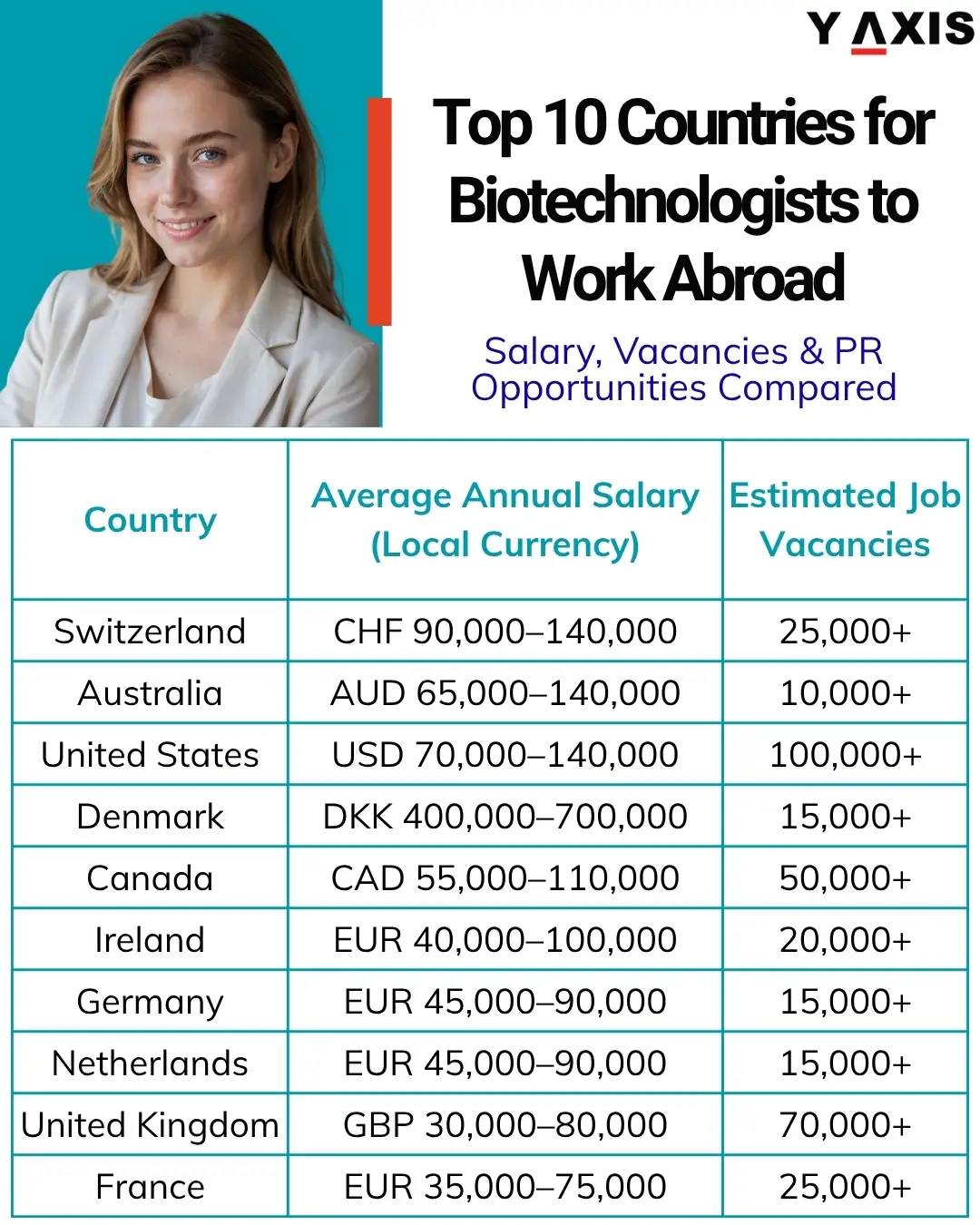
Top 10 Countries for Biotechnologists to Work Abroad: Salary, Demand & PR Opportunities Compared
Top 10 Countries for Biotechnologists to Work Abroad: Salary, Demand & PR Opportunities Compared
The best countries for Biotechnologists to work abroad are Canada, the United States, Germany, the United Kingdom, Switzerland, Australia, Ireland, the Netherlands, Denmark, and France. These countries offer high-paying biotechnology jobs, strong demand for biotechnology skills, employer-sponsored work visas, and permanent residency or long-term settlement pathways.
Biotechnologists are increasingly needed in biopharmaceuticals, drug discovery, genetic engineering, bioinformatics, clinical research, and biomanufacturing. The global biotechnology market is projected to reach USD 4.41 trillion by 2031, driven by advances in precision medicine, gene and cell therapies, biologics, synthetic biology, and AI-enabled drug discovery.
*Want to work abroad? Sign up with Y-Axis Resume Marketing Services to find right job faster.
Why Work Abroad as a Biotechnologist?
Working abroad offers Biotechnologists higher salaries, strong job demand, access to advanced research facilities, and career opportunities in leading global biotechnology markets.
- Global biotech market to reach USD 4.41 trillion by 2031
- Higher salaries in major biotech hubs
- Access to advanced laboratories and research funding
- Jobs in genomics, biologics, and biomanufacturing
- Work visa and long-term settlement pathways
How to Choose the Right Country for Biotechnologist Jobs Abroad?
The right country for Biotechnologist jobs abroad depends on job demand, salary, biotechnology specialisation, work visa options, and long-term residence pathways. Comparing these factors helps identify the country that best matches your career goals and migration plans.
- Specialisation: Match your field with the country’s biotechnology strengths.
- Salary: Compare pay with taxes and living costs.
- Job demand: Check vacancies for your exact biotechnology role.
- Visa options: Review work visa and employer sponsorship routes.
- PR pathways: Compare permanent residence options and timelines.
- Job requirements: Check degree, experience, and technical skill requirements.
Top 10 Countries for Biotechnologists to Work Abroad
Biotechnologists can find high-paying jobs and strong career opportunities across major biotechnology and life sciences markets. In leading destinations, annual salaries can exceed CAD 150,000, while countries such as Canada, the United States, Germany, and Switzerland offer strong demand across biopharmaceuticals, drug discovery, genomics, bioinformatics, clinical research, and biomanufacturing, along with work visa and long-term settlement pathways.
|
Country |
Average Annual Salary (Local Currency) |
Estimated Biotechnologist Job vacancies |
|
Canada |
CAD 55,000–110,000 |
50,000+ |
|
United States |
USD 70,000–140,000 |
100,000+ |
|
United Kingdom |
GBP 30,000–80,000 |
70,000+ |
|
Germany |
EUR 45,000–90,000 |
15,000+ |
|
Switzerland |
CHF 90,000–140,000 |
25,000+ |
|
Australia |
AUD 65,000–140,000 |
10,000+ |
|
Ireland |
EUR 40,000–100,000 |
20,000+ |
|
Netherlands |
EUR 45,000–90,000 |
15,000+ |
|
Denmark |
DKK 400,000–700,000 |
15,000+ |
|
France |
EUR 35,000–75,000 |
25,000+ |
*Want to work abroad? Sign up with Y-Axis Resume Marketing Services to find right job faster.
Best Countries for Biotechnologists to Work and Settle Abroad
Biotechnologists can find strong career and settlement opportunities in countries with established biotechnology industries, sustained demand for life sciences talent, and long-term immigration pathways. Canada, Australia, Germany, the United Kingdom, Ireland, and the Netherlands combine biotechnology jobs with permanent residency or long-term settlement options, while the United States and Switzerland stand out for larger research ecosystems and higher salaries.
Biotechnologist Jobs in Canada
Canada offers a strong job market for Biotechnologists, supported by growth in biomanufacturing, pharmaceutical research, genomics, and advanced therapies. Toronto, Vancouver, and Montreal are the main life sciences hubs, where hiring spans clinical research, bioinformatics, quality assurance, regulatory affairs, and process development. Investment in vaccine production, biologics manufacturing, cell and gene therapies, and precision medicine is also expanding the range of industry roles. As commercial-scale biomanufacturing grows, demand is increasing for Biotechnologists who can contribute to research, product development, production, quality control, and regulatory compliance.
|
Factor |
Details |
|
Biotechnologist Job Market & Job Vacancies for the Next Decade |
Canada’s biotechnology sector is expected to create more than 50,000 new jobs over the next decade, driven by growth in biopharmaceuticals, biomanufacturing, genomics, bioinformatics, and cell and gene therapies. |
|
Investment in Biotechnology & Life Sciences |
Canada has committed more than CAD 2.2 billion to its Biomanufacturing and Life Sciences Strategy, supporting research, vaccine and therapeutics development, and domestic biomanufacturing. |
|
In-Demand Biotechnology Roles & Skills |
Research scientists, bioprocess specialists, bioinformatics specialists, quality assurance specialists, and regulatory affairs associates; key skills include molecular biology, genomics, data analysis, and bioprocessing. |
|
Work Visa Options for Biotechnologists |
Temporary Foreign Worker Program (TFWP), International Mobility Program (IMP), Express Entry, Provincial Nominee Programs (PNPs), and Atlantic Immigration Program. |
|
Fast-Track Hiring Options |
Global Talent Stream for qualifying occupations, employer-specific work permits, and Provincial Nominee Programs. |
|
PR / Long-Term Residence Opportunities |
Express Entry, Canadian Experience Class, Provincial Nominee Programs, and Atlantic Immigration Program. |
|
Education & Qualification Requirements |
A bachelor’s or master’s degree in biotechnology, biology, biochemistry, microbiology, or bioinformatics; a PhD is typically required for research scientist, senior scientist, and specialised R&D roles. |
|
Eligibility for Dependents |
Spouses or partners and dependent children can accompany the primary applicant. |
|
Benefits for Family Members |
Spouse work rights, public education for children, and access to provincial healthcare where coverage requirements are met. |
*Want to work in Canada? Get expert guidance from Y-Axis professionals.
Biotechnologist Jobs in the United States
The United States has the world’s largest biotechnology market, offering extensive career opportunities in drug discovery, genetic engineering, synthetic biology, personalised medicine, and agricultural biotechnology. Boston-Cambridge, the San Francisco Bay Area, San Diego, and the Research Triangle are major centres for biotechnology employment and innovation.
Strong venture capital funding and continuous research investment support hiring across established pharmaceutical companies, research laboratories, and biotechnology start-ups. Emerging fields such as CRISPR-based therapies, computational biology, and AI-driven drug discovery are also creating specialised roles for Biotechnologists with advanced scientific and data skills.
|
Factor |
Details |
|
Biotechnologist Job Market & Job Vacancies for the Next Decade |
The United States is expected to offer more than 100,000 job opportunities for Biotechnologists over the next decade, driven by growth in drug discovery, biopharmaceuticals, genomics, bioinformatics, and cell and gene therapies. |
|
Investment in Biotechnology & Life Sciences |
The United States invests more than USD 48 billion annually through the National Institutes of Health, supporting biomedical research, genomics, drug discovery, and biotechnology innovation. |
|
In-Demand Biotechnology Roles & Skills |
Research scientists, bioinformatics scientists, bioprocess engineers, clinical scientists, and quality specialists; key skills include molecular biology, genomics, cell culture, data analysis, and bioprocessing. |
|
Work Visa Options for Biotechnologists |
H-1B Visa, O-1 Visa, L-1 Visa, and employment-based immigrant visas. |
|
Fast-Track Hiring Options |
O-1 Visa for individuals with extraordinary ability and premium processing for qualifying employment-based petitions. |
|
PR / Long-Term Residence Opportunities |
Employment-based Green Card pathways through EB-1, EB-2, and EB-3 categories. |
|
Education & Qualification Requirements |
A bachelor’s or master’s degree in biotechnology, molecular biology, biochemistry, microbiology, or bioinformatics; a PhD is typically required for senior scientist and specialised R&D roles. |
|
Eligibility for Dependents |
Spouses and dependent children can accompany the primary visa holder. |
|
Benefits for Family Members |
School access for children and spouse work rights under qualifying dependent visa categories. |
*Want to work in the United States? Get expert guidance from Y-Axis professionals.
Biotechnologist Jobs in the United Kingdom
The UK biotechnology job market is closely linked to its world-class universities, research institutions, and rapidly growing life sciences companies. The London–Oxford–Cambridge Golden Triangle is the main centre for biotechnology employment, particularly in drug development, diagnostics, genomics, and medical biotechnology. University spin-outs and research partnerships play a major role in turning scientific discoveries into new therapies and commercial products. Biotechnologists are also benefiting from growth in bioinformatics and data-led life sciences, where employers increasingly need expertise that combines biological research with computational and analytical skills.
|
Factor |
Details |
|
Biotechnologist Job Market & Job Vacancies for the Next Decade |
The UK life sciences sector is expected to create more than 70,000 new jobs over the next decade, driven by growth in biopharmaceuticals, medical technology, genomics, and data-led life sciences. |
|
Investment in Biotechnology & Life Sciences |
The UK has committed up to GBP 600 million to strengthen health data research infrastructure, supporting drug discovery, clinical research, genomics, and life sciences innovation. |
|
In-Demand Biotechnology Roles & Skills |
Research scientists, bioinformatics specialists, bioprocess engineers, clinical research scientists, and regulatory affairs specialists; key skills include molecular biology, genomics, data analysis, drug development, and bioprocessing. |
|
Work Visa Options for Biotechnologists |
Skilled Worker Visa, Global Talent Visa, Scale-up Worker Visa, High Potential Individual Visa, and employer-sponsored work visas. |
|
Fast-Track Hiring Options |
Global Talent Visa for recognised research and innovation talent, and Skilled Worker Visa sponsorship from approved employers. |
|
PR / Long-Term Residence Opportunities |
Indefinite Leave to Remain (ILR) through qualifying Skilled Worker and Global Talent routes after completing the required residence period. |
|
Education & Qualification Requirements |
A bachelor’s or master’s degree in biotechnology, molecular biology, biochemistry, microbiology, or bioinformatics; a PhD is typically required for senior research and specialised R&D roles. |
|
Eligibility for Dependents |
Spouses or partners and dependent children can accompany the primary applicant under qualifying visa routes. |
|
Benefits for Family Members |
Spouse work rights, access to public education for children, and NHS healthcare after payment of the Immigration Health Surcharge or through an exemption. |
*Want to Work in the United Kingdom? Let Y-Axis guide you through the steps.
Biotechnologist Jobs in Germany
Germany offers a strong employment market for Biotechnologists, particularly in industrial biotechnology, pharmaceutical production, molecular biology, and medical research. Munich, Berlin, Heidelberg, and the Rhine-Neckar region are major centres for biotechnology companies and scientific research.
The country’s strength in engineering and advanced manufacturing also creates opportunities at the intersection of biology and industrial production, including fermentation, enzyme technology, and sustainable bio-based processes. Close collaboration between research institutes and industry supports the development of new medicines, diagnostics, chemicals, and biological products, creating career options in both applied research and commercial biotechnology.
|
Factor |
Details |
|
Biotechnologist Job Market & Job Vacancies for the Next Decade |
Germany is expected to offer more than 15,000 job opportunities for Biotechnologists over the next decade, driven by demand across biopharmaceuticals, industrial biotechnology, molecular biology, and medical research. |
|
Investment in Biotechnology & Life Sciences |
Germany attracted approximately EUR 2 billion in biotechnology investment, a 70% annual increase, supporting cancer therapies, drug development, personalised medicine, and biotechnology R&D. |
|
In-Demand Biotechnology Roles & Skills |
Research scientists, bioprocess engineers, molecular biologists, bioinformatics specialists, and quality assurance specialists; key skills include molecular biology, fermentation, bioprocessing, genomics, and data analysis. |
|
Work Visa Options for Biotechnologists |
EU Blue Card, Skilled Worker Visa, Opportunity Card, and employer-sponsored work visas. |
|
Fast-Track Hiring Options |
Accelerated Skilled Worker Procedure for faster qualification recognition and visa processing. |
|
PR / Long-Term Residence Opportunities |
EU Blue Card holders can qualify for permanent residence after 21 months with B1 German or 27 months with A1 German. |
|
Education & Qualification Requirements |
A bachelor’s or master’s degree in biotechnology, biology, biochemistry, microbiology, or bioinformatics; a PhD is typically required for senior scientist and specialised R&D roles. |
|
Eligibility for Dependents |
Spouses and dependent children can accompany the primary applicant. |
|
Benefits for Family Members |
Spouse work rights, public education for children, and public healthcare coverage. |
*Want to work in Germany? Get expert guidance from Y-Axis professionals.
Biotechnologist Jobs in Switzerland
Switzerland is a major destination for Biotechnologists seeking careers in pharmaceutical and biotechnology research. Basel is the country’s largest life sciences hub, while Zurich, Lausanne, and Geneva also support jobs in biomedical research and emerging biotechnology fields. Much of the hiring is concentrated in high-value areas such as drug discovery, oncology, immunology, personalised medicine, and advanced therapeutics.
The presence of global pharmaceutical companies and specialised biotech firms creates opportunities to work on complex research programmes and new treatment pipelines, making Switzerland particularly attractive for Biotechnologists with specialised scientific expertise and advanced research experience.
|
Factor |
Details |
|
Biotechnologist Job Market & Job Vacancies for the Next Decade |
Switzerland is expected to offer more than 25,000 job opportunities for Biotechnologists over the next decade, supported by growth in drug discovery, biologics, precision medicine, and advanced therapeutics. |
|
Investment in Biotechnology & Life Sciences |
Swiss biotech companies raised CHF 2.6 billion in funding and invested CHF 2.5 billion in R&D, supporting drug development, clinical research, and biotechnology innovation. |
|
In-Demand Biotechnology Roles & Skills |
Research scientists, bioprocess specialists, bioinformatics specialists, clinical scientists, and regulatory affairs specialists; key skills include molecular biology, drug discovery, genomics, data analysis, and bioprocessing. |
|
Work Visa Options for Biotechnologists |
Permit L for short-term employment and Permit B for longer-term employment; EU/EFTA nationals follow free-movement rules, while non-EU/EFTA nationals require employer sponsorship. |
|
Fast-Track Hiring Options |
Employer-sponsored permits for highly qualified specialists and intra-company transfers for employees moving within multinational companies. |
|
PR / Long-Term Residence Opportunities |
Permit C provides permanent residence, generally after 10 years of residence; earlier eligibility applies to some nationalities and qualifying cases. |
|
Education & Qualification Requirements |
A bachelor’s or master’s degree in biotechnology, molecular biology, biochemistry, microbiology, or bioinformatics; a PhD is typically required for senior scientist and specialised R&D roles. |
|
Eligibility for Dependents |
Spouses or partners and dependent children can join the primary permit holder through family reunification. |
|
Benefits for Family Members |
Spouse work rights, public education for children, and access to Switzerland’s mandatory health insurance system. |
Biotechnologist Jobs in Australia
Australia’s biotechnology job market spans medical research, agricultural biotechnology, environmental science, and emerging areas of healthcare innovation. Melbourne and Sydney lead the sector, supported by major research precincts, universities, hospitals, and biotechnology companies, while Brisbane is gaining importance in biomedical innovation.
The country’s strong research base creates roles in areas such as immunology, stem cell research, diagnostics, crop biotechnology, and marine biosciences. A growing focus on translating laboratory discoveries into practical treatments and technologies also creates opportunities for Biotechnologists to contribute to clinical development, commercialisation, and research with real-world applications.
|
Factor |
Details |
|
Biotechnologist Job Market & Job Vacancies for the Next Decade |
Australia is expected to offer more than 10,000 job opportunities for Biotechnologists over the next decade, driven by growth in medical biotechnology, biopharmaceuticals, agricultural biotechnology, and translational research. |
|
Investment in Biotechnology & Life Sciences |
Australia has committed AUD 1.7 billion over 10 years to innovation, science, and digital capabilities, supporting biotechnology research, commercialisation, and advanced technologies. |
|
In-Demand Biotechnology Roles & Skills |
Research scientists, molecular biologists, bioinformatics specialists, clinical research scientists, and bioprocess specialists; key skills include molecular biology, genomics, data analysis, laboratory research, and bioprocessing. |
|
Work Visa Options for Biotechnologists |
Skills in Demand Visa (Subclass 482), Skilled Independent Visa (189), Skilled Nominated Visa (190), Employer Nomination Scheme (186), and Skilled Work Regional Visa (491). |
|
Fast-Track Hiring Options |
Employer-sponsored visas and state or territory nomination for Biotechnologists on applicable skilled occupation lists. |
|
PR / Long-Term Residence Opportunities |
Points-based PR pathways (189/190), employer-sponsored PR (186), and regional pathways (491 → PR). |
|
Education & Qualification Requirements |
A bachelor’s or master’s degree in biotechnology, molecular biology, biochemistry, microbiology, or bioinformatics; a PhD is typically required for senior scientist and specialised R&D roles. |
|
Eligibility for Dependents |
Spouses or partners and dependent children can accompany the primary applicant. |
|
Benefits for Family Members |
Spouse work rights, public education for children, and Medicare access under qualifying visa or residence status. |
*Planning to Work in Australia? Let Y-Axis guide you through every step of the process.
Biotechnologist Jobs in Ireland
Ireland has become a major European centre for biopharmaceutical production, creating strong demand for Biotechnologists across biologics, vaccines, cell therapies, and pharmaceutical operations. Dublin, Cork, Limerick, and Galway are key employment locations, supported by large manufacturing sites and continued investment from global life sciences companies.
Hiring is particularly active in upstream and downstream processing, validation, technology transfer, and manufacturing science. Ireland’s concentration of advanced production facilities makes it especially attractive for Biotechnologists who want to move beyond laboratory research into large-scale development and production of complex biological medicines.
|
Factor |
Details |
|
Biotechnologist Job Market & Job Vacancies for the Next Decade |
Ireland is expected to offer more than 20,000 job opportunities for Biotechnologists over the next decade, driven by growth in biologics manufacturing, biopharmaceutical production, cell therapies, and pharmaceutical R&D. |
|
Investment in Biotechnology & Life Sciences |
Ireland has attracted more than EUR 15 billion in biopharma foreign direct investment, supporting biologics manufacturing, pharmaceutical production, R&D, and new life sciences facilities. |
|
In-Demand Biotechnology Roles & Skills |
Bioprocess scientists, research scientists, validation specialists, manufacturing scientists, and quality specialists; key skills include bioprocessing, cell culture, validation, technology transfer, and GMP compliance. |
|
Work Visa Options for Biotechnologists |
Critical Skills Employment Permit, General Employment Permit, Intra-Company Transfer Employment Permit, and Hosting Agreement for Researchers. |
|
Fast-Track Hiring Options |
Critical Skills Employment Permit for qualifying scientific roles and Hosting Agreement for researchers. |
|
PR / Long-Term Residence Opportunities |
Stamp 4 after 21 months under a Critical Skills Employment Permit or Hosting Agreement, or after 57 months under a General Employment Permit. |
|
Education & Qualification Requirements |
A bachelor’s or master’s degree in biotechnology, biochemistry, microbiology, molecular biology, or bioprocessing; a PhD is typically required for senior scientist and specialised R&D roles. |
|
Eligibility for Dependents |
Spouses or partners and dependent children can join the primary applicant under qualifying immigration routes. |
|
Benefits for Family Members |
Spouse work rights, public education for children, and access to public healthcare services. |
Biotechnologist Jobs in the Netherlands
The Netherlands offers a highly connected biotechnology job market, with Leiden, Amsterdam, Utrecht, and Wageningen serving as major centres for life sciences research and innovation. Leiden Bio Science Park supports a large concentration of companies working in therapeutics and drug development, while Wageningen is internationally recognised for agricultural and food biotechnology.
Career opportunities also extend into regenerative medicine, diagnostics, and microbiology. The country’s close network of universities, research centres, start-ups, and established companies makes it easier for scientific discoveries to move into practical applications, supporting varied career paths for Biotechnologists.
|
Factor |
Details |
|
Biotechnologist Job Market & Job Vacancies for the Next Decade |
The Netherlands is expected to offer more than 15,000 job opportunities for Biotechnologists over the next decade, driven by growth in biopharmaceuticals, regenerative medicine, agricultural biotechnology, and diagnostics. |
|
Investment in Biotechnology & Life Sciences |
The Netherlands has committed EUR 1.3 billion to strengthen its biotechnology sector through 2040, supporting research, infrastructure, commercialisation, and biotechnology innovation. |
|
In-Demand Biotechnology Roles & Skills |
Research scientists, molecular biologists, bioinformatics specialists, bioprocess specialists, and regenerative medicine scientists; key skills include molecular biology, genomics, cell culture, data analysis, and bioprocessing. |
|
Work Visa Options for Biotechnologists |
Highly Skilled Migrant Permit, EU Blue Card, Intra-Corporate Transferee Permit, and employer-sponsored work permits. |
|
Fast-Track Hiring Options |
Highly Skilled Migrant Scheme through an IND-recognised sponsor, with streamlined residence permit processing. |
|
PR / Long-Term Residence Opportunities |
Permanent residence after 5 years of continuous legal residence and meeting income and civic integration requirements. |
|
Education & Qualification Requirements |
A bachelor’s or master’s degree in biotechnology, molecular biology, biochemistry, microbiology, or bioinformatics; a PhD is typically required for senior scientist and specialised R&D roles. |
|
Eligibility for Dependents |
Spouses or partners and dependent children can accompany the primary applicant. |
|
Benefits for Family Members |
Spouse work rights, public education for children, and access to the Dutch healthcare system through mandatory health insurance. |
Biotechnologist Jobs in Denmark
Denmark stands out for biotechnology careers linked to enzymes, fermentation, biosolutions, and sustainable production. Copenhagen and the wider Medicon Valley region are major employment centres, while Denmark’s strong industrial bioscience sector creates roles in developing biological alternatives for food, agriculture, energy, and manufacturing.
Biotechnologists are particularly sought for microbial research, strain development, fermentation technology, and the use of enzymes in commercial products. The country’s shift towards a bio-based economy is also expanding career opportunities in areas where biotechnology is used to reduce waste, improve resource efficiency, and develop more sustainable industrial processes.
|
Factor |
Details |
|
Biotechnologist Job Market & Job Vacancies for the Next Decade |
Denmark is expected to offer more than 15,000 job opportunities for Biotechnologists over the next decade, driven by growth in biopharmaceuticals, enzymes, fermentation, biosolutions, and sustainable biotechnology. |
|
Investment in Biotechnology & Life Sciences |
Denmark’s life sciences companies invest nearly DKK 16 billion annually in R&D, supporting drug development, biotechnology research, enzymes, and advanced biological solutions. |
|
In-Demand Biotechnology Roles & Skills |
Research scientists, fermentation scientists, bioprocess specialists, microbiologists, and enzyme specialists; key skills include microbial biotechnology, fermentation, strain development, bioprocessing, and molecular biology. |
|
Work Visa Options for Biotechnologists |
Positive List for People with a Higher Education, Pay Limit Scheme, Fast-track Scheme, and Researcher Scheme. |
|
Fast-Track Hiring Options |
Fast-track Scheme through SIRI-certified employers and the Positive List for occupations facing labour shortages. |
|
PR / Long-Term Residence Opportunities |
Permanent residence generally after 8 years of legal residence, or after 4 years when all supplementary requirements are met. |
|
Education & Qualification Requirements |
A bachelor’s or master’s degree in biotechnology, microbiology, biochemistry, molecular biology, or biochemical engineering; a PhD is typically required for senior scientist and specialised R&D roles. |
|
Eligibility for Dependents |
Spouses or partners and dependent children can accompany the primary applicant. |
|
Benefits for Family Members |
Spouse work rights, public education for children, and access to Denmark’s public healthcare system after registration. |
Biotechnologist Jobs in France
France has a diverse biotechnology job market built around healthcare innovation, scientific research, and a growing network of biotech companies. Paris, Lyon, Strasbourg, and Toulouse are important employment centres, with opportunities in immunotherapy, infectious diseases, diagnostics, microbiology, and rare disease research. The country’s major public research institutions also contribute to the development of new medicines and biotechnology applications.
Growth in specialised biotech companies is creating more career options beyond academic research, particularly for Biotechnologists involved in preclinical development, biomarker discovery, laboratory technologies, and the early-stage development of new therapies.
|
Factor |
Details |
|
Biotechnologist Job Market & Job Vacancies for the Next Decade |
France is expected to offer more than 20,000 job opportunities for Biotechnologists over the next decade, driven by growth in biopharmaceuticals, immunotherapy, diagnostics, microbiology, and advanced therapies. |
|
Investment in Biotechnology & Life Sciences |
France has committed EUR 7.5 billion under France 2030 to health innovation, supporting biotherapies, biomanufacturing, infectious diseases, medical technologies, and digital health. |
|
In-Demand Biotechnology Roles & Skills |
Research scientists, molecular biologists, bioprocess specialists, clinical research scientists, and bioinformatics specialists; key skills include molecular biology, immunology, genomics, cell culture, and data analysis. |
|
Work Visa Options for Biotechnologists |
Talent Passport, Researcher Talent Passport, EU Blue Card, and employer-sponsored work permits. |
|
Fast-Track Hiring Options |
Talent Passport for highly qualified employees and Researcher Talent Passport for scientists with a hosting agreement. |
|
PR / Long-Term Residence Opportunities |
Long-term resident status after 5 years of continuous legal residence and meeting income, integration, and language requirements. |
|
Education & Qualification Requirements |
A bachelor’s or master’s degree in biotechnology, molecular biology, biochemistry, microbiology, or bioinformatics; a PhD is typically required for senior scientist and specialised R&D roles. |
|
Eligibility for Dependents |
Spouses or partners and dependent children can accompany the primary applicant. |
|
Benefits for Family Members |
Spouse work rights, public education for children, and access to France’s public healthcare system. |
Job Outlook for Biotechnologists over the Next Decade
The job outlook for Biotechnologists over the next decade is highly positive due to expansion of biotechnology across healthcare, pharmaceuticals, agriculture, food production, and environmental science. Growth in biologics, cell and gene therapies, genomics, bioinformatics, and biomanufacturing is increasing demand for biotechnology expertise worldwide. Canada alone is expected to create more than 50,000 biotechnology and pharmaceutical jobs, while major life sciences markets across Europe, North America, and Asia-Pacific continue to expand.
Hiring will be particularly strong in research and development, bioprocessing, quality assurance, regulatory affairs, and computational biology. Biotechnologists with expertise in molecular biology, genomics, data analysis, automation, and commercial-scale production will have the strongest international career prospects.
*Want to work abroad? Sign up with Y-Axis Resume Marketing Services to find right job faster.
Apply Now
FAQs
Which country is best for Biotechnologists to work abroad?
Canada is best for job opportunities and PR pathways, Switzerland for high salaries and pharmaceutical R&D, Ireland for biopharmaceutical manufacturing, Germany for industrial biotechnology, and Denmark for enzymes, fermentation, and biosolutions.
Which country pays the highest salary for Biotechnologists?
Switzerland generally offers the highest salaries among the countries compared, with Biotechnologists earning around CHF 90,000–140,000 annually. The United States also offers high salaries, particularly in drug discovery, bioinformatics, genomics, and biopharmaceutical R&D.
Which country has the highest demand for Biotechnologists?
The United States has the largest biotechnology employment market, while Canada is expected to create more than 50,000 biotechnology and pharmaceutical jobs over the next decade. The UK, Germany, Ireland, and Switzerland also recruit Biotechnologists across research, bioprocessing, manufacturing, bioinformatics, and quality assurance.
Is biotechnology a good career abroad?
Yes. Biotechnology offers careers in drug discovery, vaccine development, biologics manufacturing, genomics, bioinformatics, agricultural biotechnology, and environmental biotechnology. Job prospects are strongest for Biotechnologists with laboratory expertise, bioprocessing experience, computational skills, or knowledge of GMP and regulatory requirements.
What are the highest-paying biotechnology jobs abroad?
Principal scientists, senior research scientists, bioinformatics scientists, computational biologists, clinical development scientists, bioprocess engineers, and R&D directors are among the highest-paying biotechnology roles. Principal scientist and R&D leadership positions usually require extensive industry experience and, for research-intensive roles, a PhD.
What qualifications are required to work as a Biotechnologist abroad?
Most employers require a bachelor’s or master’s degree in biotechnology, molecular biology, biochemistry, microbiology, bioinformatics, or biochemical engineering. Senior scientist, principal scientist, and research-intensive drug discovery roles commonly require a PhD and relevant laboratory or industry experience.
Can I work abroad after completing a BSc in biotechnology?
Yes. A BSc in biotechnology can lead to entry-level jobs such as laboratory technician, quality control analyst, biomanufacturing associate, research assistant, and clinical research assistant. Research scientist and specialised drug discovery roles usually require a master’s degree or PhD.
Can I work abroad after completing an MSc in biotechnology?
Yes. An MSc in biotechnology can qualify candidates for roles such as research associate, bioprocess scientist, molecular biology specialist, quality assurance specialist, regulatory affairs associate, and clinical research associate. Employers commonly prioritise laboratory techniques, industry internships, GMP knowledge, and experience with relevant instruments or software.
Is a PhD required for biotechnology jobs abroad?
No. A PhD is generally not required for quality assurance, regulatory affairs, biomanufacturing, laboratory operations, or many bioprocessing roles. It is commonly required for principal scientist, senior research scientist, independent drug discovery, and specialised R&D positions.
Which biotechnology field has the best career scope abroad?
Biopharmaceuticals, bioinformatics, genomics, cell and gene therapy, biomanufacturing, synthetic biology, and computational biology have the strongest international career scope. Biopharmaceutical manufacturing is particularly prominent in Ireland, pharmaceutical R&D in Switzerland, industrial biotechnology in Germany, and fermentation and biosolutions in Denmark.
What skills are most in demand for biotechnology jobs abroad?
In-demand skills include molecular biology, PCR, genomics, cell culture, fermentation, bioprocessing, bioinformatics, GMP compliance, quality assurance, and regulatory documentation. Python, R, next-generation sequencing analysis, laboratory automation, and computational biology are particularly valuable for biotechnology roles involving biological data.
What is the average salary of a Biotechnologist abroad?
Biotechnologists can earn around CAD 70,000–110,000 in Canada, CHF 90,000–140,000 in Switzerland, AUD 80,000–120,000 in Australia, and EUR 55,000–90,000 in Germany. Salaries vary by job role, experience, biotechnology specialisation, and employer.
Which European country is best for biotechnology jobs?
Switzerland is best for pharmaceutical R&D and high salaries, Ireland for biologics manufacturing, Germany for industrial biotechnology, Denmark for enzymes and fermentation, and the Netherlands for regenerative medicine and agricultural biotechnology. The best country depends on the Biotechnologist’s specialisation.
Can Biotechnologists get permanent residence abroad?
Yes. Canada offers Express Entry and Provincial Nominee Programs, Australia offers Subclass 189, 190, 186, and 491 pathways, Germany provides permanent residence routes for skilled workers and EU Blue Card holders, and Ireland offers Stamp 4 to qualifying employment permit holders.
Which country is easiest for Biotechnologists to immigrate to?
Canada and Australia provide structured skilled migration and PR pathways for qualifying Biotechnologists. Germany offers the EU Blue Card and Skilled Worker Visa, while Ireland provides the Critical Skills Employment Permit for qualifying roles. Eligibility depends on qualifications, occupation classification, salary, work experience, and job offer requirements.
Do biotechnology jobs abroad require work experience?
Not always. Laboratory technician, research assistant, quality control analyst, and biomanufacturing associate roles may accept graduates with internships or laboratory training. Scientist, bioprocess development, regulatory affairs, and management roles generally require relevant research or industry experience.
Can Biotechnologists work in pharmaceutical companies?
Yes. Pharmaceutical companies hire Biotechnologists as research scientists, bioprocess scientists, quality assurance specialists, validation specialists, regulatory affairs associates, clinical research scientists, and manufacturing scientists. Their work covers drug discovery, biologics production, clinical development, quality control, and regulatory approval.
What are the best cities for biotechnology jobs abroad?
Major biotechnology hubs include Boston and San Francisco in the United States, Toronto and Vancouver in Canada, Basel in Switzerland, Cambridge in the UK, Munich and Berlin in Germany, Dublin and Cork in Ireland, Leiden in the Netherlands, Copenhagen in Denmark, and Melbourne in Australia.
Is biotechnology in demand for the next decade?
Yes. Hiring is expected to expand in biologics manufacturing, cell and gene therapies, genomics, bioinformatics, vaccine development, and computational biology. Biotechnologists with expertise in bioprocessing, molecular biology, GMP environments, next-generation sequencing, and biological data analysis will be well positioned for future roles.
How can I get a biotechnology job abroad?
Choose countries hiring in your biotechnology specialisation, check the required qualifications and work visa, and target matching job titles. Build experience in laboratory methods, bioprocessing, bioinformatics, GMP, or regulatory documentation, and then apply to biotechnology companies, pharmaceutical manufacturers, CDMOs, research institutes, universities, and hospitals.
Posted on July 07 2026
Trending Article
Posted On July 22 2026
Top 10 Countries for Doctors to Work Abroad: Salary, Demand & PR Opportunities Compared