

Posted on July 29 2026
Top 10 Countries for Dentists to Work Abroad: Salary, Demand & PR Opportunities Compared

By , Editor & Director
Updated July 30 2026
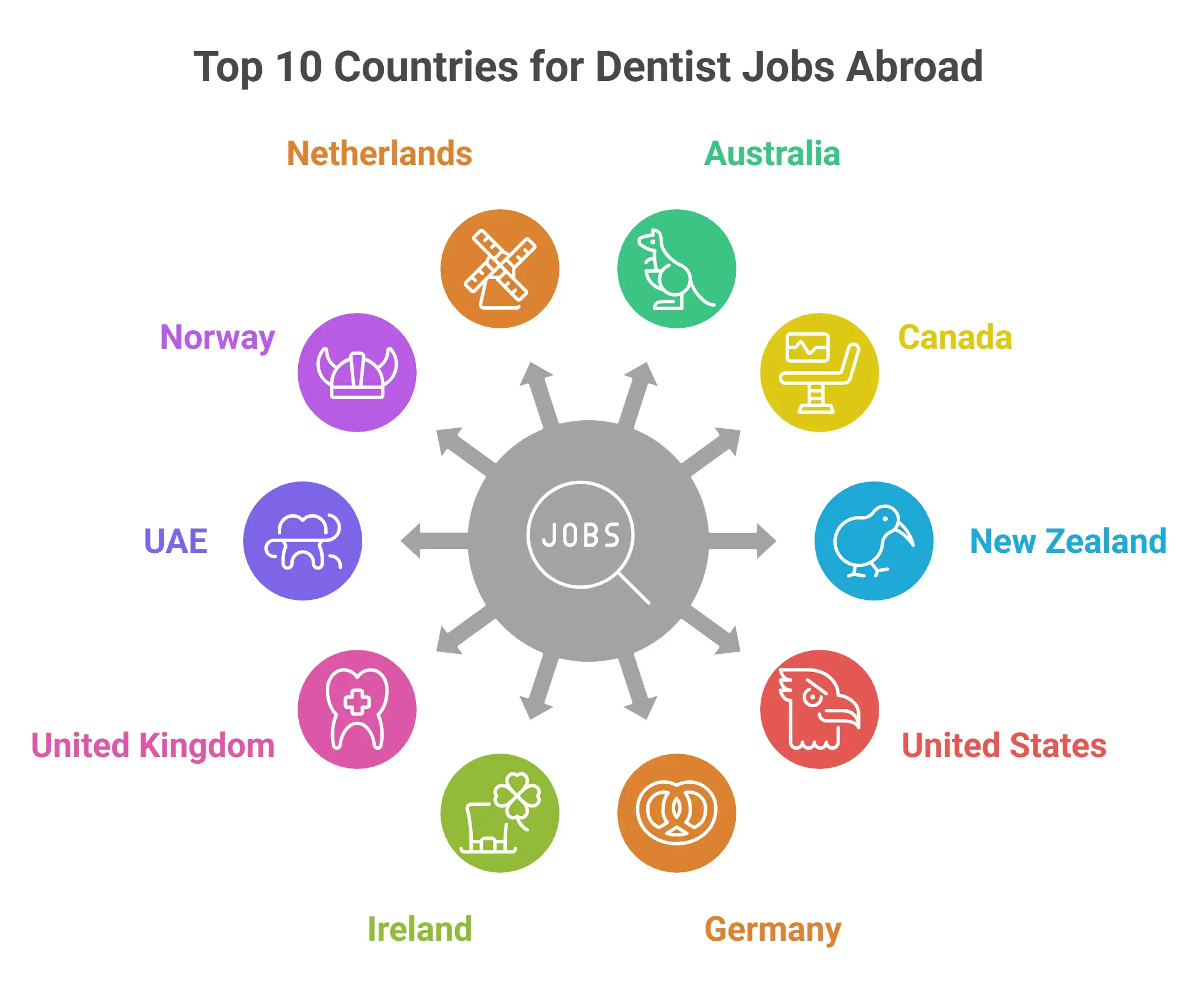
The best countries for dentists to work abroad include Australia, Canada, New Zealand, the USA, the UK, Ireland, Germany, the Netherlands, Norway, and the UAE. These countries offer attractive salaries, strong demand for dental services, varied job opportunities, and permanent residence pathways in several destinations.
According to the World Health Organization (WHO), more than 68% of Member States have fewer than 5 dentists per 10,000 people. Ageing populations, dental workforce shortages, and rising demand for preventive, restorative, and specialist dental care continue to increase the need for dentists worldwide, creating more opportunities for general and specialist dentists to work abroad.
*Want to work abroad? Sign up with Y-Axis Resume Marketing Services to find right job faster.
Benefits of Working Abroad as a Dentist
Working abroad offers dentists higher salaries, specialist career opportunities, international clinical experience, and long-term settlement options. Nearly 3.7 billion people worldwide are affected by oral diseases, supporting continued demand for dental care.
- Earn competitive salaries in global dental markets
- Access general and specialist dental roles
- Work with advanced dental technologies
- Pursue permanent residence pathways
- Gain international clinical experience
- Advance into senior or specialist roles
How to Choose the Right Country for Dentist Jobs Abroad?
Choosing the right country for dentist jobs abroad requires comparing salary, job demand, licensing requirements, visa options, and permanent residence pathways. Dentists should also check whether their dental degree is recognized and whether additional exams or registration are required to practise.
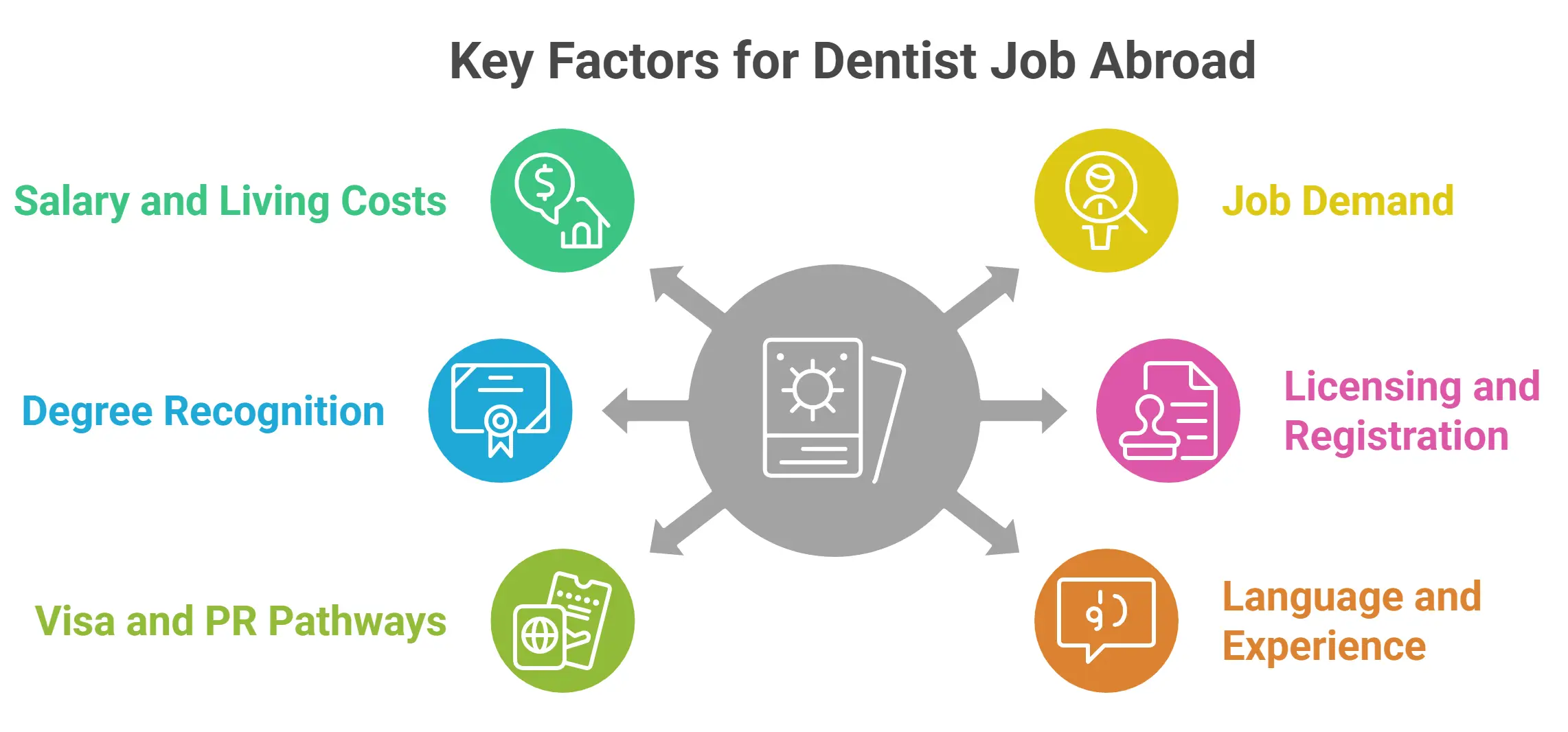
- Compare dentist salaries and living costs
- Check demand for your dental specialization
- Verify dental degree recognition
- Review licensing and registration requirements
- Compare work visa and PR pathways
- Check language and clinical experience requirements
Top 10 Countries for Dentists to Work Abroad
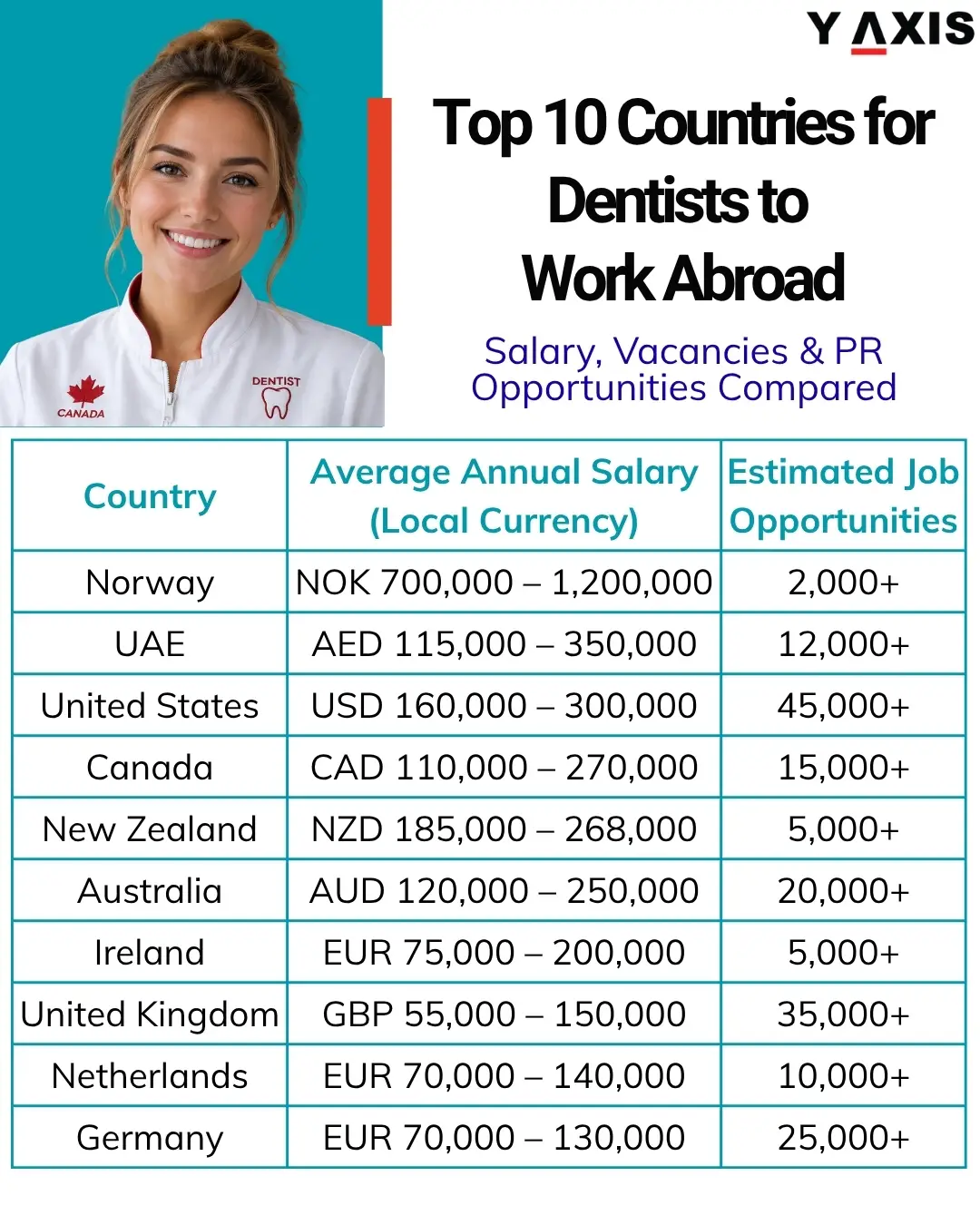
Dentists can find opportunities abroad in private practices, hospitals, dental clinics, and specialist centres. Countries such as Australia, New Zealand, Canada, and the USA have established dental markets, with dentist salaries ranging from around CAD 100,000 to over CAD 200,000 per year in some destinations. Demand for general and specialist dentists also creates career opportunities across several global healthcare markets.
|
Country |
Average Annual Salary (Local Currency) |
Estimated Dentist Job Opportunities |
|
Australia |
AUD 120,000 – 250,000 |
20,000+ |
|
Canada |
CAD 110,000 – 270,000 |
15,000+ |
|
New Zealand |
NZD 185,000 – 268,000 |
5,000+ |
|
United States |
USD 160,000 – 300,000 |
45,000+ |
|
Germany |
EUR 70,000 – 130,000 |
25,000+ |
|
Ireland |
EUR 75,000 – 200,000 |
5,000+ |
|
United Kingdom |
GBP 55,000 – 150,000 |
35,000+ |
|
UAE |
AED 115,000 – 350,000 |
12,000+ |
|
Norway |
NOK 700,000 – 1,200,000 |
2,000+ |
|
Netherlands |
EUR 70,000 – 140,000 |
10,000+ |
*Want to work abroad? Sign up with Y-Axis Resume Marketing Services to find right job faster.
Best Countries for Dentist Jobs Abroad and Permanent Residency
Dentists planning a long-term career abroad can consider countries that combine dental job demand with permanent residency pathways. Australia, Canada, New Zealand, Germany, and the UK offer skilled migration, employment-based residence, or long-term settlement routes for dentists. These pathways provide opportunities to build a dental career and secure permanent residence abroad.
Dentist Jobs in Australia
Australia has an established dental job market across private practices, public dental clinics, hospitals, community health services, and regional healthcare facilities. Recruitment needs are particularly relevant outside major metropolitan areas, while general and specialist dentistry provide career options across the country. Dentists trained overseas whose qualifications are not recognised for direct registration generally complete the Australian Dental Council assessment before registering with the Dental Board of Australia.
Dentist (ANZSCO 252312) is included in Australia’s skilled occupation framework, supporting visa routes such as the Skills in Demand visa (subclass 482), Employer Nomination Scheme (subclass 186), and regional skilled visas. Employer-sponsored and regional migration routes can also provide pathways to permanent residence.
|
Factor |
Details |
|
Dentist Job Market & Job Vacancies for the Next Decade |
Australia has high demand for dentists, particularly in regional and remote areas, with more than 20,000 openings estimated over the next decade across private practices, public dental services, specialist clinics and community oral health services. |
|
Investment in Dental & Oral Healthcare |
Australia is investing AUD 431 million in Public Dental Services for Adults. The 10-year National Oral Health Plan will guide prevention, dental care access and oral health priorities nationwide. |
|
In-Demand Dentist Roles & Skills |
Key roles include general dentists, orthodontists, endodontists, periodontists, prosthodontists and oral and maxillofacial surgeons. Skills include diagnosis, restorative dentistry, preventive care, implants and specialist procedures. |
|
Work Visa Options for Dentists |
Visa routes include the Skills in Demand Visa (Subclass 482), Employer Nomination Scheme (Subclass 186), Skilled Work Regional Visa (Subclass 491) and Skilled Employer Sponsored Regional Visa (Subclass 494). |
|
Fast-Track Hiring Options |
Employer sponsorship, regional migration, and state or territory nomination can support recruitment, particularly for regional dentist roles. |
|
PR / Long-Term Residence Opportunities |
Subclass 186 provides an employer-sponsored PR route, while skilled and regional migration pathways can also lead to permanent residence. |
|
Licensing & Registration Requirements |
Dentists must register with the Dental Board of Australia through AHPRA. Some overseas-trained dentists must complete the Australian Dental Council (ADC) assessment process. |
|
Language Requirements |
Dentists must meet the Dental Board of Australia’s English-language skills registration standard through an accepted education pathway or approved English test. |
|
Eligibility for Dependants |
A spouse or partner and dependent children can be included in skilled and employer-sponsored visa applications where permitted. |
|
Benefits for Family Members |
Family members can receive work and study rights based on visa conditions, while Medicare access depends on the visa held. |
Dentist Jobs in Canada
Canada’s dentist job market is supported by population growth, dental workforce retirements, and continued demand for oral healthcare. Dentists work mainly in private practices, while opportunities are also available in community clinics, hospitals, public health programs, and other dental care settings across the provinces and territories. Canada’s national labour outlook indicates a strong risk of dentist shortages over the coming years.
Dentists trained outside Canada generally need certification through the National Dental Examining Board of Canada before obtaining a licence from the province or territory where they intend to practise. For immigration, dentists can explore Express Entry and Provincial Nominee Programs, which provide established routes to Canadian permanent residence.
|
Factor |
Details |
|
Dentist Job Market & Job Vacancies for the Next Decade |
Canada has a stable dental job market, supported by population growth, retirements and expanding oral healthcare access, with more than 15,000 openings estimated over the next decade across private practices, community clinics, public health services and oral healthcare centres. |
|
Investment in Dental & Oral Healthcare |
Canada has committed $250 million over three years and $75 million in ongoing funding through the Oral Health Access Fund to expand oral healthcare access, provider capacity and services in underserved communities. |
|
In-Demand Dentist Roles & Skills |
Key roles include general dentists, orthodontists, periodontists, endodontists, prosthodontists and oral and maxillofacial surgeons. Important skills include diagnosis, restorative dentistry, preventive care, treatment planning and specialist procedures. |
|
Work Visa Options for Dentists |
Dentists with Canadian employment can work through an employer-specific work permit, while Express Entry and Provincial Nominee Programs provide immigration pathways. |
|
Fast-Track Hiring Options |
Dentists are classified under NOC 31110 and included in the healthcare and social services category, supporting selection through healthcare-focused Express Entry and provincial immigration pathways. |
|
PR / Long-Term Residence Opportunities |
Dentists can pursue permanent residence through Express Entry and Provincial Nominee Programs (PNPs) at the federal and provincial levels. |
|
Licensing & Registration Requirements |
International dentists generally need National Dental Examining Board of Canada (NDEB) certification and registration with the dental regulatory authority in their province of practice. |
|
Language Requirements |
Dentists must meet English or French language requirements for immigration and the professional registration requirements of their province. |
|
Eligibility for Dependants |
A spouse or common-law partner and dependent children can accompany a dentist through applicable work permit or permanent residence pathways. |
|
Benefits for Family Members |
Spouses may qualify for an open work permit, children can access education, and provincial healthcare coverage depends on immigration status and provincial rules. |
*Want to work in Canada? Get expert assistance from Y-Axis to find the right job faster.
Dentist Jobs in New Zealand
New Zealand combines demand for dentists with one of the more direct residence options available to the occupation. Dental practices, hospitals, community services, and public healthcare providers employ dentists, with workforce needs particularly relevant in regional areas. Registration with the Dental Council of New Zealand is required to practise, and the registration route depends on where the dental degree was completed and whether it is prescribed or recognised.
Dentist is included on New Zealand’s Green List under the Straight to Residence pathway. Dentists with New Zealand registration and a job or job offer that meets the pathway requirements can apply for residence, making employment and long-term settlement closely connected.
|
Factor |
Details |
|
Dentist Job Market & Job Vacancies for the Next Decade |
New Zealand has high demand for dentists across public, private and community dental services, with more than 5,000 openings estimated over the next decade, including general, specialist and community dentistry roles. |
|
Investment in Dental & Oral Healthcare |
New Zealand is investing more than NZ$5.8 billion in new health operating funding and over NZ$680 million in capital funding, supporting frontline and community healthcare services, including publicly funded oral healthcare. |
|
In-Demand Dentist Roles & Skills |
Dentist and Dental Specialist are included on New Zealand’s Green List. Roles span general dentistry, orthodontics, periodontics, endodontics, prosthodontics and oral and maxillofacial surgery, with skills in diagnosis, restorative care, preventive dentistry and treatment planning. |
|
Work Visa Options for Dentists |
Dentists with a job offer from an accredited employer can apply for the Accredited Employer Work Visa (AEWV), while Green List pathways provide residence options for Dentist and Dental Specialist roles. |
|
Fast-Track Hiring Options |
Dentist and Dental Specialist are Green List Tier 1 roles, providing access to the Straight to Residence pathway with a qualifying New Zealand job or job offer. |
|
PR / Long-Term Residence Opportunities |
The Straight to Residence Visa provides a direct residence route. After holding a resident visa for at least two years, dentists can apply for a Permanent Resident Visa after meeting its requirements. |
|
Licensing & Registration Requirements |
Dentists must register with the Dental Council of New Zealand and hold a current Annual Practising Certificate. Overseas-trained dentists follow the registration route applicable to their dental qualification. |
|
Language Requirements |
Dentists must meet the Dental Council of New Zealand’s English-language standard through an accepted education pathway or approved English-language test. |
|
Eligibility for Dependants |
Dentists can include or support applications for their partner and dependent children under the family provisions of their work or residence visa. |
|
Benefits for Family Members |
Partners can receive work rights under applicable visa conditions, while dependent children can access education and family members may access publicly funded healthcare based on their visa or residence status. |
Dentist Jobs in the United States
The United States has one of the largest dental employment markets globally, spanning private practices, dental groups, hospitals, community health centres, universities, and specialist clinics. General dentists account for much of the workforce, alongside orthodontists, prosthodontists, oral surgeons, and other dental specialists. Each state regulates dental practice separately, making licensing requirements an important part of working in the country.
Internationally trained dentists commonly need a DDS or DMD from an accredited US dental program before completing state licensing requirements. Employer-sponsored visas such as the H-1B may be available for certain positions, while employment-based Green Card categories provide routes to permanent residence for dentists building their careers in the United States.
|
Factor |
Details |
|
Dentist Job Market & Job Vacancies for the Next Decade |
The United States has a large dental job market, with about 45,000 openings projected over the next decade across general and specialist dentistry, driven by preventive, restorative, cosmetic and age-related oral healthcare needs. |
|
Investment in Dental & Oral Healthcare |
US spending on dental services is projected to exceed $300 billion by the early 2030s, covering preventive, restorative and specialist oral healthcare services. |
|
In-Demand Dentist Roles & Skills |
Key roles include general dentists, orthodontists, endodontists, periodontists, prosthodontists and oral and maxillofacial surgeons. Important skills include diagnosis, restorative dentistry, preventive care, treatment planning and specialist procedures. |
|
Work Visa Options for Dentists |
International dentists can work through the H-1B Visa for specialty-occupation positions, with employer sponsorship providing a key route to dental employment. |
|
Fast-Track Hiring Options |
Employer-sponsored and academic employment routes support international dentist recruitment across dental practices, healthcare organisations and universities. |
|
PR / Long-Term Residence Opportunities |
Dentists can pursue permanent residence through employment-based Green Card routes, including EB-2 and EB-3. |
|
Licensing & Registration Requirements |
International dentists commonly complete an advanced-standing DDS or DMD programme, pass the Integrated National Board Dental Examination (INBDE) and obtain a licence from the relevant state dental board. |
|
Language Requirements |
International dentists entering advanced-standing DDS or DMD programmes generally demonstrate English proficiency, with TOEFL commonly accepted by US dental schools. |
|
Eligibility for Dependants |
Dentists holding H-1B status can bring a spouse and unmarried children under 21 through H-4 status. |
|
Benefits for Family Members |
H-4 family members can live and study in the United States, while certain H-4 spouses can apply for employment authorisation. |
*Want to work in the USA? Avail Y-Axis Resume Marketing Services to shortlist the job faster.
Dentist Jobs in Germany
Working as a dentist in Germany centres on obtaining Approbation, the state licence that allows independent dental practice. Dentists are employed in private practices, dental clinics, hospitals, and university dental centres, with opportunities across general and specialist dentistry. Dental degrees obtained abroad are assessed against German training standards, and a knowledge examination may be required where substantial differences are identified. German language and dental communication skills are also required for clinical practice.
Dentists from outside the EU can enter Germany through residence permits for skilled employment, while the EU Blue Card may apply to certain positions. Employment and legal residence can later provide access to a settlement permit and long-term residence in Germany.
|
Factor |
Details |
|
Dentist Job Market & Job Vacancies for the Next Decade |
Germany has an established dental market, with around 25,000 openings estimated over the next decade across dental practices, clinics and specialist services, supported by workforce replacement and continued demand for dental care. |
|
Investment in Dental & Oral Healthcare |
Germany spends more than €20 billion annually on dental treatment and dentures through statutory health insurance, supporting preventive, restorative, prosthetic and specialist dental care. |
|
In-Demand Dentist Roles & Skills |
Key roles include general dentists, orthodontists, oral surgeons, periodontists and other dental specialists. Important skills include diagnosis, restorative dentistry, preventive care, prosthodontics, treatment planning and oral surgery. |
|
Work Visa Options for Dentists |
Dentists can work in Germany through the EU Blue Card and Skilled Worker Visa after completing the required professional recognition. |
|
Fast-Track Hiring Options |
Germany’s Accelerated Skilled Worker Procedure allows employers to coordinate qualification recognition, employment approval and visa procedures when recruiting dentists from abroad. |
|
PR / Long-Term Residence Opportunities |
Dentists can progress to a German settlement permit through skilled-worker residence routes, while the EU Blue Card provides an accelerated pathway to permanent settlement. |
|
Licensing & Registration Requirements |
Dentistry is a regulated profession in Germany. Dentists trained abroad must complete qualification recognition and obtain Approbation, the state licence required to practise dentistry. |
|
Language Requirements |
Dentists generally need German at B2 level and a C1-level specialist language examination for professional dental practice and Approbation. |
|
Eligibility for Dependants |
Dentists holding a German work residence permit can bring their spouse and dependent children through Germany’s family reunification route. |
|
Benefits for Family Members |
Family members can access work rights, public education and healthcare through Germany’s family reunification and residence system. |
Dentist Jobs in Ireland
Ireland provides an English-speaking dental job market across private practices, community dental services, hospitals, and public healthcare. Recruitment pressures within dental services have increased attention on dentist staffing and access to oral healthcare. Registration with the Dental Council of Ireland is required before practising, with the registration process determined by where the dental qualification was obtained. Some overseas-trained dentists may need to complete the Dental Council examination.
Dentists moving from outside the EEA can take up employment through Ireland’s employment permit system. Depending on the immigration permission and period of legal employment, dentists can later move towards Stamp 4 permission or long-term residence, reducing dependence on employment permits over time.
|
Factor |
Details |
|
Dentist Job Market & Job Vacancies for the Next Decade |
Ireland has growing demand for dentists across private and public dental services, with around 5,000 openings estimated over the next decade across general dentistry, specialist practices and community dental services. |
|
Investment in Dental & Oral Healthcare |
Ireland’s health budget has reached €27.4 billion, supporting healthcare infrastructure and community services. Public funding also supports oral healthcare through HSE dental services and state-funded dental schemes. |
|
In-Demand Dentist Roles & Skills |
Key roles include general dentists, orthodontists, periodontists, endodontists, prosthodontists and oral surgeons. Important skills include diagnosis, restorative dentistry, preventive care, treatment planning, prosthodontics and specialist procedures. |
|
Work Visa Options for Dentists |
Dentists from outside the EEA can work through the General Employment Permit or Critical Skills Employment Permit, depending on the occupation, position and salary requirements. |
|
Fast-Track Hiring Options |
The Critical Skills Employment Permit provides a streamlined employment route and does not require a Labour Market Needs Test for positions covered by the permit. |
|
PR / Long-Term Residence Opportunities |
Dentists on a Critical Skills Employment Permit can progress to Stamp 4, allowing them to work without an employment permit. Long-term residence is available after the required period of legal residence. |
|
Licensing & Registration Requirements |
Dentists must register with the Dental Council of Ireland before practising. The registration route depends on where the qualification was obtained, with the Dental Council Examination available for certain overseas qualifications. |
|
Language Requirements |
Dentists must demonstrate English-language competence through evidence or language assessment accepted by the Dental Council of Ireland. |
|
Eligibility for Dependants |
Dentists can bring their spouse, partner and dependent children through Ireland’s family reunification provisions linked to their immigration permission. |
|
Benefits for Family Members |
Family members can access work, education and healthcare services according to the immigration permission granted in Ireland. |
Dentist Jobs in the UK
Demand for dentists in the UK is closely linked to continuing recruitment pressures within NHS dentistry and the need to improve access to dental care. Jobs are available across NHS and private practices, hospitals, community dental services, and specialist settings. Dentists trained overseas must register with the General Dental Council (GDC), and many need to pass the Overseas Registration Examination (ORE) before obtaining registration.
Overseas dentists can take sponsored positions through the Skilled Worker visa where the employment meets the visa conditions. The Skilled Worker route can lead to Indefinite Leave to Remain after five years, giving dentists a defined pathway from sponsored employment to settlement in the UK.
|
Factor |
Details |
|
Dentist Job Market & Job Vacancies for the Next Decade |
The UK has high demand for dentists, with around 35,000 openings estimated over the next decade across NHS dental practices, private clinics, community dental services, hospitals and specialist dentistry. |
|
Investment in Dental & Oral Healthcare |
England has a £4.2 billion ring-fenced NHS dentistry budget, supporting NHS dental treatment, urgent care, patient access and dental service delivery. |
|
In-Demand Dentist Roles & Skills |
Key roles include general dentists, orthodontists, endodontists, periodontists, prosthodontists and oral surgeons. Important skills include diagnosis, restorative dentistry, preventive care, treatment planning, orthodontics and specialist procedures. |
|
Work Visa Options for Dentists |
Dentists can work through the Health and Care Worker Visa in sponsored roles with the NHS, organisations providing NHS services and other approved healthcare employers. |
|
Fast-Track Hiring Options |
The Health and Care Worker Visa provides a dedicated route for sponsored healthcare roles, with reduced visa fees and exemption from the Immigration Health Surcharge. |
|
PR / Long-Term Residence Opportunities |
Dentists on the Health and Care Worker route can progress to Indefinite Leave to Remain after 5 years of qualifying continuous residence. |
|
Licensing & Registration Requirements |
Dentists must register with the General Dental Council (GDC) before practising. Overseas-trained dentists can complete the Overseas Registration Examination (ORE) when required for registration. |
|
Language Requirements |
Dentists must demonstrate English-language proficiency through evidence accepted by the GDC and meet the English requirement for their UK work visa. |
|
Eligibility for Dependants |
Dentists on the Health and Care Worker Visa can bring their partner and dependent children through the visa’s dependant route. |
|
Benefits for Family Members |
Dependants can work and study in the UK and access NHS healthcare under the conditions of their immigration status. |
Dentist Jobs in the UAE
Private healthcare expansion, medical tourism, and demand for general, specialist, and cosmetic dentistry shape the UAE’s dental job market. Dubai and Abu Dhabi have a high concentration of private dental clinics, multispecialty medical centres, and hospital groups, with roles spanning general dentistry, orthodontics, endodontics, prosthodontics, periodontics, and oral surgery. Dental licensing is managed by the health authority responsible for the emirate, including DHA in Dubai and DoH in Abu Dhabi.
Dentists commonly move to the UAE through employer-sponsored work and residence permits. Instead of conventional permanent residency, the UAE provides long-term residence options such as the Golden Visa under designated categories, allowing longer-term residence beyond standard employment-linked permits.
|
Factor |
Details |
|
Dentist Job Market & Job Vacancies for the Next Decade |
The UAE has an expanding private dental market, driven by population growth, medical tourism and specialist healthcare development, with around 12,000 openings estimated over the next decade, particularly across Dubai, Abu Dhabi and other healthcare centres. |
|
Investment in Dental & Oral Healthcare |
The UAE healthcare market is projected to exceed $50 billion by 2029, with investment expanding across private healthcare, medical tourism, digital health, AI and specialist services, including dental care. |
|
In-Demand Dentist Roles & Skills |
Key roles include general dentists, orthodontists, endodontists, periodontists, prosthodontists and oral and maxillofacial surgeons. Important skills include cosmetic dentistry, implants, restorative care, orthodontics, diagnosis and specialist procedures. |
|
Work Visa Options for Dentists |
Dentists can work through an employer-sponsored Work Visa and residence permit, while the Green Visa and Golden Visa provide additional residence routes under their respective requirements. |
|
Fast-Track Hiring Options |
Employer-sponsored recruitment allows hospitals, dental clinics and healthcare groups to arrange work and residence permits after the required professional licence is obtained. |
|
PR / Long-Term Residence Opportunities |
The UAE does not offer traditional permanent residence. Dentists can obtain long-term renewable residence through the Golden Visa or continue through renewable employment-based residence. |
|
Licensing & Registration Requirements |
Dentists must obtain a professional licence from the relevant health authority, including DHA in Dubai, DoH in Abu Dhabi or MOHAP in the jurisdictions it regulates. |
|
Language Requirements |
English is widely used in dental practice and patient communication, while Arabic is an advantage when treating Arabic-speaking patients. |
|
Eligibility for Dependants |
Dentists holding UAE residence can sponsor their spouse and children through the country’s family residence provisions. |
|
Benefits for Family Members |
Sponsored family members can live, study and access healthcare in the UAE, with residence linked to the applicable family sponsorship or long-term residence arrangement. |
Dentist Jobs in Norway
Regional dental services are an important part of Norway’s employment market for dentists, particularly across northern and less densely populated areas. Dentists work in county-run public dental services as well as private practices, with the public system providing dental care to children, young adults, and other priority groups. Dentists trained abroad need authorization from the Norwegian Directorate of Health before starting clinical practice, and Norwegian language skills are required for working with patients.
Dentists from outside the EU/EEA can use Norway’s skilled worker residence permit to take up dental employment. Residence on permits that count towards permanent residence can later support settlement, giving dentists a route from employment to long-term residence in Norway.
|
Factor |
Details |
|
Dentist Job Market & Job Vacancies for the Next Decade |
Norway has demand for dentists across public and private dental services, particularly in regional and northern areas, with around 2,000 openings estimated over the next decade. |
|
Investment in Dental & Oral Healthcare |
Norway spends around NOK 5.1 billion on public dental healthcare, supporting treatment for children, young adults, priority groups and public dental services. |
|
In-Demand Dentist Roles & Skills |
Key roles include general dentists, orthodontists, oral surgeons, periodontists, endodontists and prosthodontists. Skills include diagnosis, restorative dentistry, preventive care, prosthodontics and oral surgery. |
|
Work Visa Options for Dentists |
Dentists from outside the EU/EEA can work through the Skilled Worker residence permit after securing employment and professional authorisation. |
|
Fast-Track Hiring Options |
Dentists with professional authorisation and a confirmed job offer can use Norway’s Skilled Worker route for employment. |
|
PR / Long-Term Residence Opportunities |
Dentists can apply for permanent residence after 3 years on residence permits that count towards permanent residence. |
|
Licensing & Registration Requirements |
Dentists must obtain authorisation from the Norwegian Directorate of Health before practising and complete the required qualification recognition process. |
|
Language Requirements |
Dentists trained outside the EU/EEA generally need Norwegian language proficiency at B2 level for authorisation. |
|
Eligibility for Dependants |
Dentists can bring their spouse or cohabiting partner and dependent children through family immigration. |
|
Benefits for Family Members |
Family members can access work, education and healthcare according to their residence status in Norway. |
Dentist Jobs in the Netherlands
Dentists in the Netherlands work predominantly in private and group dental practices, with additional positions in specialist centres, hospitals, and academic dentistry. General dentistry forms a major part of the market, alongside orthodontics, periodontics, endodontics, restorative dentistry, and oral surgery. An ageing population and regular use of dental services continue to support demand for oral healthcare across the country.
Dentistry is regulated through the BIG register, so dentists trained abroad must have their dental qualifications recognised and complete BIG registration before practising. Dutch language proficiency is required for registration and patient care. Dentists from outside the EU/EEA also need the appropriate work and residence permission, with continued legal residence providing a pathway towards permanent residence in the Netherlands.
|
Factor |
Details |
|
Dentist Job Market & Job Vacancies for the Next Decade |
The Netherlands has a stable dental job market, with around 10,000 openings estimated over the next decade across private practices, group clinics and multidisciplinary oral healthcare centres in general and specialist dentistry. |
|
Investment in Dental & Oral Healthcare |
The Netherlands spends more than €3.6 billion annually through dental practices, while continued healthcare investment supports oral healthcare, digitalisation and modern dental services. |
|
In-Demand Dentist Roles & Skills |
Key roles include general dentists, orthodontists, oral surgeons, periodontists and other dental specialists. Important skills include restorative dentistry, preventive care, diagnosis, prosthodontics, treatment planning and specialist procedures. |
|
Work Visa Options for Dentists |
Dentists can work through the Highly Skilled Migrant residence permit, EU Blue Card, and employer-sponsored work and residence routes. |
|
Fast-Track Hiring Options |
The Highly Skilled Migrant Scheme allows recognised sponsors to recruit dentists from abroad through a streamlined immigration process. |
|
PR / Long-Term Residence Opportunities |
Dentists can apply for permanent residence after 5 years of continuous legal residence in the Netherlands after meeting the residence requirements. |
|
Licensing & Registration Requirements |
Dentists must obtain BIG registration before practising under the protected dentist title. Dentists trained abroad must complete the applicable qualification recognition and registration process. |
|
Language Requirements |
Dentists must demonstrate Dutch-language proficiency for professional recognition, BIG registration and patient-facing dental practice. |
|
Eligibility for Dependants |
Dentists holding a Dutch work and residence permit can bring their partner and dependent children through the applicable family residence route. |
|
Benefits for Family Members |
Family members can access education and the Dutch healthcare system, while partner work rights depend on the residence permit linked to the dentist’s employment status. |
Job Outlook for Dentists over the Next Decade
The global job outlook for dentists remains positive over the next decade, supported by population growth, ageing populations, dentist retirements and increasing demand for preventive, restorative and specialist dental care. According to the World Health Organization (WHO), more than 68% of Member States have fewer than 5 dentists per 10,000 people, indicating continued dental workforce gaps worldwide. Demand is expected across private dental practices, hospitals, public dental services, community clinics and specialist centres. General dentists, orthodontists, periodontists, endodontists, prosthodontists and oral surgeons are expected to remain in demand as countries expand oral healthcare access, strengthen dental services and address changing population needs over the coming decade.
*Want to work abroad? Sign up with Y-Axis Resume Marketing Services to find right job faster.
FAQs
Which country is best for dentists to work abroad?
Australia, Canada, New Zealand, the United States, the UK, Germany, Ireland, the UAE, Norway, and the Netherlands are among the best countries for dentist jobs abroad. They offer employment across general and specialist dentistry, established dental licensing systems, work visa routes, and long-term residence options. The best choice depends on salary, licensing process, language requirements, immigration pathway, and preferred dental specialty.
Which countries have the highest demand for dentists?
Australia, Canada, New Zealand, the UK, Germany, and the United States have continued demand for dentists across private practices, hospitals, public dental services, community clinics, and specialist centres. Dentist retirements, ageing populations, regional staffing gaps, and increasing demand for preventive, restorative, and specialist dental treatment are supporting recruitment across these markets.
Which country pays the highest salary for dentists?
The United States, Australia, Canada, Switzerland, and the UAE are among the higher-paying countries for dentists. In the United States, dentist salaries can reach around USD 300,000 annually for higher-paying roles, while earnings in Australia and Canada can also exceed AUD 200,000 and CAD 200,000. Salaries vary by specialty, location, clinical experience, and practice type.
What are the top countries for dentist jobs abroad?
Australia, Canada, New Zealand, the United States, the UK, Germany, Ireland, the UAE, Norway, and the Netherlands are leading destinations for dentist jobs abroad. Employment is available across private dental practices, public dental services, hospitals, specialist clinics, and community healthcare. These countries also have defined registration and immigration processes for dentists trained outside their healthcare systems.
Which countries are facing a shortage of dentists?
Dentist shortages and recruitment gaps are reported across Canada, Australia, New Zealand, the UK, and parts of Europe, particularly in rural, regional, and underserved areas. According to the World Health Organization, more than 68% of Member States have fewer than five dentists per 10,000 people, highlighting substantial differences in dentist availability worldwide.
Which country is easiest for dentists to immigrate to?
New Zealand and Australia have structured immigration routes for dentists. New Zealand includes Dentist and Dental Specialist on its Green List Tier 1, providing a Straight to Residence pathway. Australia includes Dentist (ANZSCO 252312) within its skilled occupation framework, supporting skilled, regional, and employer-sponsored migration routes. Dental registration must be completed separately from the immigration process.
Which countries offer permanent residency for dentists?
Canada, Australia, New Zealand, Germany, the UK, Ireland, Norway, and the Netherlands provide routes to permanent residence or long-term settlement for dentists. Canada offers Express Entry and PNPs, New Zealand has Straight to Residence, and Australia provides skilled and employer-sponsored PR pathways. The UK provides settlement through Indefinite Leave to Remain after the required qualifying residence.
Can dentists get PR through skilled migration programs?
Yes. Dentists can obtain permanent residence through skilled migration programs in countries such as Canada, Australia, and New Zealand. Canada provides Express Entry and Provincial Nominee Programs, while Australia offers skilled, regional, and employer-sponsored migration pathways. New Zealand lists Dentist and Dental Specialist as Green List Tier 1 roles under its Straight to Residence pathway.
What are the requirements to work as a dentist abroad?
Dentists typically need a dental degree accepted by the destination’s regulatory authority, professional registration, a licence to practise, and the required language proficiency. Overseas-trained dentists may also need qualification recognition, a licensing or competency examination, additional dental education, or supervised clinical practice. Immigration permission, such as a work visa or residence permit, is also required for overseas employment.
Do dentists need a licence to work abroad?
Yes. Dentists must obtain registration or professional authorisation before practising in most countries. Australia requires Dental Board of Australia registration, the UK requires General Dental Council registration, Germany requires Approbation, and the Netherlands requires BIG registration. New Zealand dentists must register with the Dental Council of New Zealand and hold a current Annual Practising Certificate.
Which countries accept foreign-trained dentists?
Australia, Canada, New Zealand, the United States, the UK, Germany, Ireland, Norway, the Netherlands, and the UAE provide registration routes for dentists trained abroad. The process differs by country and dental degree. It can involve qualification recognition, professional examinations, language testing, additional dental education, clinical assessments, or registration with the national or regional dental regulator.
Do foreign-trained dentists need to take a licensing exam?
Licensing examinations depend on where the dental degree was obtained and the destination country’s recognition rules. Australia may require the Australian Dental Council assessment, while the UK may require the Overseas Registration Examination. In the United States, internationally trained dentists commonly complete an advanced-standing DDS or DMD program and the INBDE before meeting state licensing requirements.
Is IELTS required to work as a dentist abroad?
IELTS is required only when the dental regulator or immigration pathway accepts or specifies it as evidence of English proficiency. Some countries also accept OET, TOEFL, other approved tests, or qualifying education completed in English. Dentists moving to Germany, Norway, or the Netherlands generally need proficiency in the local language for professional registration and patient-facing clinical work.
What work visas are available for dentists abroad?
Dentists can use country-specific work routes such as Australia’s Skills in Demand Visa (Subclass 482), New Zealand’s Accredited Employer Work Visa, the UK’s Health and Care Worker Visa, Norway’s Skilled Worker residence permit, and Germany’s skilled worker routes. Canada provides employer-specific work permits, while the UAE primarily uses employer-sponsored work and residence permits.
How can dentists find jobs abroad?
Dentists can search for overseas jobs through dental clinic and hospital career pages, government employment portals, healthcare recruitment agencies, dental associations, and established job platforms. Before applying, dentists should check the destination’s dental registration process and begin qualification recognition or licensing where required. They should also target employers that recruit internationally or provide visa sponsorship.
How much do dentists earn abroad?
Dentist salaries vary widely by country and dental specialty. Based on the destinations covered in this article, annual salaries range from around EUR 70,000 in Germany and the Netherlands to as much as USD 300,000 for higher-paying roles in the United States. Orthodontics, oral surgery, prosthodontics, and other specialist areas can command higher salaries than many general dentistry positions.
Is Australia a good country for dentists?
Yes. Australia has demand for dentists across private practices, public dental services, hospitals, community healthcare, and regional areas. Dentist (ANZSCO 252312) is included in Australia’s skilled occupation framework. Work and migration routes include the Skills in Demand Visa (Subclass 482), Employer Nomination Scheme (Subclass 186), and regional skilled visa pathways.
Is New Zealand a good country for dentists?
Yes. New Zealand provides dentist jobs across private practices, public dental services, hospitals, and community healthcare. Dentist and Dental Specialist are included on the Green List as Tier 1 roles. Dentists with New Zealand registration and a qualifying job or job offer can use the Straight to Residence pathway, connecting dental employment directly with residence.
Can dentists work in the UK through a work visa?
Yes. Dentists can work in the UK through the Health and Care Worker Visa in sponsored healthcare positions. Before practising, overseas dentists must obtain registration with the General Dental Council, with the Overseas Registration Examination required for many overseas dental qualifications. The Health and Care Worker route can lead to Indefinite Leave to Remain after five years of qualifying residence.
Can dentists move to the USA for work?
Yes. International dentists can work in the United States after completing the education and state licensing requirements that apply to their dental qualification. Many internationally trained dentists complete an advanced-standing DDS or DMD program before obtaining state licensure. H-1B sponsorship can apply to certain dental positions, while EB-2 and EB-3 employment-based Green Card routes provide permanent residence options.
Tags:
Dentist Jobs Abroad
Dentist Jobs Overseas
International Dentist Jobs
Best Countries for Dentists
Dentist Salary Abroad
Dentist Salary by Country
Countries with Demand for Dentists
Highest Paying Countries for Dentists
Immigration for Dentists
PR
Share
Latest Article
Popular Post
Trending Article
Posted On October 22 2026
What Are the Different Types of UK Visas to Immigrate?