

Posted on July 22 2026
Top 10 Countries for Doctors to Work Abroad: Salary, Demand & PR Opportunities Compared

By , Editor & Director
Updated July 23 2026
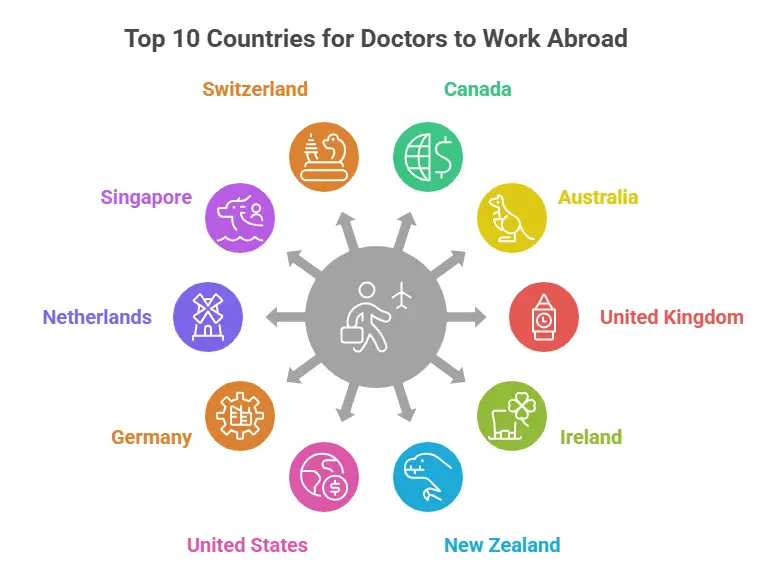
The top 10 countries for doctors to work abroad are the United States, Canada, Australia, the United Kingdom, New Zealand, Ireland, Germany, Switzerland, Singapore, and the Netherlands. These countries offer competitive salaries, high demand for doctors, advanced healthcare systems and pathways to permanent residence.
Global demand for doctors is increasing due to ageing populations, growing healthcare needs, and workforce shortages. The global health workforce shortage is projected to reach 11 million by 2030, while many countries continue to recruit internationally trained doctors to fill critical healthcare roles, creating strong career opportunities for doctors seeking to work abroad.
*Want to work abroad? Sign up with Y-Axis Resume Marketing Services to find right job faster.
Benefits of Working Abroad as a Doctor
Doctors working abroad can benefit from higher salaries, better career opportunities, advanced medical training, and international clinical experience. Many countries also offer opportunities to work in high-demand specialties and qualify for permanent residence.
- OECD countries employ 600,000+ foreign-trained doctors
- Specialists earn about 40% more than GPs across OECD countries
- Access to advanced medical technology and training
- Opportunities in high-demand medical specialties
- International clinical experience
- PR pathways in major immigration destinations
How to Choose the Right Country for Doctor Jobs Abroad?
The right country for doctor jobs abroad depends on salary, demand for your specialization, medical licensing requirements, work visa options, and permanent residence pathways. Comparing these factors can help identify countries that match your qualifications and career goals.
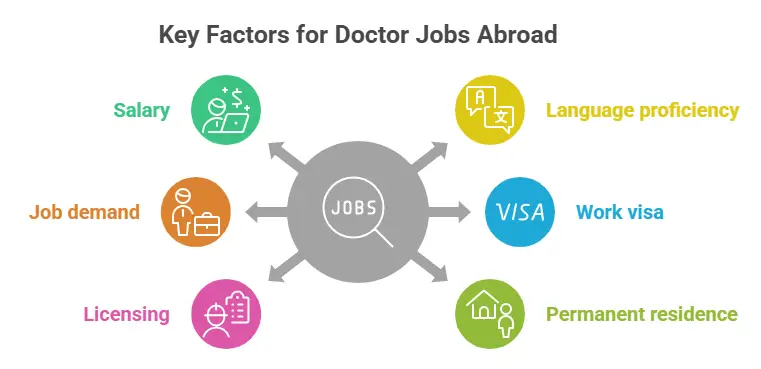
- Salary: Compare doctor salaries, taxes, and living costs.
- Job demand: Check vacancies for your medical specialization.
- Licensing: Review qualification recognition, exams, and registration.
- Language: Check medical and immigration language requirements.
- Work visa: Compare visa eligibility and employer requirements.
- Permanent residence: Review PR eligibility and required work experience.
Top 10 Countries for Doctors to Work Abroad
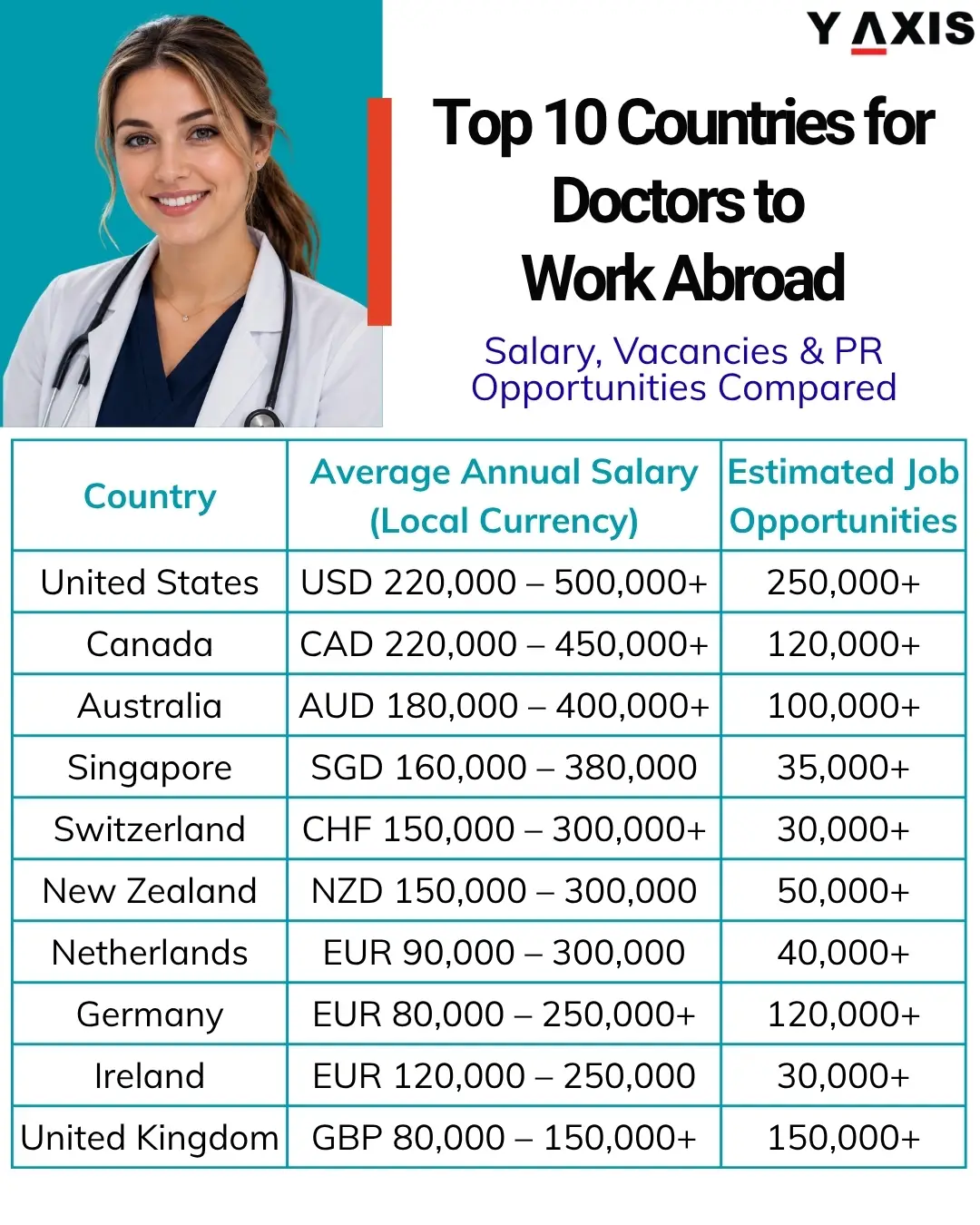
Doctors have strong career opportunities in countries such as the United States, Canada, Australia, the United Kingdom, and New Zealand, driven by demand across primary and specialist care. Annual salaries can range from around CAD 90,000 to over CAD 400,000, with opportunities for family doctors, general practitioners, psychiatrists, radiologists, anaesthesiologists, and emergency medicine doctors. Many of these countries also offer work visa and permanent residence pathways for doctors.
|
Country |
Average Annual Salary |
Estimated Doctor |
|
Canada |
CAD 220,000 – 450,000+ |
120,000+ |
|
United States |
USD 220,000 – 500,000+ |
250,000+ |
|
Australia |
AUD 180,000 – 400,000+ |
100,000+ |
|
United Kingdom |
GBP 80,000 – 150,000+ |
150,000+ |
|
New Zealand |
NZD 150,000 – 300,000 |
50,000+ |
|
Ireland |
EUR 120,000 – 250,000 |
30,000+ |
|
Germany |
EUR 80,000 – 250,000+ |
120,000+ |
|
Switzerland |
CHF 150,000 – 300,000+ |
30,000+ |
|
Singapore |
SGD 160,000 – 380,000 |
35,000+ |
|
Netherlands |
EUR 90,000 – 300,000 |
40,000+ |
*Want to work abroad? Sign up with Y-Axis Resume Marketing Services to find right job faster.
Best Countries for Doctors to Work and Settle Abroad
Canada, Australia, New Zealand, the United Kingdom, and Germany are among the leading countries for doctors to work and settle abroad. These countries offer high demand for doctors, competitive salaries, work visa options, and pathways to permanent residence across a range of medical specialties.
Doctor Jobs in Canada
Canada has sustained demand for family doctors, general practitioners, psychiatrists, surgeons, anaesthesiologists, and other medical specialists across hospitals, clinics, and primary care services. Internationally trained doctors already have a significant presence in the workforce, accounting for 31% of family physicians in Canada. Job prospects for doctors range from good to very good across most provinces and territories.
Canada also has a dedicated Express Entry category for medical doctors with Canadian work experience, alongside Provincial Nominee Program pathways. These immigration routes provide doctors with options to pursue permanent residence while building long-term careers within Canada’s healthcare system.
|
Factor |
Details |
|
Doctor Job Market & Job Vacancies for the Next Decade |
Canada continues to see strong demand for doctors, with over 120,000 job vacancies expected over the next decade across hospitals, long-term care facilities, and community healthcare services nationwide. |
|
Investment in Healthcare Sector |
Canada is investing up to $14.3 million to address labour shortages in the health sector and nearly $200 billion over 10 years, supporting demand for doctors across hospitals, primary care, and community health services. |
|
In-Demand Doctor Roles & Skills |
General practitioners, specialist doctors, and hospital doctors; key skills include clinical care, diagnostics, and patient management. |
|
Work Visa Options for Doctors |
Employer-specific work permits, Express Entry-linked work permits, and Provincial Nominee Programs (PNPs). |
|
Fast-Track Hiring Options |
Category based Express Entry draws, Provincial healthcare recruitment streams, and priority processing for in-demand healthcare occupations, including doctors. |
|
PR / Long-Term Residence Opportunities |
Permanent residence through Express Entry and Provincial Nominee Programs, with healthcare roles often receiving priority. |
|
Licensing & Registration Requirements |
Mandatory registration with provincial regulatory bodies, such as the provincial College of Physicians and Surgeons, based on the province of employment. |
|
Language Requirements |
English or French language proficiency demonstrated through approved language tests. |
|
Eligibility for Dependents |
Spouses and dependent children can accompany the primary applicant. |
|
Benefits for Family Members |
Spouse work rights, access to public healthcare, and public education for children. |
*Want to work in Canada? Get expert assistance from Y-Axis to find the right job faster.
Doctor Jobs in the United States
The United States has one of the world’s largest healthcare job markets, with around 23,600 openings for physicians and surgeons projected each year. Family medicine, internal medicine, psychiatry, anaesthesiology, radiology, surgery, and paediatrics provide opportunities across hospitals, physician practices, outpatient centres, and academic medical centres.
International medical graduates already form an important part of the US physician workforce. Doctors can pursue employment-based immigration through EB-2 and EB-3 routes, which can lead to a US Green Card. The country also provides extensive opportunities for specialist practice, medical research, teaching, and advanced clinical careers.
|
Factor |
Details |
|
Doctor Job Market & Job Vacancies for the Next Decade |
The US is expected to remain one of the largest employment markets for doctors, with over 250,000 job vacancies projected over the next decade across hospitals, clinics, and specialised healthcare services. |
|
Investment in Healthcare Sector |
The US is increasing healthcare investment toward 2030, with healthcare spending projected to exceed $5 trillion by the early 2030s. Investment in digital transformation, AI, value-based care, preventive health, telehealth, remote monitoring, and data-driven care models is supporting demand for doctors. |
|
In-Demand Doctor Roles & Skills |
General physicians, specialist doctors, surgeons, and hospital doctors; key skills include clinical care, diagnostics, patient management, and specialised treatments. |
|
Work Visa Options for Doctors |
H-1B Visa, H-1C (limited), O-1 Visa, and employer-sponsored work visas. |
|
Fast-Track Hiring Options |
H-1B and EB-3 sponsorship for healthcare shortage occupations, including doctors. |
|
PR / Long-Term Residence Opportunities |
Employment-based Green Cards through EB-2 and EB-3. |
|
Licensing & Registration Requirements |
Mandatory state-level medical licensing and professional certification before practising as a doctor. |
|
Language Requirements |
English language proficiency for medical practice in the United States. |
|
Eligibility for Dependents |
Spouses and dependent children can accompany the primary applicant. |
|
Benefits for Family Members |
Dependent visas are available, with spouse work rights based on the visa category and approval. |
*Want to work in the USA? Avail Y-Axis Resume Marketing Services to shortlist the job faster.
Doctor Jobs in Australia
Australia relies significantly on internationally trained doctors to support its healthcare workforce across general practice and specialist medical services. Doctor jobs are available in emergency medicine, psychiatry, anaesthesiology, surgery, internal medicine, general practice, and other specialties across public hospitals, private hospitals, clinics, and community healthcare services.
Overseas doctors can obtain medical registration through pathways administered by the Medical Board of Australia and AHPRA. Australia also has skilled migration and employer-sponsored visa routes for medical practitioners, including pathways to permanent residence. These routes allow doctors to combine healthcare employment with long-term settlement in Australia.
|
Factor |
Details |
|
Doctor Job Market & Job Vacancies for the Next Decade |
Australia has steady demand for doctors, with over 100,000 job vacancies expected over the next decade across hospitals, regional healthcare services, and aged care facilities. |
|
Investment in Healthcare Sector |
Australia is making record healthcare investments, with funding rising to $140 billion and $537 billion committed over four years, supporting demand for doctors across Medicare, public hospitals, digital health, medical research, and aged care services. |
|
In-Demand Doctor Roles & Skills |
General practitioners (GPs), specialist doctors, and hospital doctors; key skills include clinical care, diagnostics, patient management, and rehabilitation. |
|
Work Visa Options for Doctors |
Skills in Demand Visa (Subclass 482), Skilled Independent (189), Skilled Nominated (190), Employer Nomination Scheme (186), Skilled Work Regional (491). |
|
Fast-Track Hiring Options |
Employer-sponsored visas and state or territory nomination pathways for priority healthcare occupations, including doctors. |
|
PR / Long-Term Residence Opportunities |
Points-based PR pathways (189/190), employer-sponsored PR (186), and regional pathways (491 → PR). |
|
Licensing & Registration Requirements |
Mandatory registration with the Australian Health Practitioner Regulation Agency (AHPRA) before practising as a doctor in Australia. |
|
Language Requirements |
English language proficiency, typically demonstrated through IELTS or an equivalent approved language test. |
|
Eligibility for Dependents |
Spouses and dependent children can accompany the primary applicant. |
|
Benefits for Family Members |
Spouse work rights, access to public education, and Medicare access (subject to visa conditions). |
Doctor Jobs in the United Kingdom
The United Kingdom recruits doctors internationally to work across the NHS, GP practices, specialist centres, community healthcare services, and private hospitals. General practice, psychiatry, emergency medicine, anaesthetics, radiology, surgery, paediatrics, and internal medicine provide a broad range of career options. International medical graduates already represent a substantial share of doctors working in the country.
Doctors with an approved healthcare job can use the Health and Care Worker visa to live and work in the UK. The visa can lead to Indefinite Leave to Remain after five years, providing a defined route from medical employment to long-term settlement.
|
Factor |
Details |
|
Doctor Job Market & Job Vacancies for the Next Decade |
The UK is projected to see continued recruitment of doctors, with over 150,000 job vacancies expected over the next decade across the NHS and private healthcare sector. |
|
Investment in Healthcare Sector |
The UK invests over £200 billion annually in the NHS, supporting hospitals, community healthcare services, workforce expansion, and digital health initiatives that drive demand for doctors across the country. |
|
In-Demand Doctor Roles & Skills |
General practitioners (GPs), specialist doctors, and hospital doctors; key skills include clinical care, diagnostics, patient management, and healthcare services. |
|
Work Visa Options for Doctors |
Skilled Worker Visa, Health and Care Worker Visa, Global Talent Visa, Scale-Up Visa, and UK employer-sponsored work visas. |
|
Fast-Track Hiring Options |
Health and Care Worker Visa with priority processing and reduced visa fees. |
|
PR / Long-Term Residence Opportunities |
Indefinite Leave to Remain (ILR) after completing the required residence period. |
|
Licensing & Registration Requirements |
Mandatory registration with the General Medical Council (GMC) before practising as a doctor in the UK. |
|
Language Requirements |
English language proficiency demonstrated through approved tests such as IELTS or recognised UK qualifications. |
|
Eligibility for Dependents |
Spouses and dependent children can accompany the primary applicant. |
|
Benefits for Family Members |
Spouse work rights, access to public education, and NHS healthcare (subject to visa conditions). |
*Want to work in the UK? Avail Y-Axis Resume Marketing Services to find the right job faster.
Doctor Jobs in New Zealand
New Zealand gives doctors access to one of the most direct residence pathways among the countries compared in this article. Medical doctor occupations are included on the Green List under the Straight to Residence pathway. Doctors with a Tier 1 Green List job or job offer from an accredited employer can apply for residence.
Employment opportunities span general practice, emergency medicine, psychiatry, radiology, anaesthesiology, surgery, and internal medicine across hospitals and primary care services. Internationally trained doctors already form a significant part of the medical workforce, strengthening New Zealand’s position as a destination for doctors seeking both employment and residence.
|
Factor |
Details |
|
Doctor Job Market & Job Vacancies for the Next Decade |
New Zealand continues to have strong employment prospects for doctors, with over 50,000 job vacancies expected over the next decade across hospitals, primary care, mental health services, and aged care facilities. |
|
Investment in Healthcare Sector |
New Zealand is increasing healthcare investment, with over $5.5 billion in funding increases for digital health, hospital infrastructure, and workforce development. A further $14 billion is required for hospital upgrades over the next decade, alongside growing investment in AI and integrated care. |
|
In-Demand Doctor Roles & Skills |
General practitioners (GPs), specialist doctors, and hospital doctors; key skills include clinical care, diagnostics, and patient management. |
|
Work Visa Options for Doctors |
Accredited Employer Work Visa (AEWV), employer-sponsored work visas, and sector-specific recruitment pathways. |
|
Fast-Track Hiring Options |
Green List roles with priority processing and fast-track residence options. |
|
PR / Long-Term Residence Opportunities |
Residence pathways through the Green List and Skilled Migrant Category. |
|
Licensing & Registration Requirements |
Mandatory registration with the Medical Council of New Zealand before practising as a doctor. |
|
Language Requirements |
English language proficiency demonstrated through approved tests or recognised qualifications. |
|
Eligibility for Dependents |
Spouses and dependent children can accompany the primary applicant. |
|
Benefits for Family Members |
Spouse work rights, access to public education, and public healthcare services (subject to visa conditions). |
Doctor Jobs in Ireland
Ireland includes medical practitioners on its Critical Skills Occupations List, creating a direct employment and immigration route for doctors from overseas. General practitioners, consultants, psychiatrists, anaesthesiologists, radiologists, surgeons, and emergency medicine doctors work across public hospitals, private hospitals, primary care services, and specialist facilities.
Internationally trained doctors already make up a significant part of Ireland’s medical workforce. Doctor roles covered by the Critical Skills system can access the Critical Skills Employment Permit, which supports long-term residence. Ireland therefore combines healthcare recruitment with a structured pathway for doctors planning to establish their careers and settle in the country.
|
Factor |
Details |
|
Doctor Job Market & Job Vacancies for the Next Decade |
Ireland is expected to see continued demand for doctors, with over 30,000 job vacancies projected over the next decade across hospitals, primary care services, and aged care facilities. |
|
Investment in Healthcare Sector |
Ireland is making its largest-ever healthcare investment, with €9.25 billion under the National Development Plan and a record €27.4 billion health budget. Funding for digital health, new hospital capacity, community care, and workforce expansion is supporting demand for doctors. |
|
In-Demand Doctor Roles & Skills |
General practitioners (GPs), specialist doctors, and hospital doctors; key skills include clinical care, diagnostics, and patient management. |
|
Work Visa Options for Doctors |
Critical Skills Employment Permit, General Employment Permit, and employer-sponsored work permits. |
|
Fast-Track Hiring Options |
Critical Skills Employment Permit for priority healthcare occupations, including doctors. |
|
PR / Long-Term Residence Opportunities |
Stamp 4 (long-term residence) after completing the required residence and employment period. |
|
Licensing & Registration Requirements |
Mandatory registration with the Medical Council of Ireland before practising as a doctor. |
|
Language Requirements |
English language proficiency demonstrated through approved tests or recognised qualifications. |
|
Eligibility for Dependents |
Spouses and dependent children can accompany the primary applicant. |
|
Benefits for Family Members |
Spouse work rights, access to public education, and public healthcare services (subject to visa conditions). |
Doctor Jobs in Germany
Germany has one of Europe’s largest healthcare systems, creating doctor jobs across hospitals, university medical centres, medical practices, rehabilitation centres, and specialist facilities. General practice, internal medicine, psychiatry, anaesthesiology, surgery, and radiology are among the major fields for medical employment. Foreign-trained doctors already form an important part of Germany’s medical workforce.
Overseas doctors can obtain an Approbation licence after completing medical qualification recognition and language requirements. Germany also provides employment-based residence routes, including the EU Blue Card for doctor jobs reaching the specified salary threshold, along with pathways to permanent residence for long-term settlement.
|
Factor |
Details |
|
Doctor Job Market & Job Vacancies for the Next Decade |
Germany is seeing growing demand for doctors, with over 120,000 job vacancies expected over the next decade across hospitals, elderly care services, and specialised medical facilities. |
|
Investment in Healthcare Sector |
Germany’s healthcare spending exceeds €538 billion, alongside a €50 billion Hospital Transformation Fund to modernise hospitals by 2030. Investment in digital health, AI, telemedicine, and workforce expansion is supporting continued demand for doctors. |
|
In-Demand Doctor Roles & Skills |
General practitioners (GPs), specialist doctors, and hospital doctors; key skills include clinical care, diagnostics, and patient management. |
|
Work Visa Options for Doctors |
EU Blue Card, Skilled Worker Visa, and employer-sponsored work visas. |
|
Fast-Track Hiring Options |
Accelerated Skilled Worker Procedure (ASVP) with expedited visa processing and qualification checks for healthcare occupations, including doctors. |
|
PR / Long-Term Residence Opportunities |
Permanent residence after completing the required residence period and German language requirements. |
|
Licensing & Registration Requirements |
Doctors must secure qualification recognition (Anerkennung) and obtain licensing from the State Medical Association (Ärztekammer) before practising in Germany. |
|
Language Requirements |
German language proficiency, typically at B1–B2 level, depending on the role. |
|
Eligibility for Dependents |
Spouses and dependent children can accompany the primary applicant. |
|
Benefits for Family Members |
Spouse work rights, access to public education, and comprehensive public healthcare coverage. |
Doctor Jobs in Switzerland
Switzerland combines high earning potential for doctors with careers in university hospitals, cantonal hospitals, private clinics, specialist practices, and primary care services. Employment spans internal medicine, psychiatry, anaesthesiology, radiology, surgery, general practice, and other medical specialties. Internationally trained doctors already represent a substantial share of Switzerland’s medical workforce.
The country is also known for advanced hospital infrastructure, specialist treatment, medical research, and high healthcare investment. Foreign doctors can have their medical qualifications recognised through the Swiss medical recognition system and pursue clinical careers across the healthcare sector, with residence pathways supporting longer-term settlement in Switzerland.
|
Factor |
Details |
|
Doctor Job Market & Job Vacancies for the Next Decade |
Switzerland has steady demand for doctors, with over 30,000 job opportunities expected over the next decade across hospitals, specialist clinics, medical practices, and healthcare services. |
|
Investment in Healthcare Sector |
Switzerland’s healthcare expenditure is projected to reach CHF 109.6 billion by 2027, while the Health2030 Strategy supports continued investment in digital healthcare, medical technologies, health data, and healthcare system development through 2030. |
|
In-Demand Doctor Roles & Skills |
General practitioners (GPs), specialist doctors, and hospital doctors; key skills include clinical care, diagnostics, patient management, and specialised treatments. |
|
Work Visa Options for Doctors |
L Permit, B Permit, and employer-sponsored Swiss work permits. |
|
Fast-Track Hiring Options |
Employer-led recruitment and cantonal work permit processing for doctor positions. |
|
PR / Long-Term Residence Opportunities |
C Permit (settlement permit) provides permanent residence after the required period of residence in Switzerland. |
|
Licensing & Registration Requirements |
Medical qualification recognition or registration through MEBEKO and entry in the MedReg register before practising as a doctor in Switzerland. |
|
Language Requirements |
Language proficiency in German, French, or Italian, based on the canton and language used for medical practice. |
|
Eligibility for Dependents |
Spouses and dependent children can accompany the primary applicant through family reunification provisions. |
|
Benefits for Family Members |
Access to education and healthcare, with spouse work rights based on the residence permit. |
Doctor Jobs in Singapore
Singapore is a major Asian medical hub for specialist care, clinical research, medical education, and advanced healthcare services. Doctors work across public hospitals, national specialist centres, polyclinics, teaching institutions, private hospitals, and specialist medical groups. Career options include family medicine, internal medicine, surgery, anaesthesiology, psychiatry, emergency medicine, oncology, and other specialties.
Overseas-trained doctors can enter medical practice through Singapore Medical Council registration pathways. Conditional registration allows supervised practice in approved healthcare institutions, while full registration permits independent practice. Singapore provides particularly strong career options for doctors interested in specialist medicine, clinical research, teaching, and advanced hospital care.
|
Factor |
Details |
|
Doctor Job Market & Job Vacancies for the Next Decade |
Singapore is experiencing expanding demand for doctors, with over 35,000 job vacancies expected over the next decade across hospitals, specialised medical centres, and community healthcare services. |
|
Investment in Healthcare Sector |
Singapore is increasing healthcare investment, with over SGD 13 billion allocated to expand and strengthen the healthcare system through new hospitals, digital health infrastructure, AI-driven healthcare, and biomedical research, supporting demand for doctors. |
|
In-Demand Doctor Roles & Skills |
General practitioners (GPs), specialist doctors, and hospital doctors; key skills include clinical care, diagnostics, patient management, and specialised treatments. |
|
Work Visa Options for Doctors |
Employment Pass (EP), S Pass, and employer-sponsored work visas. |
|
Fast-Track Hiring Options |
Employment Pass with streamlined processing for doctors. |
|
PR / Long-Term Residence Opportunities |
Permanent Residence (PR) through Singapore’s immigration pathways based on employment and residency. |
|
Licensing & Registration Requirements |
Mandatory registration with the Singapore Medical Council (SMC) before practising as a doctor in Singapore. |
|
Language Requirements |
English language proficiency, as English is the primary language used in Singapore’s healthcare system. |
|
Eligibility for Dependents |
Spouses and dependent children can accompany the primary applicant. |
|
Benefits for Family Members |
Dependent Pass, access to education, and healthcare services in Singapore. |
Doctor Jobs in the Netherlands
The Netherlands has a healthcare system where general practitioners play a central role in primary care, alongside extensive hospital and specialist services. Doctor jobs are also available for psychiatrists, anaesthesiologists, radiologists, surgeons, internal medicine doctors, and other specialists across hospitals, university medical centres, mental healthcare services, and specialist clinics.
International doctors can enter medical practice after completing qualification recognition, Dutch-language requirements, and BIG registration. Doctors from outside the EU can use employment-based residence routes to work in the country. After five consecutive years of legal residence, doctors can apply for permanent residence and establish long-term careers in the Netherlands.
|
Factor |
Details |
|
Doctor Job Market & Job Vacancies for the Next Decade |
The Netherlands is projected to have steady demand for doctors, with over 40,000 job vacancies expected over the next decade across hospitals, nursing homes, and community healthcare services. |
|
Investment in Healthcare Sector |
Healthcare spending in the Netherlands stands at nearly €155 billion, with major investment across pharma and MedTech, including $3 billion from Eli Lilly. Investment in AI, data-driven care, and sustainability is further strengthening the healthcare system and supporting demand for doctors. |
|
In-Demand Doctor Roles & Skills |
General practitioners (GPs), specialist doctors, and hospital doctors; key skills include clinical care, patient management, and rehabilitation. |
|
Work Visa Options for Doctors |
Highly Skilled Migrant Visa, EU Blue Card, employer-sponsored work permits. |
|
Fast-Track Hiring Options |
Highly Skilled Migrant Scheme with expedited processing for healthcare roles, including doctors. |
|
PR / Long-Term Residence Opportunities |
Permanent residence after completing the required legal residence period. |
|
Licensing & Registration Requirements |
Mandatory registration in the BIG Register before practising as a doctor in the Netherlands. |
|
Language Requirements |
Dutch language proficiency, particularly for patient-facing roles. |
|
Eligibility for Dependents |
Spouses and dependent children can accompany the primary applicant. |
|
Benefits for Family Members |
Spouse work rights, access to public education, and healthcare benefits under the Dutch healthcare system. |
Job Outlook for Doctors over the Next Decade
The job outlook for doctors over the next decade remains strong, with employment in several medical roles projected to grow by up to 6%. Canada, the United States, Australia, the UK, Germany, and other major healthcare markets are expected to continue recruiting doctors across hospitals, primary care, specialist medicine, and community healthcare. Rising healthcare investment, ageing populations, expanding hospital capacity, and increasing demand for medical services are supporting long-term job opportunities.
Growth in digital health, AI-assisted diagnostics, telemedicine, medical research, and preventive care is also transforming healthcare delivery. General practitioners, specialist doctors, surgeons, psychiatrists, and hospital doctors are expected to remain in demand over the next decade.
*Want to work abroad? Sign up with Y-Axis Resume Marketing Services to find right job faster.
Apply Now
FAQs
Which country is best for doctors to work abroad?
Canada, the United States, Australia, the UK, Germany, New Zealand, Switzerland, Ireland, Singapore, and the Netherlands are leading countries for doctors to work abroad. Canada and Australia stand out for combining doctor demand with permanent residence pathways, while the United States and Switzerland offer some of the highest earning potential for medical roles.
Which country pays doctors the highest salary?
The United States is among the highest-paying countries for doctors, with annual earnings ranging from approximately USD 220,000 to USD 500,000 or more. Switzerland, Canada, Australia, and Singapore also offer high earning potential. Actual income varies by medical specialty, experience, location, healthcare setting, and whether the doctor works in salaried or private practice.
Which countries have the highest demand for doctors?
The United States, Canada, the UK, Germany, Australia, and New Zealand have substantial demand for doctors. Recruitment is particularly important across general practice, family medicine, specialist care, hospitals, mental health, aged care, and community healthcare. Demand is expected to continue as countries expand healthcare capacity and replace retiring medical workers.
Which country is best for doctors to work and settle permanently?
Canada and Australia are among the strongest choices for doctors seeking both employment and permanent settlement. Canada provides Express Entry and Provincial Nominee Program pathways, while Australia provides skilled, state-nominated, regional, and employer-sponsored permanent residence routes. New Zealand and Germany are also attractive options for doctors planning long-term residence abroad.
Which countries are best for international medical graduates?
Canada, the UK, Australia, New Zealand, Ireland, Germany, and the United States are major destinations for international medical graduates. Each has a defined process for recognising overseas medical qualifications. IMGs generally complete credential verification, medical examinations or assessments, language requirements, professional registration, and country-specific licensing before beginning independent medical practice.
Which country is easiest for foreign doctors to work in?
The UK, Australia, New Zealand, and Ireland are among the easier countries for foreign doctors to work in because they have established pathways for overseas-trained doctors. The UK provides GMC registration routes and NHS recruitment, while Australia and New Zealand have structured medical registration and employer-sponsored pathways. The easiest option depends on the doctor’s qualifications, specialty, training, and country of medical education.
Which countries offer permanent residency for doctors?
Canada, Australia, New Zealand, Germany, and Ireland provide established permanent or long-term residence routes for doctors. Canada offers Express Entry and PNPs, Australia has skilled and employer-sponsored PR pathways, New Zealand provides skilled residence routes, while Germany and Ireland provide long-term residence options after completing their respective employment and residence conditions.
Is Canada a good country for foreign doctors?
Yes. Canada is a leading destination for foreign-trained doctors because healthcare systems across the provinces continue to recruit physicians. Opportunities exist in family medicine, hospitals, specialist care, and community healthcare. International doctors can also pursue permanent residence through Express Entry or Provincial Nominee Programs while completing the medical licensing process required by their province.
How can a foreign doctor work in Canada?
A foreign doctor must first complete the required medical credential verification and licensing process for the province or territory where they intend to practise. Depending on their background, this can involve examinations, assessment of postgraduate training, language requirements, and registration with the provincial medical regulator. They must also have valid authorization to work in Canada.
What is the average salary of a doctor in Canada?
Doctors in Canada can earn approximately CAD 220,000 to CAD 450,000 or more annually across the broad profession. Earnings differ substantially between family physicians, medical specialists, and surgical specialists and can also vary by province, experience, practice setting, billing arrangement, patient volume, and working hours.
Which doctor specialties are most in demand in Canada?
Canada has notable demand for family physicians, general practitioners, psychiatrists, anesthesiologists, emergency physicians, internal medicine specialists, and pediatricians. The specific specialties being recruited vary across provinces and health regions according to population needs, hospital staffing requirements, retirement patterns, and availability of specialist medical services.
Which Canadian province has the highest demand for doctors?
Doctor demand is significant across Ontario, British Columbia, Alberta, Saskatchewan, Manitoba, and Atlantic Canada, but no single province has the highest demand for every specialty. Family physicians may be heavily recruited in one region while another requires psychiatrists, anesthesiologists, emergency physicians, or other specialists. Provincial healthcare recruitment priorities therefore provide a better measure than one national ranking.
Do foreign doctors need a licence to work in Canada?
Yes. Foreign-trained doctors must obtain medical registration or licensing from the regulator in the province or territory where they intend to practise. The process can include verification of medical qualifications, examinations, assessment of postgraduate training, language proficiency, and registration requirements. A foreign medical degree alone does not automatically provide authorization to practise medicine in Canada.
How can international medical graduates get licensed in Canada?
International medical graduates generally begin by verifying their medical credentials, followed by the examinations, assessments, postgraduate training recognition, or practice-ready assessment required for their pathway. They then apply to the medical regulatory authority in their destination province or territory. The exact licensing process differs according to medical education, specialty, training history, and province.
Can doctors immigrate to Canada through Express Entry?
Yes. Doctors can obtain Canadian permanent residence through Express Entry when they qualify under one of its immigration programs. Physicians are included within the healthcare and social services category used for category-based Express Entry selection, giving qualifying doctors an additional opportunity to receive an invitation for permanent residence.
Can doctors get Canada PR through a Provincial Nominee Program?
Yes. Doctors can pursue Canadian permanent residence through Provincial Nominee Programs (PNPs). Provinces and territories can nominate physicians through applicable healthcare, skilled worker, employer-supported, or regional immigration streams. The available pathway depends on the province, employment arrangement, immigration criteria, and healthcare recruitment requirements at the time of application.
Can doctors bring their spouse and children when moving abroad?
Yes. Major destinations including Canada, Australia, the UK, New Zealand, Germany, and Ireland provide routes for doctors to bring spouses and dependent children. Depending on the country and immigration status, spouses may receive work rights while children can access schools and healthcare services. Family provisions vary according to the specific visa or residence pathway.
Is Canada or Australia better for doctors?
Canada and Australia are both strong options for doctors, but their pathways differ. Canada provides Express Entry, PNPs, and provincial healthcare recruitment, while Australia offers skilled, state-nominated, regional, and employer-sponsored visas. Canada may suit doctors prioritising Canadian PR pathways, while Australia provides several structured skilled migration options alongside its medical registration system.
Is Canada or the UK better for doctors?
Canada and the UK both recruit internationally trained doctors. Canada combines physician demand with Express Entry and provincial immigration pathways, while the UK provides extensive NHS recruitment and the Health and Care Worker Visa. Doctors in Canada require licensing from the relevant provincial regulator, while UK doctors generally require registration with the General Medical Council (GMC).
What is the job outlook for doctors over the next decade?
The job outlook for doctors over the next decade remains strong, with employment in several medical roles projected to grow by up to 6%. Recruitment is expected across family medicine, specialist care, hospitals, mental health, aged care, and community healthcare as countries expand medical services, invest in healthcare infrastructure, and respond to changing population healthcare needs.
Tags:
Doctors Abroad
Doctor Jobs Abroad
Doctor Salaries Abroad
Foreign Doctors
International Doctors
Medical Licensing
Doctor Work Visa
Permanent Residency for Doctors
High-Demand Doctor Jobs
Overseas Doctor Jobs
Share
Latest Article
Popular Post
Trending Article
Posted On July 22 2026
Top 10 Countries for Doctors to Work Abroad: Salary, Demand & PR Opportunities Compared