


Posted on June 24 2026
What are the eligibility requirements for Canada PR?

By , Editor & Director
Updated June 24 2026
To qualify for Canada permanent residence (PR), applicants must meet eligibility requirements related to age, education, skilled work experience, language proficiency, and proof of funds. Most skilled workers apply through Express Entry, which evaluates candidates using the Comprehensive Ranking System (CRS) and ranks them based on factors such as age, education, work experience, and language ability. Applicants may also qualify through a Provincial Nominee Program (PNP), which can significantly improve their chances of receiving an Invitation to Apply (ITA), or through Family Sponsorship if they have an eligible relative who is a Canadian citizen or permanent resident.
|
Requirement |
Details |
|
Age |
No maximum age limit applies, but age is assessed under the CRS for Express Entry |
|
Education |
Secondary school or higher; foreign educational credentials generally require an Educational Credential Assessment (ECA) |
|
Work Experience |
Skilled work experience is required for most Express Entry programs and many PNP streams |
|
Language |
English or French language proficiency is required; most Federal Skilled Worker applicants need a minimum CLB 7 |
|
Proof of Funds |
Required for most applicants under the Federal Skilled Worker Program and Federal Skilled Trades Program unless exempt |
|
Job Offer |
Not mandatory for most Canada PR pathways, including Express Entry |
*Want to apply for Canada PR? Let Y-Axis guide you through every step of the process.
Eligibility Requirements for Canada PR
Canada PR eligibility depends on factors such as education, skilled work experience, language proficiency, and the immigration pathway you apply through. The most common pathways to permanent residence include Express Entry, Provincial Nominee Programs (PNPs), and Family Sponsorship.
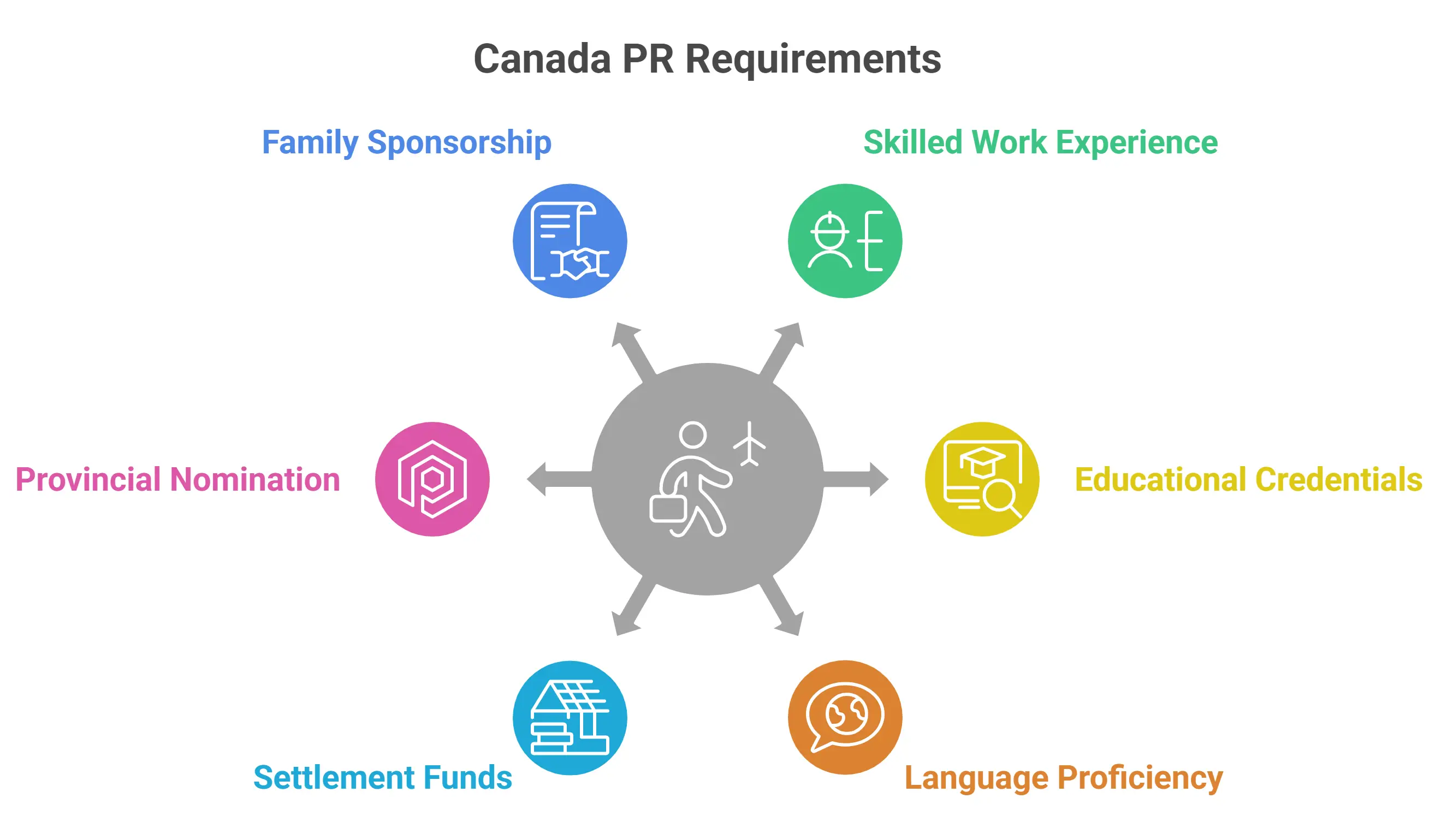
To be eligible for Canada PR, applicants generally need:
- Skilled work experience for pathways such as Express Entry and many Provincial Nominee Programs (PNPs)
- Educational credentials and an Educational Credential Assessment (ECA) for most foreign qualifications
- Valid English or French language test results from an approved provider
- Proof of settlement funds for eligible immigration programs
- A provincial nomination for PNP applicants or an eligible family relationship for Family Sponsorship applicants
*Want to check your eligibility? Get a free eligibility assessment from Y-Axis today.
Documents Required for Canada PR
The documents required for Canada PR vary by immigration pathway, but most applicants must submit documents that verify their identity, education, work experience, language proficiency, and financial eligibility.
- Valid passport
- Language test results from an approved provider such as IELTS, CELPIP, TEF Canada, or TCF Canada
- Educational Credential Assessment for foreign degrees and diplomas
- Employment reference letters and supporting documents confirming work experience
- Bank statements confirming available settlement funds where required
- Police clearance certificates from countries where the applicant has lived for six months or more since the age of 18
- Medical examination results from an approved IRCC panel physician
- Photographs that meet IRCC specifications
- Provincial nomination certificate for PNP applicants
- Relationship documents for Family Sponsorship applicants
How to Apply for Canada PR?
The application process for Canada PR varies depending on the immigration pathway you choose. Express Entry is Canada's most common permanent residence pathway for skilled workers, and the process generally involves the following steps:
Step 1: Check your eligibility for an Express Entry program and obtain your language test results and ECA, if required.
Step 2: Create your Express Entry profile on the IRCC portal. Your CRS score is calculated automatically based on your age, education, work experience, and language results.
Step 3: Enter the Express Entry pool and wait for an Invitation to Apply.
Step 4: If invited, submit your electronic Application for Permanent Residence within 60 days with all required documents and fees.
Step 5: Complete your medical examination with an approved IRCC panel physician and submit police clearance certificates.
Step 6: Await a decision from IRCC. Most Express Entry applications are processed within approximately 6 months after a complete application is submitted.
Step 7: Receive your Confirmation of Permanent Residence and travel to Canada to complete your landing as a permanent resident.
*Want to apply for Canada PR? Get expert guidance from Y-Axis professionals.
Apply Now
FAQs
What is the minimum CRS score for Canada PR?
There is no fixed minimum CRS score. The cut-off changes with every Express Entry draw depending on the candidate pool and draw type. Recent general draws have typically required CRS scores in the high 400s, while category-based draws may have lower cut-offs. A provincial nomination adds 600 CRS points, effectively guaranteeing an Invitation to Apply.
What is the difference between Express Entry and the PNP?
Express Entry is a federal points-based system ranking candidates by CRS score across three permanent residence programs. The Provincial Nominee Program allows provinces to select candidates matching their labour market needs. Enhanced PNP streams link to Express Entry and add 600 CRS points upon nomination. Base PNP streams operate outside Express Entry through a separate paper-based process with processing times of 6 to 18 months or longer.
How long does Canada PR processing take?
Most Express Entry applications are processed within 6 months of submission. Enhanced PNP applications follow a similar timeline. Base PNP applications take 6 to 18 months, with some paper-based files reaching 20 to 24 months. Spousal and partner sponsorship typically takes 10 to 14 months. Parent and grandparent sponsorship involves an annual lottery, with processing taking 20 to 24 months after an invitation is received.
What is the proof of funds requirement for Canada PR?
Proof of funds is required for Federal Skilled Worker and Federal Skilled Trades applicants unless they hold a valid Canadian job offer or are currently working legally in Canada. For a single applicant, the current minimum is CAD 15,263. The amount increases with family size and is updated annually by IRCC. Canadian Experience Class applicants are exempt. Always confirm the latest figure on the official IRCC website before applying.
Do I need a job offer for Canada PR?
A job offer is not required for Canada PR through Express Entry. Most candidates who receive Invitations to Apply do not hold a Canadian job offer. A valid offer in a qualifying occupation may benefit certain PNP stream applications. For most candidates, a provincial nomination adds far more value to a CRS score than a job offer and is the more impactful route to securing an Invitation to Apply.
What language score do I need for Canada PR?
Federal Skilled Worker Program applicants generally need a minimum Canadian Language Benchmark level 7. Language requirements for the Canadian Experience Class vary depending on the occupation. Higher language scores significantly improve CRS points. Approved tests include IELTS and CELPIP for English and TEF or TCF for French. French proficiency at CLB 7 or above adds 25 to 50 additional CRS points and may qualify candidates for French-language category draws with lower cut-off scores.
What is category-based selection in Express Entry?
Category-based selection allows IRCC to run targeted draws for candidates in specific occupations at lower CRS cut-offs than general draws. Active categories include healthcare, STEM, education, transport, skilled trades, and French proficiency. New categories include foreign-trained medical doctors with Canadian experience, senior managers, transport professionals, and certain skilled military personnel. Category draws offer a valuable pathway for candidates with in-demand experience who may not reach the general draw cut-off.
Can I get Canada PR without Canadian work experience?
Yes. The Federal Skilled Worker Program and Federal Skilled Trades Program do not require Canadian work experience. Candidates with strong foreign work experience, high language scores, and a recognised ECA can qualify and build a competitive CRS score. Canadian work experience strengthens a profile and is the primary requirement for the Canadian Experience Class, but it is not needed for the Federal Skilled Worker Program, Federal Skilled Trades Program, or most Provincial Nominee Program streams.
How long does Canada PR take through family sponsorship?
Spousal and common-law partner sponsorship is processed within 10 to 14 months. Dependent children added to a parent's application follow a similar timeline, while standalone child sponsorship takes approximately 10 to 12 months. Parent and grandparent sponsorship involves an annual interest to sponsor lottery, with processing taking 20 to 24 months after a complete application is received. The lottery opens once a year and only a limited number of sponsors are selected.
What is the difference between Canadian PR and Canadian citizenship?
Permanent residence gives the right to live and work anywhere in Canada and access most social benefits. Permanent residents must spend at least 730 days in Canada within every five-year period to maintain status. Citizenship requires three years of physical presence within the five years before applying, language proficiency, and passing a citizenship knowledge test. Citizens can hold a Canadian passport, vote in federal elections, and live outside Canada without restriction.
Tags:
Canada PR
Canada Permanent Residence
Express Entry Canada
Canada PR Requirements
Canada PNP
Canada PR Eligibility
Canada CRS Score
Canada PR Processing Time
Canada PR Application
Canada Citizenship
Share
Latest Article
Popular Post
Trending Article
Posted On October 22 2026
What Are the Different Types of UK Visas to Immigrate?