

Posted on June 15 2026
What are the eligibility requirements for a Canada Work Visa?

By , Editor & Director
Updated June 23 2026
To qualify for a Canada Work Visa, you generally need a valid job offer from a Canadian employer, a Labour Market Impact Assessment (LMIA) in most cases, relevant work experience, and a valid passport. Most applicants apply through either the Temporary Foreign Worker Program (TFWP), which requires an LMIA, or the International Mobility Program (IMP), which includes LMIA-exempt streams such as intra-company transfers and pathways under international agreements. Depending on your work permit type, you may also need proof of language proficiency, educational qualifications, financial stability, and medical and background clearances.
|
Requirement |
Details |
|
Job Offer |
Valid job offer from a Canadian employer for most work permit streams |
|
LMIA |
Required for TFWP streams. LMIA-exempt authorization available through IMP. |
|
Age |
Minimum age is 18, with no upper age limit for most streams. IEC is open to applicants aged 18 to 35. |
|
Language Proficiency |
CLB score may be required depending on the occupation and stream |
|
Work Experience |
Relevant experience in the job offer occupation |
|
Education |
Educational credentials relevant to the role. ECA required for certain occupations. |
|
Health and Background |
Medical examination and police clearance certificates |
|
Financial Proof |
Evidence of sufficient funds to support yourself and dependants |
*Want to apply for a Canada Work Visa? Let Y-Axis guide you through every step of the process.
Eligibility Requirements for a Canada Work Visa
Canada offers multiple work permit pathways under the Temporary Foreign Worker Program (TFWP) and the International Mobility Program (IMP), each with specific eligibility criteria. In most cases, applicants must have a valid job offer, meet experience and educational standards, and satisfy health, character, and financial requirements.
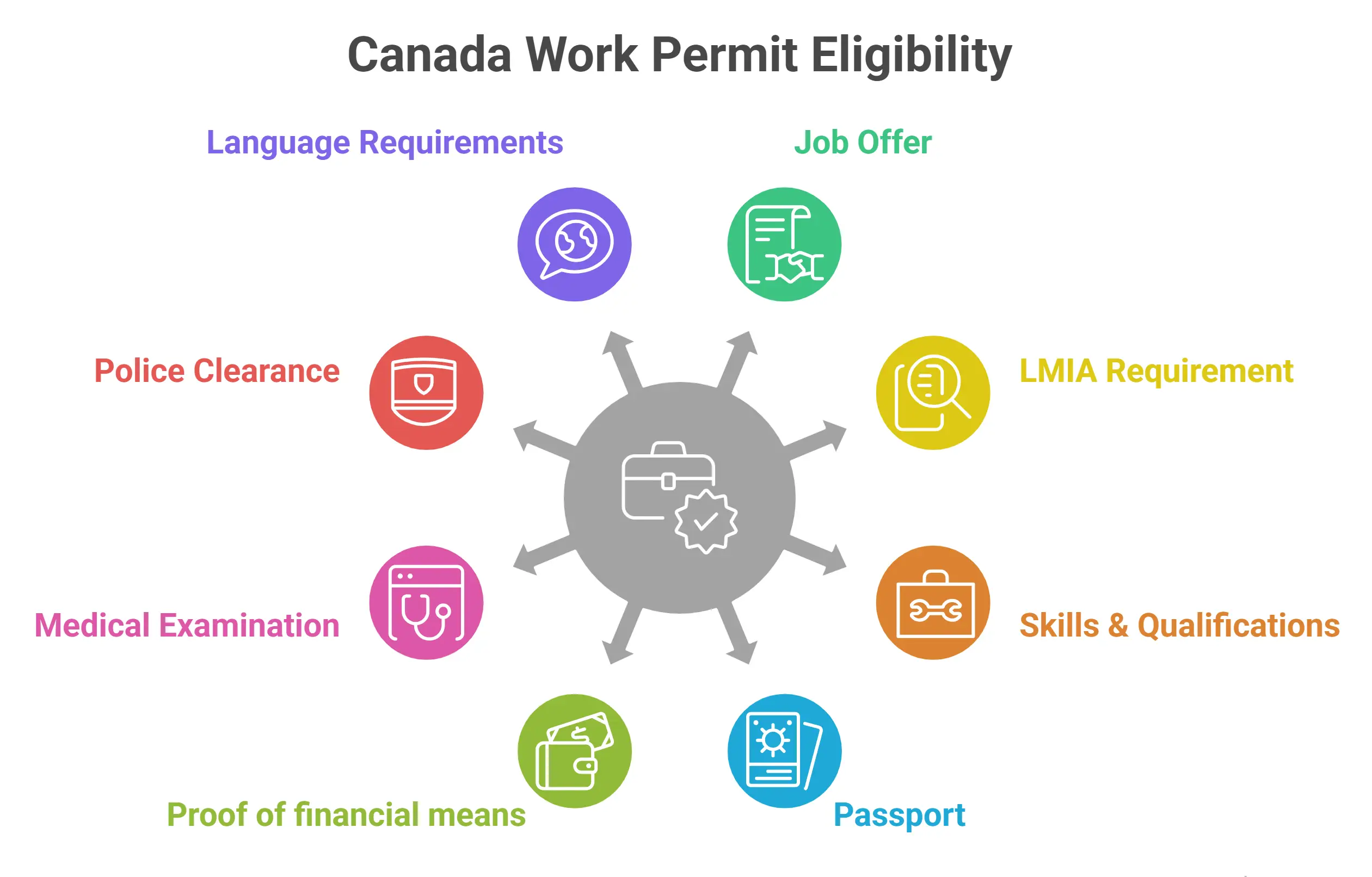
To be eligible for a Canada Work Permit, you may need:
- A valid job offer from a Canadian employer, confirmed through an LMIA or LMIA-exempt authorization
- Relevant work experience and educational qualifications matching your occupation
- Proof of language proficiency such as a CLB score, based on your occupation and stream
- A valid passport and identity documents
- Medical examination, police clearance certificates, and proof of financial means
*Want to check your eligibility? Get free eligibility assessment from Y-Axis today.
Documents Required for a Canada Work Permit
To apply for a Canada Work Permit, you must submit documents related to your identity, qualifications, work experience, language proficiency, and financial standing.
- Valid passport or travel document
- Job offer letter from a Canadian employer, including job title, duties, duration, and salary
- LMIA approval number or LMIA-exempt authorization code
- Educational certificates, transcripts, and ECA report
- Employment reference letters and work experience documents
- Language test results such as IELTS or CELPIP
- Medical examination results, police clearance certificates, and proof of financial means
How to Apply for a Canada Work Visa?
To apply for a Canada Work Visa, you must identify the right work permit stream for your situation, secure a job offer or qualifying authorization where required, and submit a complete application through IRCC.
Step by step application process for a Canada Work Visa:
Step 1: Confirm your eligibility by identifying the work permit stream that applies to your job offer, occupation, and immigration situation.
Step 2: Secure a valid job offer from a Canadian employer. For TFWP applications, ensure your employer has obtained an approved LMIA. For IMP streams, confirm the applicable LMIA exemption code.
Step 3: Gather all required documents, including your passport, educational certificates, language test results, and proof of financial means.
Step 4: Complete a medical examination with a designated physician and obtain police clearance certificates as part of your application.
Step 5: Create an IRCC account and submit your Canada Work Permit application online. Pay the applicable government processing fee.
Step 6: Provide biometrics at a designated Visa Application Centre (VAC).
Step 7: If approved, you will receive a Port of Entry Letter of Introduction to present at the Canadian border.
*Want to apply for a Canada Work Permit? Get expert guidance from Y-Axis professionals.
Apply Now
FAQs
What is the easiest Canada Work Permit to get?
The Open Work Permit is generally the most accessible Canada Work Permit for eligible applicants, as it does not require a specific job offer or LMIA. It is available to spouses of skilled workers, recent Canadian graduates, and applicants in specific humanitarian streams. For those with a job offer, LMIA-exempt streams under the International Mobility Program offer a faster and less complex route than the standard TFWP process.
Can I get a Canada Work Permit without a job offer?
Yes. Certain Canada Work Permit pathways do not require a job offer. The Open Work Permit allows you to work for any compliant Canadian employer and is available to eligible applicants such as spouses of skilled workers, refugee claimants, and participants in specific government programs. Some Provincial Nominee Program streams also allow candidates to obtain a work permit without a prior job offer, provided they meet the province's eligibility criteria.
What is an LMIA and do I need one for a Canada Work Permit?
A Labour Market Impact Assessment (LMIA) is a document a Canadian employer obtains before hiring a foreign worker through the Temporary Foreign Worker Program (TFWP). A positive LMIA confirms no qualified Canadian was available for the role. Many streams under the International Mobility Program (IMP) are LMIA-exempt, including intra-company transfers and roles covered under international trade agreements such as CUSMA.
What is the difference between an open and closed Canada Work Permit?
A closed Canada Work Permit ties you to a specific employer, job title, and location. An open work permit allows you to work for any compliant Canadian employer in most occupations across the country. Open work permits are available to specific groups, including spouses of skilled workers, recent graduates from Canadian institutions, and applicants in refugee or humanitarian streams.
How long does Canada Work Permit processing take?
Processing times vary depending on the stream, country of residence, and application completeness. LMIA-exempt streams under the International Mobility Program may be processed within a few weeks. TFWP applications requiring LMIA approval take longer, depending on the employer's timeline. Global Skills Strategy positions may qualify for two-week processing.
How much does a Canada Work Permit cost?
The Canada Work Permit application fee is CAD 155 for most applicants. An Open Work Permit holder fee of CAD 100 may also apply. Additional costs include biometrics at CAD 85 per person, medical examination fees, police clearance certificates, and document preparation. Employers applying for an LMIA through the TFWP pay a separate processing fee of CAD 1,000 per position in most cases.
Can a Canada Work Permit lead to permanent residency?
Yes. A Canada Work Permit is often the first step toward permanent residence. Skilled workers who gain Canadian work experience under NOC TEER 0, 1, 2, or 3 may qualify for the Canadian Experience Class (CEC) under Express Entry. Provincial Nominee Programs also target workers with Canadian experience in specific occupations or regions, providing an additional pathway to permanent residence.
Is IELTS required for a Canada Work Permit?
Canada Work Permit language requirements vary by stream. Certain occupations and programs require proof of English or French ability through IELTS, CELPIP, or TEF Canada. For applicants planning to transition to permanent residence through Express Entry, meeting language benchmarks is an important step toward building a competitive CRS score.
Can I bring my family to Canada on a Work Permit?
Yes. Most Canada Work Permit holders can bring their spouse or common-law partner and dependent children. Spouses of workers in NOC TEER 0 or 1 occupations, or those in specific high-demand sectors, may qualify for an Open Work Permit, allowing them to work for any compliant Canadian employer. Dependent children can typically study in Canada without a separate study permit in many situations.
What jobs qualify for a Canada Work Permit?
A wide range of occupations qualify for a Canada Work Permit, particularly in high-demand sectors such as information technology, healthcare, engineering, construction, skilled trades, education, and finance. Positions must typically be supported by a valid job offer from a Canadian employer. Roles classified under NOC TEER 0, 1, 2, or 3 are commonly eligible for work permits that can support a pathway to permanent residence.
Tags:
Canada Work Permit
Canada Work Visa
Canada Work Permit Requirements
Canada Immigration
Work in Canada
LMIA Work Permit Canada
Canada Open Work Permit
Canada Skilled Worker Visa
Canada Work Permit Eligibility
Canada Jobs for Foreign Workers
Share
Latest Article
Popular Post
Trending Article
Posted On October 22 2026
What Are the Different Types of UK Visas to Immigrate?