

Posted on October 19 2026
How Can I Get Permanent Residency in Germany?

By , Editor & Director
Updated October 22 2026
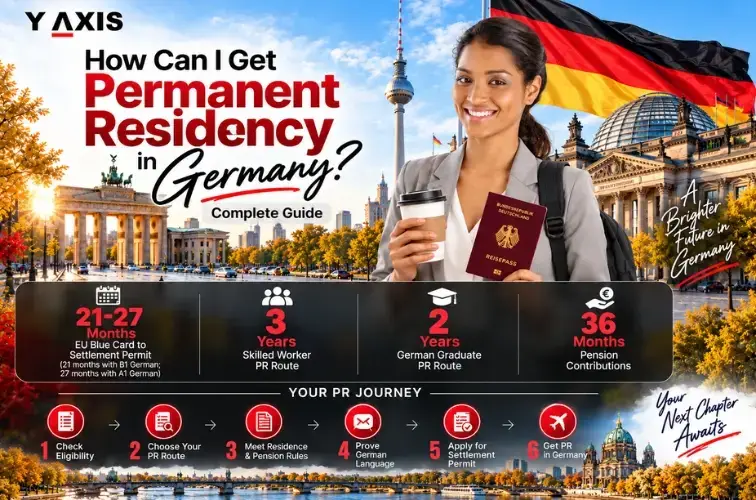
You can get permanent residency (PR) in Germany through a skilled worker residence permit, an EU Blue Card or other qualifying residence routes. Most skilled workers can apply for a settlement permit (Niederlassungserlaubnis) after five years of residence, while eligible EU Blue Card holders can qualify after 21 months with B1-level German or 27 months with A1-level German. Applicants must also meet the requirements for employment, income, pension contributions and German language proficiency. Meeting these requirements allows you to apply for permanent residency and build a long-term future in Germany.
*Want to apply for Germany PR? Let Y-Axis guide you through the application process.
What Are the Pathways to Permanent Residency in Germany?
Germany offers five main pathways to permanent residency (PR), including the EU Blue Card, skilled worker permit, standard settlement permit, German university graduate route and self-employment route. EU Blue Card holders can qualify after 21 months with B1-level German or 27 months with A1-level German. Skilled workers and German graduates may also qualify through faster routes, depending on their residence permit and employment history.
- Standard Settlement Permit: Available after five years of legal residence in Germany, subject to income, pension contribution and language requirements.
- EU Blue Card: Offers a faster PR route after 21 months with B1-level German or 27 months with A1-level German.
- Skilled Workers: Can qualify after three years with a qualifying residence permit and the required pension contributions.
- German University Graduates: Can qualify after two years of skilled employment in Germany and 24 months of pension contributions.
- Self-Employed Individuals: Can qualify after three years of successful business activity and proof of a secure livelihood.
Germany PR Eligibility Requirements
To qualify for permanent residency (PR) in Germany, you generally need five years of residence, 60 months of pension contributions, B1-level German, sufficient income and adequate accommodation. EU Blue Card holders, skilled workers and German university graduates may qualify with shorter residence periods and different pension contribution requirements.
- Residence: At least five years of qualifying residence in Germany.
- Income: Sufficient income to support yourself and your dependants without relying on public assistance.
- Pension contributions: At least 60 months of contributions to the German statutory pension scheme, unless an exemption or different rule applies.
- German language: At least B1-level German.
- Integration test: Basic knowledge of Germany's legal and social system, usually demonstrated through the Living in Germany test or an accepted equivalent.
- Accommodation: Adequate living space for yourself and your family.
- Employment: A valid residence status and, where required, permission to work.
- Criminal record: No serious criminal convictions that would prevent the permit from being granted.
*Need help with Germany PR requirements? Book a free consultation with Y-Axis today.
Documents Required for Germany PR
The documents required for Germany PR include a valid passport, current residence permit, proof of employment and income, pension contribution records, health insurance and proof of accommodation. Applicants may also need a German language certificate and an integration test certificate, depending on their residence permit and settlement route.
- Valid passport and recent biometric photograph
- Current German residence permit and residence history
- Employment contract and recent salary slips
- Proof of income through payslips or tax records
- German Pension Insurance contribution statement
- German language certificate, usually B1 for the standard settlement permit
- Proof of valid health insurance in Germany
- Rental agreement or property ownership documents
- Living in Germany test certificate or accepted equivalent, where required
How to Apply for Permanent Residency in Germany?
To apply for permanent residency (PR) in Germany, meet the eligibility requirements, prepare the required documents and submit your application to the local immigration office (Ausländerbehörde). After approval, you receive a settlement permit (Niederlassungserlaubnis) allowing you to live and work in Germany indefinitely.
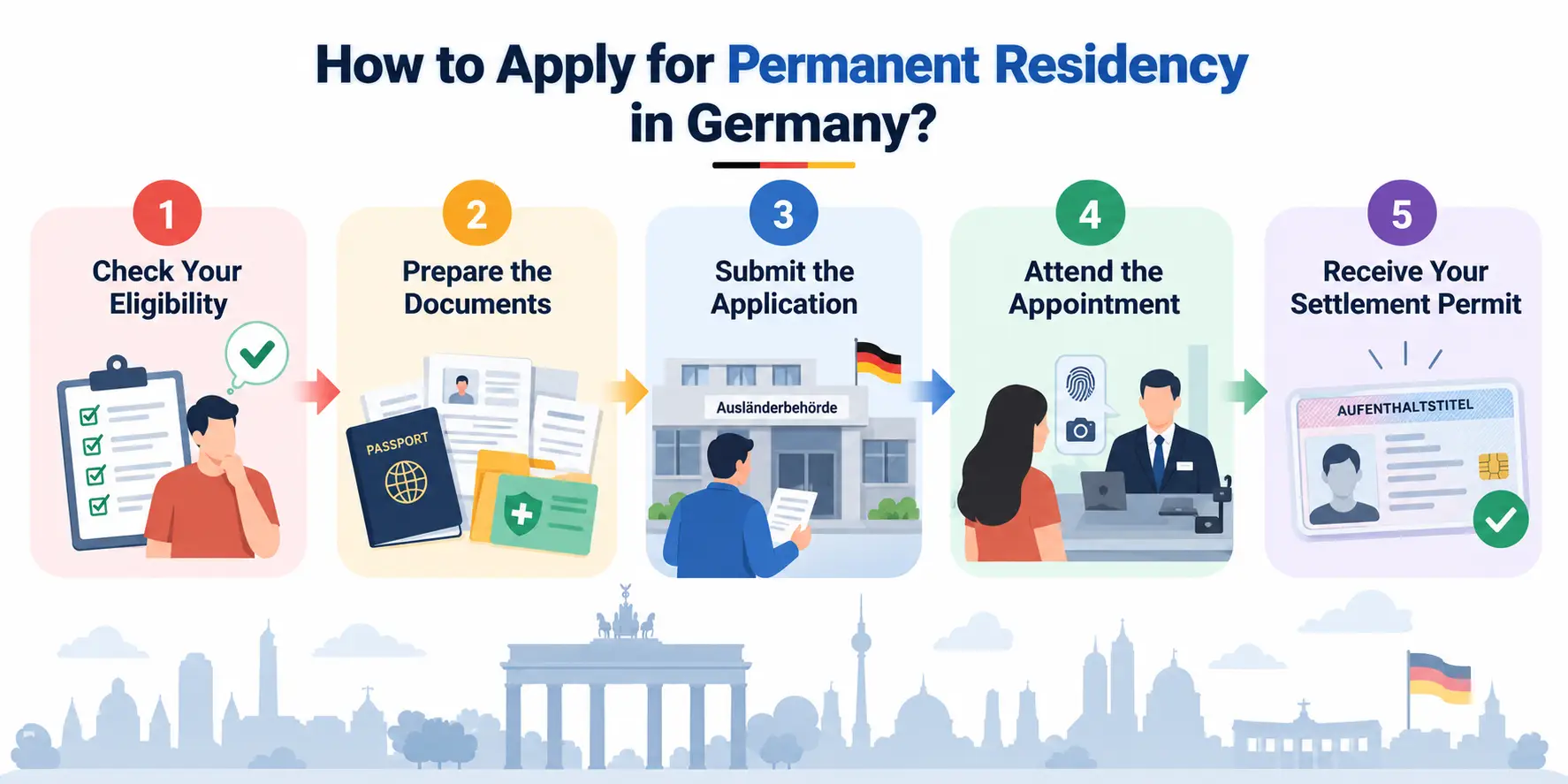
Step 1: Check Your Eligibility
Confirm that you meet the residence period, employment, income, pension contribution and language requirements for your settlement permit.
Step 2: Prepare the Documents
Gather your passport, residence permit, employment contract, income proof, pension contribution record, health insurance and required certificates.
Step 3: Submit the Application
Complete the application form and submit it to the local immigration office (Ausländerbehörde), online or by appointment, depending on local procedures.
Step 4: Attend the Appointment
Present original documents and complete identity verification or provide biometrics if required.
Step 5: Receive Your Settlement Permit
After approval, receive your electronic residence permit card (eAT), confirming your permanent residency status.
*Want to apply for Germany PR? Book a free consultation with Y-Axis today.
Germany PR Fees and Application Costs
The Germany PR application fee is €113 for a standard settlement permit, €147 for highly qualified applicants and €124 for self-employed applicants. Additional expenses may include German language tests, document translation and certification.
|
Applicant Category |
Application Fee |
|
Standard settlement permit |
€113 |
|
Highly qualified applicants |
€147 |
|
Self-employed applicants |
€124 |
Germany PR Processing Time
The processing time for permanent residency in Germany is typically 6 to 8 weeks, depending on the local immigration office and the completeness of the application. After approval, issuing the electronic residence permit card (eAT) may take an additional 4 to 6 weeks. Actual processing times vary by city and application volume.
*Want to settle in Germany permanently? Book a free consultation with Y-Axis today.
FAQs
How long does it take to get permanent residency in Germany?
Most skilled workers qualify after five years of qualifying residence. EU Blue Card holders may qualify after 21 months with B1-level German or 27 months with A1-level German, subject to other requirements.
What are the requirements for Germany PR?
The standard settlement permit generally requires five years of residence, 60 months of pension contributions, B1-level German, sufficient income, adequate accommodation and knowledge of German law and society.
What is the minimum salary required for Germany PR?
Germany has no single minimum salary for all settlement permits. Applicants must demonstrate sufficient income to cover their living expenses and dependants.
Can I get Germany PR without B1 German?
Yes. Eligible EU Blue Card holders can qualify after 27 months of qualified employment with A1-level German. Other settlement routes have different language requirements.
How much does permanent residency in Germany cost?
A standard settlement permit costs €113. Highly qualified applicants generally pay €147, while self-employed applicants generally pay €124. Additional costs may include document translation and language tests.
How long does Germany PR processing take?
Processing times vary by immigration office. Some applications take several weeks, while others take longer due to appointment availability, document checks or application volume.
What is the fastest way to get PR in Germany?
The EU Blue Card offers one of the fastest routes for eligible skilled workers. A settlement permit may be available after 21 months with B1-level German or 27 months with A1-level German, subject to other requirements.
Can I get Germany PR with a job offer?
A job offer alone does not qualify you for PR. It can help you obtain a qualifying German work permit, after which you can build the residence and employment history needed for a settlement permit.
How long after graduation can you get PR in Germany?
Graduates of German universities may qualify after two years of holding a qualifying skilled worker residence permit and completing 24 months of pension contributions, subject to other requirements.
What is the difference between Germany PR and citizenship?
Germany PR allows foreign nationals to live and work in Germany indefinitely while retaining their existing nationality. German citizenship provides a German passport, voting rights in national elections and other citizenship rights.
Tags:
Germany PR
Germany Permanent Residency
Germany Settlement Permit
EU Blue Card Germany
Germany PR Requirements
Germany PR Timeline
Germany PR Eligibility
Germany PR for International Students
Germany PR Language Requirement
Germany PR Pathways
Share
Latest Article
Popular Post
Trending Article
Posted On October 22 2026
What Are the Different Types of UK Visas to Immigrate?