

Posted on June 21 2026
What are the eligibility requirements for an Ireland Work Visa?

By , Editor & Director
Updated June 23 2026
To qualify for an Ireland Work Visa, you need a confirmed job offer from an Irish employer, a valid employment permit, and a Long Stay D Visa. The Critical Skills Employment Permit suits highly skilled professionals in shortage occupations with a minimum salary of €40,904 per year. The General Employment Permit covers a broader range of skilled roles with a minimum salary of €36,605 per year. The employer applies for your permit on your behalf, after which you apply for the D Visa through the Irish Embassy in Ottawa.
|
Requirement |
Details |
|
Job Offer |
Confirmed offer from an Irish employer for a minimum of two years |
|
Permit Type |
Critical Skills Employment Permit or General Employment Permit depending on role and salary |
|
CSEP Salary |
€40,904 per year with a relevant degree; €68,911 without a relevant degree |
|
GEP Salary |
€36,605 per year for most roles; €32,691 for healthcare assistants and agri-food workers |
|
Qualifications |
Relevant degree and experience required for CSEP; role-specific qualifications for GEP |
|
D Visa |
Long Stay D Visa required for Canadian applicants in addition to the employment permit |
|
Language |
No official language test required; employer determines language requirements |
|
Processing Time |
8 to 16 weeks total including employment permit and D Visa processing |
*Want to apply for an Ireland Work Visa? Let Y-Axis guide you through every step of the process.
Eligibility Requirements for an Ireland Work Visa
Eligibility for an Ireland Work Visa depends on your occupation, salary, and qualifications. The Critical Skills Employment Permit and General Employment Permit each have their own salary thresholds and requirements. Your employer selects the appropriate route based on your role and applies on your behalf.
To be eligible for an Ireland Work Visa, you need:
- A confirmed job offer from an Irish employer for a minimum duration of two years
- A salary meeting the minimum threshold for your permit type — €40,904 for CSEP or €36,605 for GEP
- Relevant qualifications and professional experience suited to the role
- A valid passport with sufficient validity for the duration of your permit
- A clean immigration and criminal background meeting Irish work permit requirements
- A Long Stay D Visa to enter Ireland, applied for after your employment permit is approved
- For CSEP: a role on the Critical Skills Occupation List or a salary of €68,911 for roles not on the list
- For GEP: employer confirmation that the role could not be filled from within the EEA labour market
*Want to check your eligibility? Get a free eligibility assessment from Y-Axis today.
Documents Required for an Ireland Work Visa
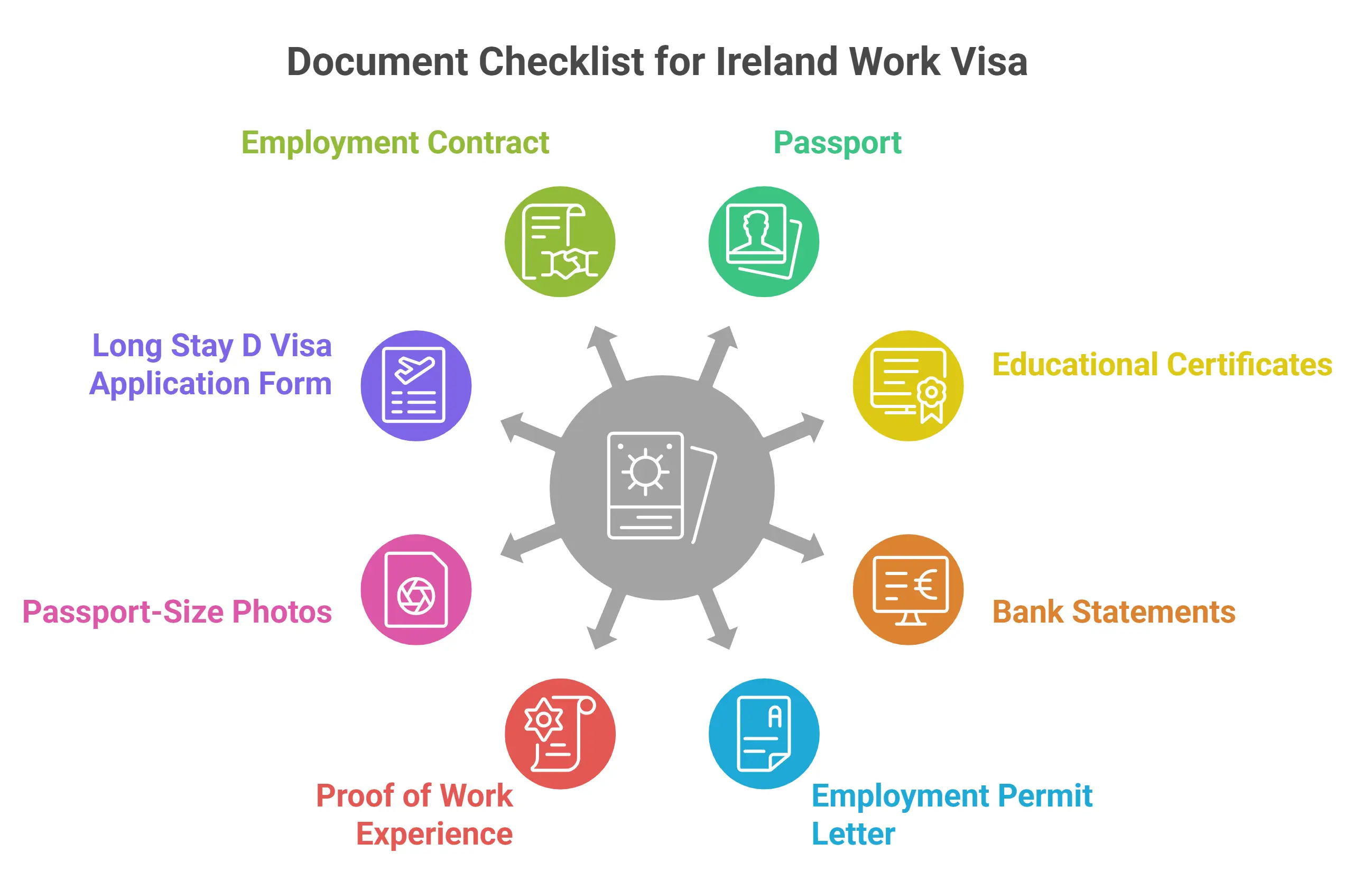
To apply for an Ireland Work Visa from Canada, you must provide documents supporting your job offer, qualifications, identity, and immigration eligibility. While the employment permit application is usually submitted by your employer, you are responsible for submitting the Long Stay D Visa application and supporting documents.
- Valid passport with sufficient validity for your intended stay in Ireland
- Signed employment contract confirming job title, salary, and duration of employment
- Educational certificates, degrees, and professional qualification documents
- Evidence of relevant work experience such as reference letters or payslips
- Bank statements showing proof of sufficient funds to support yourself on arrival
- Passport-size photographs meeting Irish visa specifications
- Completed Long Stay D Visa application form submitted through the AVATS portal
- Employment permit approval letter issued by the relevant Irish authority
- Any additional documents requested by the Irish Embassy in Ottawa during visa processing
How to Apply for an Ireland Work Visa from Canada?
Applying for an Ireland Work Visa from Canada is a two-stage process. Your employer submits the employment permit application first. Once approved, you apply for your Long Stay D Visa through the Irish Embassy in Ottawa.
Step 1: Secure a confirmed job offer from an Irish employer for a role that meets the salary and eligibility requirements for the Critical Skills Employment Permit or General Employment Permit.
Step 2: Your employer submits the employment permit application on your behalf, including all required supporting documents and confirmation of the role and salary.
Step 3: The employment permit application is processed by the relevant Irish authority. Processing typically takes 4 to 8 weeks.
Step 4: Once your employment permit is approved, gather all required documents for your Long Stay D Visa application including your passport, permit approval letter, employment contract, and financial documents.
Step 5: Submit your Long Stay D Visa application and book an appointment at the Irish Embassy in Ottawa to provide biometrics and supporting documents.
Step 6: Pay the D Visa application fee and await your visa decision. D Visa processing typically takes an additional 4 to 8 weeks.
Step 7: Travel to Ireland once your D Visa is approved and register your immigration permission with the relevant Irish immigration authority upon arrival.
*Want to apply for an Ireland Work Visa? Get expert guidance from Y-Axis professionals.
Apply Now
FAQs
What is the difference between the Critical Skills and General Employment Permit?
The Critical Skills Employment Permit is designed for highly skilled professionals working in occupations experiencing labour shortages in Ireland. It generally requires a minimum annual salary of €40,904 with a relevant qualification and does not require a Labour Market Needs Test. The General Employment Permit covers a wider range of occupations, usually requires a minimum salary of €36,605, and requires employers to demonstrate that suitable local or EEA candidates were unavailable.
What salary do I need for an Ireland Work Visa?
The salary requirement depends on the employment permit category. The Critical Skills Employment Permit generally requires a minimum annual salary of €40,904 with a relevant degree or qualification, while higher thresholds apply in certain cases. The General Employment Permit usually requires at least €36,605 per year, although some eligible occupations have lower thresholds. Salaries must meet permit requirements before an application can be approved.
Do Canadians need a visa to work in Ireland?
Yes. Canadian citizens planning to work in Ireland typically need an approved employment permit and a Long Stay D Visa before travelling. The employment permit is usually secured through an Irish employer offering a qualifying job. Once the permit is approved, applicants can apply for the appropriate visa. Both approvals are generally required before entering Ireland for employment purposes and beginning work legally.
How much does an Ireland Work Visa cost from Canada?
The cost of working in Ireland includes both permit and visa-related fees. Employment permits valid for more than six months generally carry a fee of €1,000. Applicants also pay a Long Stay D Visa fee, which is usually €60 for single entry or €100 for multiple entry. Additional expenses may include document certification, translations, medical requirements, courier charges, and professional assistance if needed.
What jobs are in demand for an Ireland Work Visa?
Ireland continues to experience strong demand for skilled workers in information technology, software development, engineering, healthcare, pharmaceuticals, life sciences, financial services, and construction. Many of these occupations appear on Ireland’s Critical Skills Occupations List, making them eligible for favourable permit conditions. Major employment opportunities are concentrated in Dublin, Cork, Galway, and Limerick, where multinational companies and expanding industries regularly recruit international talent.
How long does Ireland Work Visa processing take from Canada?
Processing times vary depending on application volumes and individual circumstances. Employment permit applications are generally processed within four to eight weeks. Once approved, applicants can apply for a Long Stay D Visa, which may require another four to eight weeks for processing. In most cases, the complete process from permit application to arrival in Ireland takes approximately eight to sixteen weeks.
What is Stamp 4 and how do I get it?
Stamp 4 is an Irish immigration permission that allows non-citizens to live and work in Ireland without requiring a separate employment permit. Critical Skills Employment Permit holders may become eligible for Stamp 4 after completing 21 months of qualifying employment. This permission offers greater flexibility, allowing holders to change employers freely and pursue career opportunities without applying for additional work authorisations.
Can I change jobs on an Ireland Work Visa?
Employment permits are generally linked to a specific employer and approved position. Critical Skills Employment Permit and General Employment Permit holders may change employers after meeting eligibility requirements and obtaining approval for a new permit where required. The new role must usually satisfy permit conditions. Once a worker obtains Stamp 4 permission, they can change employers freely without needing a separate employment permit.
Can the Ireland Work Visa lead to permanent residency?
Yes. Employment permit holders who maintain continuous legal residence in Ireland may become eligible for long-term residence or permanent residency after meeting residency requirements. In many cases, five years of lawful residence on qualifying permissions can support a permanent residency application. Those interested in Irish citizenship may also qualify through naturalisation after satisfying residence, character, and other eligibility criteria established by Irish authorities.
Can I bring my family to Ireland on a Work Visa?
Yes. Family reunification options are available for eligible employment permit holders in Ireland. Critical Skills Employment Permit holders can often bring their spouse, partner, and dependent children soon after arrival. Spouses of Critical Skills permit holders may be eligible to work without obtaining a separate employment permit. Family members who require visas must submit their own visa applications before travelling to Ireland.
Tags:
Ireland Work Visa
Ireland Work Permit
Ireland Work Visa Requirements
Ireland Immigration
Work in Ireland
Ireland Critical Skills Permit
Ireland General Employment Permit
Ireland Work Visa Canada
Ireland PR
Ireland Stamp 4
Share
Latest Article
Popular Post
Trending Article

Posted On October 22 2026
What Are the Different Types of UK Visas to Immigrate?