

Posted on July 07 2026
Top 10 Countries for Biotechnologists to Work Abroad: Salary, Demand & PR Opportunities Compared

By , Editor & Director
Updated July 07 2026
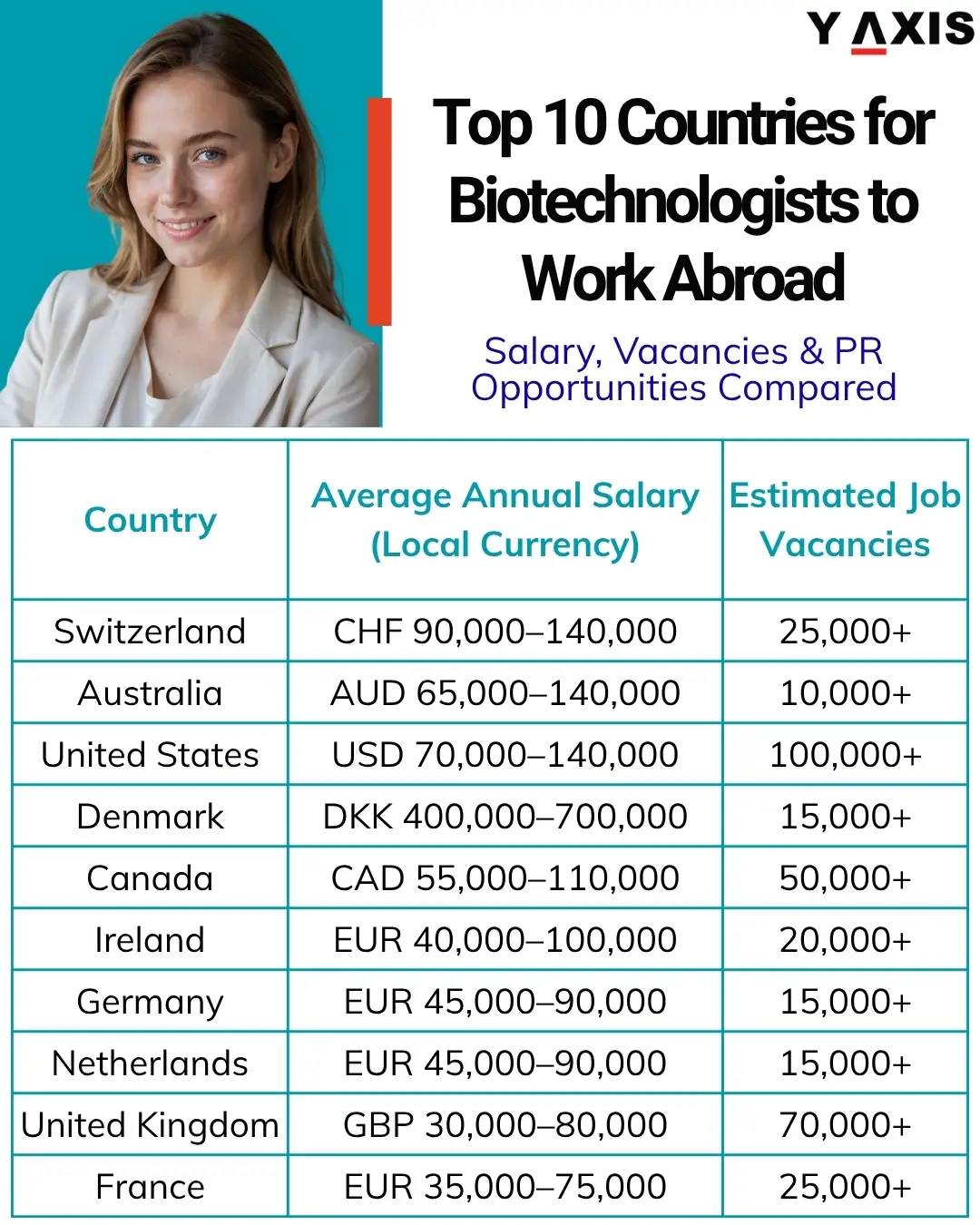
The best countries for Biotechnologists to work abroad are Canada, the United States, Germany, the United Kingdom, Switzerland, Australia, Ireland, the Netherlands, Denmark, and France. These countries offer high-paying biotechnology jobs, strong demand for biotechnology skills, employer-sponsored work visas, and permanent residency or long-term settlement pathways.
Biotechnologists are increasingly needed in biopharmaceuticals, drug discovery, genetic engineering, bioinformatics, clinical research, and biomanufacturing. The global biotechnology market is projected to reach USD 4.41 trillion by 2031, driven by advances in precision medicine, gene and cell therapies, biologics, synthetic biology, and AI-enabled drug discovery.
*Want to work abroad? Sign up with Y-Axis Resume Marketing Services to find right job faster.
Why Work Abroad as a Biotechnologist?
Working abroad offers Biotechnologists higher salaries, strong job demand, access to advanced research facilities, and career opportunities in leading global biotechnology markets.
- Global biotech market to reach USD 4.41 trillion by 2031
- Higher salaries in major biotech hubs
- Access to advanced laboratories and research funding
- Jobs in genomics, biologics, and biomanufacturing
- Work visa and long-term settlement pathways
How to Choose the Right Country for Biotechnologist Jobs Abroad?
The right country for Biotechnologist jobs abroad depends on job demand, salary, biotechnology specialisation, work visa options, and long-term residence pathways. Comparing these factors helps identify the country that best matches your career goals and migration plans.
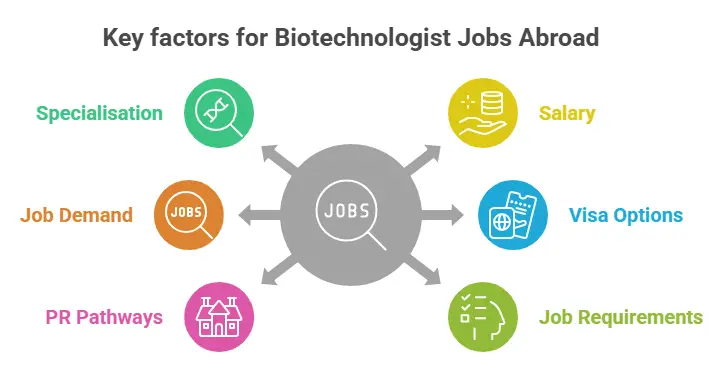
- Specialisation: Match your field with the country’s biotechnology strengths.
- Salary: Compare pay with taxes and living costs.
- Job demand: Check vacancies for your exact biotechnology role.
- Visa options: Review work visa and employer sponsorship routes.
- PR pathways: Compare permanent residence options and timelines.
- Job requirements: Check degree, experience, and technical skill requirements.
Top 10 Countries for Biotechnologists to Work Abroad
Biotechnologists can find high-paying jobs and strong career opportunities across major biotechnology and life sciences markets. In leading destinations, annual salaries can exceed CAD 150,000, while countries such as Canada, the United States, Germany, and Switzerland offer strong demand across biopharmaceuticals, drug discovery, genomics, bioinformatics, clinical research, and biomanufacturing, along with work visa and long-term settlement pathways.
|
Country |
Average Annual Salary (Local Currency) |
Estimated Biotechnologist Job vacancies |
|
Canada |
CAD 55,000–110,000 |
50,000+ |
|
United States |
USD 70,000–140,000 |
100,000+ |
|
United Kingdom |
GBP 30,000–80,000 |
70,000+ |
|
Germany |
EUR 45,000–90,000 |
15,000+ |
|
Switzerland |
CHF 90,000–140,000 |
25,000+ |
|
Australia |
AUD 65,000–140,000 |
10,000+ |
|
Ireland |
EUR 40,000–100,000 |
20,000+ |
|
Netherlands |
EUR 45,000–90,000 |
15,000+ |
|
Denmark |
DKK 400,000–700,000 |
15,000+ |
|
France |
EUR 35,000–75,000 |
25,000+ |
*Want to work abroad? Sign up with Y-Axis Resume Marketing Services to find right job faster.
Best Countries for Biotechnologists to Work and Settle Abroad
Biotechnologists can find strong career and settlement opportunities in countries with established biotechnology industries, sustained demand for life sciences talent, and long-term immigration pathways. Canada, Australia, Germany, the United Kingdom, Ireland, and the Netherlands combine biotechnology jobs with permanent residency or long-term settlement options, while the United States and Switzerland stand out for larger research ecosystems and higher salaries.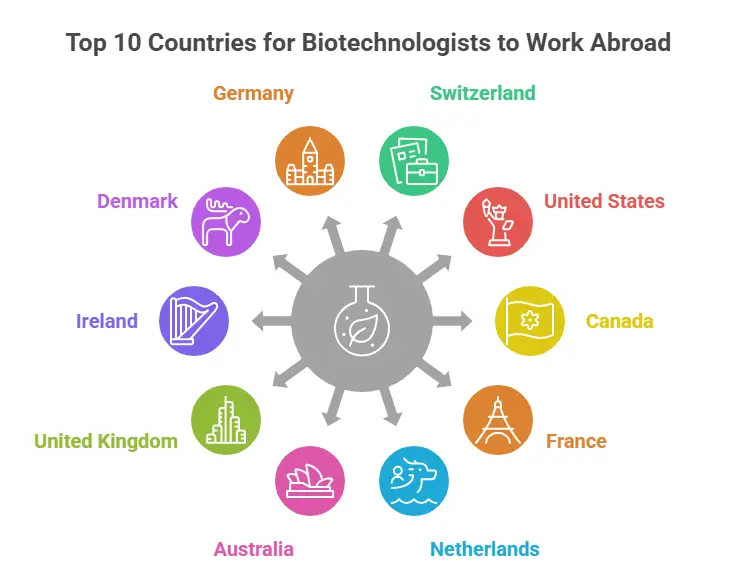
Biotechnologist Jobs in Canada
Canada offers a strong job market for Biotechnologists, supported by growth in biomanufacturing, pharmaceutical research, genomics, and advanced therapies. Toronto, Vancouver, and Montreal are the main life sciences hubs, where hiring spans clinical research, bioinformatics, quality assurance, regulatory affairs, and process development. Investment in vaccine production, biologics manufacturing, cell and gene therapies, and precision medicine is also expanding the range of industry roles. As commercial-scale biomanufacturing grows, demand is increasing for Biotechnologists who can contribute to research, product development, production, quality control, and regulatory compliance.
|
Factor |
Details |
|
Biotechnologist Job Market & Job Vacancies for the Next Decade |
Canada’s biotechnology sector is expected to create more than 50,000 new jobs over the next decade, driven by growth in biopharmaceuticals, biomanufacturing, genomics, bioinformatics, and cell and gene therapies. |
|
Investment in Biotechnology & Life Sciences |
Canada has committed more than CAD 2.2 billion to its Biomanufacturing and Life Sciences Strategy, supporting research, vaccine and therapeutics development, and domestic biomanufacturing. |
|
In-Demand Biotechnology Roles & Skills |
Research scientists, bioprocess specialists, bioinformatics specialists, quality assurance specialists, and regulatory affairs associates; key skills include molecular biology, genomics, data analysis, and bioprocessing. |
|
Work Visa Options for Biotechnologists |
Temporary Foreign Worker Program (TFWP), International Mobility Program (IMP), Express Entry, Provincial Nominee Programs (PNPs), and Atlantic Immigration Program. |
|
Fast-Track Hiring Options |
Global Talent Stream for qualifying occupations, employer-specific work permits, and Provincial Nominee Programs. |
|
PR / Long-Term Residence Opportunities |
Express Entry, Canadian Experience Class, Provincial Nominee Programs, and Atlantic Immigration Program. |
|
Education & Qualification Requirements |
A bachelor’s or master’s degree in biotechnology, biology, biochemistry, microbiology, or bioinformatics; a PhD is typically required for research scientist, senior scientist, and specialised R&D roles. |
|
Eligibility for Dependents |
Spouses or partners and dependent children can accompany the primary applicant. |
|
Benefits for Family Members |
Spouse work rights, public education for children, and access to provincial healthcare where coverage requirements are met. |
*Want to work in Canada? Get expert guidance from Y-Axis professionals.
Biotechnologist Jobs in the United States
The United States has the world’s largest biotechnology market, offering extensive career opportunities in drug discovery, genetic engineering, synthetic biology, personalised medicine, and agricultural biotechnology. Boston-Cambridge, the San Francisco Bay Area, San Diego, and the Research Triangle are major centres for biotechnology employment and innovation.
Strong venture capital funding and continuous research investment support hiring across established pharmaceutical companies, research laboratories, and biotechnology start-ups. Emerging fields such as CRISPR-based therapies, computational biology, and AI-driven drug discovery are also creating specialised roles for Biotechnologists with advanced scientific and data skills.
|
Factor |
Details |
|
Biotechnologist Job Market & Job Vacancies for the Next Decade |
The United States is expected to offer more than 100,000 job opportunities for Biotechnologists over the next decade, driven by growth in drug discovery, biopharmaceuticals, genomics, bioinformatics, and cell and gene therapies. |
|
Investment in Biotechnology & Life Sciences |
The United States invests more than USD 48 billion annually through the National Institutes of Health, supporting biomedical research, genomics, drug discovery, and biotechnology innovation. |
|
In-Demand Biotechnology Roles & Skills |
Research scientists, bioinformatics scientists, bioprocess engineers, clinical scientists, and quality specialists; key skills include molecular biology, genomics, cell culture, data analysis, and bioprocessing. |
|
Work Visa Options for Biotechnologists |
H-1B Visa, O-1 Visa, L-1 Visa, and employment-based immigrant visas. |
|
Fast-Track Hiring Options |
O-1 Visa for individuals with extraordinary ability and premium processing for qualifying employment-based petitions. |
|
PR / Long-Term Residence Opportunities |
Employment-based Green Card pathways through EB-1, EB-2, and EB-3 categories. |
|
Education & Qualification Requirements |
A bachelor’s or master’s degree in biotechnology, molecular biology, biochemistry, microbiology, or bioinformatics; a PhD is typically required for senior scientist and specialised R&D roles. |
|
Eligibility for Dependents |
Spouses and dependent children can accompany the primary visa holder. |
|
Benefits for Family Members |
School access for children and spouse work rights under qualifying dependent visa categories. |
*Want to work in the United States? Get expert guidance from Y-Axis professionals.
Biotechnologist Jobs in the United Kingdom
The UK biotechnology job market is closely linked to its world-class universities, research institutions, and rapidly growing life sciences companies. The London–Oxford–Cambridge Golden Triangle is the main centre for biotechnology employment, particularly in drug development, diagnostics, genomics, and medical biotechnology. University spin-outs and research partnerships play a major role in turning scientific discoveries into new therapies and commercial products. Biotechnologists are also benefiting from growth in bioinformatics and data-led life sciences, where employers increasingly need expertise that combines biological research with computational and analytical skills.
|
Factor |
Details |
|
Biotechnologist Job Market & Job Vacancies for the Next Decade |
The UK life sciences sector is expected to create more than 70,000 new jobs over the next decade, driven by growth in biopharmaceuticals, medical technology, genomics, and data-led life sciences. |
|
Investment in Biotechnology & Life Sciences |
The UK has committed up to GBP 600 million to strengthen health data research infrastructure, supporting drug discovery, clinical research, genomics, and life sciences innovation. |
|
In-Demand Biotechnology Roles & Skills |
Research scientists, bioinformatics specialists, bioprocess engineers, clinical research scientists, and regulatory affairs specialists; key skills include molecular biology, genomics, data analysis, drug development, and bioprocessing. |
|
Work Visa Options for Biotechnologists |
Skilled Worker Visa, Global Talent Visa, Scale-up Worker Visa, High Potential Individual Visa, and employer-sponsored work visas. |
|
Fast-Track Hiring Options |
Global Talent Visa for recognised research and innovation talent, and Skilled Worker Visa sponsorship from approved employers. |
|
PR / Long-Term Residence Opportunities |
Indefinite Leave to Remain (ILR) through qualifying Skilled Worker and Global Talent routes after completing the required residence period. |
|
Education & Qualification Requirements |
A bachelor’s or master’s degree in biotechnology, molecular biology, biochemistry, microbiology, or bioinformatics; a PhD is typically required for senior research and specialised R&D roles. |
|
Eligibility for Dependents |
Spouses or partners and dependent children can accompany the primary applicant under qualifying visa routes. |
|
Benefits for Family Members |
Spouse work rights, access to public education for children, and NHS healthcare after payment of the Immigration Health Surcharge or through an exemption. |
*Want to Work in the United Kingdom? Let Y-Axis guide you through the steps.
Biotechnologist Jobs in Germany
Germany offers a strong employment market for Biotechnologists, particularly in industrial biotechnology, pharmaceutical production, molecular biology, and medical research. Munich, Berlin, Heidelberg, and the Rhine-Neckar region are major centres for biotechnology companies and scientific research.
The country’s strength in engineering and advanced manufacturing also creates opportunities at the intersection of biology and industrial production, including fermentation, enzyme technology, and sustainable bio-based processes. Close collaboration between research institutes and industry supports the development of new medicines, diagnostics, chemicals, and biological products, creating career options in both applied research and commercial biotechnology.
|
Factor |
Details |
|
Biotechnologist Job Market & Job Vacancies for the Next Decade |
Germany is expected to offer more than 15,000 job opportunities for Biotechnologists over the next decade, driven by demand across biopharmaceuticals, industrial biotechnology, molecular biology, and medical research. |
|
Investment in Biotechnology & Life Sciences |
Germany attracted approximately EUR 2 billion in biotechnology investment, a 70% annual increase, supporting cancer therapies, drug development, personalised medicine, and biotechnology R&D. |
|
In-Demand Biotechnology Roles & Skills |
Research scientists, bioprocess engineers, molecular biologists, bioinformatics specialists, and quality assurance specialists; key skills include molecular biology, fermentation, bioprocessing, genomics, and data analysis. |
|
Work Visa Options for Biotechnologists |
EU Blue Card, Skilled Worker Visa, Opportunity Card, and employer-sponsored work visas. |
|
Fast-Track Hiring Options |
Accelerated Skilled Worker Procedure for faster qualification recognition and visa processing. |
|
PR / Long-Term Residence Opportunities |
EU Blue Card holders can qualify for permanent residence after 21 months with B1 German or 27 months with A1 German. |
|
Education & Qualification Requirements |
A bachelor’s or master’s degree in biotechnology, biology, biochemistry, microbiology, or bioinformatics; a PhD is typically required for senior scientist and specialised R&D roles. |
|
Eligibility for Dependents |
Spouses and dependent children can accompany the primary applicant. |
|
Benefits for Family Members |
Spouse work rights, public education for children, and public healthcare coverage. |
*Want to work in Germany? Get expert guidance from Y-Axis professionals.
Biotechnologist Jobs in Switzerland
Switzerland is a major destination for Biotechnologists seeking careers in pharmaceutical and biotechnology research. Basel is the country’s largest life sciences hub, while Zurich, Lausanne, and Geneva also support jobs in biomedical research and emerging biotechnology fields. Much of the hiring is concentrated in high-value areas such as drug discovery, oncology, immunology, personalised medicine, and advanced therapeutics.
The presence of global pharmaceutical companies and specialised biotech firms creates opportunities to work on complex research programmes and new treatment pipelines, making Switzerland particularly attractive for Biotechnologists with specialised scientific expertise and advanced research experience.
|
Factor |
Details |
|
Biotechnologist Job Market & Job Vacancies for the Next Decade |
Switzerland is expected to offer more than 25,000 job opportunities for Biotechnologists over the next decade, supported by growth in drug discovery, biologics, precision medicine, and advanced therapeutics. |
|
Investment in Biotechnology & Life Sciences |
Swiss biotech companies raised CHF 2.6 billion in funding and invested CHF 2.5 billion in R&D, supporting drug development, clinical research, and biotechnology innovation. |
|
In-Demand Biotechnology Roles & Skills |
Research scientists, bioprocess specialists, bioinformatics specialists, clinical scientists, and regulatory affairs specialists; key skills include molecular biology, drug discovery, genomics, data analysis, and bioprocessing. |
|
Work Visa Options for Biotechnologists |
Permit L for short-term employment and Permit B for longer-term employment; EU/EFTA nationals follow free-movement rules, while non-EU/EFTA nationals require employer sponsorship. |
|
Fast-Track Hiring Options |
Employer-sponsored permits for highly qualified specialists and intra-company transfers for employees moving within multinational companies. |
|
PR / Long-Term Residence Opportunities |
Permit C provides permanent residence, generally after 10 years of residence; earlier eligibility applies to some nationalities and qualifying cases. |
|
Education & Qualification Requirements |
A bachelor’s or master’s degree in biotechnology, molecular biology, biochemistry, microbiology, or bioinformatics; a PhD is typically required for senior scientist and specialised R&D roles. |
|
Eligibility for Dependents |
Spouses or partners and dependent children can join the primary permit holder through family reunification. |
|
Benefits for Family Members |
Spouse work rights, public education for children, and access to Switzerland’s mandatory health insurance system. |
Biotechnologist Jobs in Australia
Australia’s biotechnology job market spans medical research, agricultural biotechnology, environmental science, and emerging areas of healthcare innovation. Melbourne and Sydney lead the sector, supported by major research precincts, universities, hospitals, and biotechnology companies, while Brisbane is gaining importance in biomedical innovation.
The country’s strong research base creates roles in areas such as immunology, stem cell research, diagnostics, crop biotechnology, and marine biosciences. A growing focus on translating laboratory discoveries into practical treatments and technologies also creates opportunities for Biotechnologists to contribute to clinical development, commercialisation, and research with real-world applications.
|
Factor |
Details |
|
Biotechnologist Job Market & Job Vacancies for the Next Decade |
Australia is expected to offer more than 10,000 job opportunities for Biotechnologists over the next decade, driven by growth in medical biotechnology, biopharmaceuticals, agricultural biotechnology, and translational research. |
|
Investment in Biotechnology & Life Sciences |
Australia has committed AUD 1.7 billion over 10 years to innovation, science, and digital capabilities, supporting biotechnology research, commercialisation, and advanced technologies. |
|
In-Demand Biotechnology Roles & Skills |
Research scientists, molecular biologists, bioinformatics specialists, clinical research scientists, and bioprocess specialists; key skills include molecular biology, genomics, data analysis, laboratory research, and bioprocessing. |
|
Work Visa Options for Biotechnologists |
Skills in Demand Visa (Subclass 482), Skilled Independent Visa (189), Skilled Nominated Visa (190), Employer Nomination Scheme (186), and Skilled Work Regional Visa (491). |
|
Fast-Track Hiring Options |
Employer-sponsored visas and state or territory nomination for Biotechnologists on applicable skilled occupation lists. |
|
PR / Long-Term Residence Opportunities |
Points-based PR pathways (189/190), employer-sponsored PR (186), and regional pathways (491 → PR). |
|
Education & Qualification Requirements |
A bachelor’s or master’s degree in biotechnology, molecular biology, biochemistry, microbiology, or bioinformatics; a PhD is typically required for senior scientist and specialised R&D roles. |
|
Eligibility for Dependents |
Spouses or partners and dependent children can accompany the primary applicant. |
|
Benefits for Family Members |
Spouse work rights, public education for children, and Medicare access under qualifying visa or residence status. |
*Planning to Work in Australia? Let Y-Axis guide you through every step of the process.
Biotechnologist Jobs in Ireland
Ireland has become a major European centre for biopharmaceutical production, creating strong demand for Biotechnologists across biologics, vaccines, cell therapies, and pharmaceutical operations. Dublin, Cork, Limerick, and Galway are key employment locations, supported by large manufacturing sites and continued investment from global life sciences companies.
Hiring is particularly active in upstream and downstream processing, validation, technology transfer, and manufacturing science. Ireland’s concentration of advanced production facilities makes it especially attractive for Biotechnologists who want to move beyond laboratory research into large-scale development and production of complex biological medicines.
|
Factor |
Details |
|
Biotechnologist Job Market & Job Vacancies for the Next Decade |
Ireland is expected to offer more than 20,000 job opportunities for Biotechnologists over the next decade, driven by growth in biologics manufacturing, biopharmaceutical production, cell therapies, and pharmaceutical R&D. |
|
Investment in Biotechnology & Life Sciences |
Ireland has attracted more than EUR 15 billion in biopharma foreign direct investment, supporting biologics manufacturing, pharmaceutical production, R&D, and new life sciences facilities. |
|
In-Demand Biotechnology Roles & Skills |
Bioprocess scientists, research scientists, validation specialists, manufacturing scientists, and quality specialists; key skills include bioprocessing, cell culture, validation, technology transfer, and GMP compliance. |
|
Work Visa Options for Biotechnologists |
Critical Skills Employment Permit, General Employment Permit, Intra-Company Transfer Employment Permit, and Hosting Agreement for Researchers. |
|
Fast-Track Hiring Options |
Critical Skills Employment Permit for qualifying scientific roles and Hosting Agreement for researchers. |
|
PR / Long-Term Residence Opportunities |
Stamp 4 after 21 months under a Critical Skills Employment Permit or Hosting Agreement, or after 57 months under a General Employment Permit. |
|
Education & Qualification Requirements |
A bachelor’s or master’s degree in biotechnology, biochemistry, microbiology, molecular biology, or bioprocessing; a PhD is typically required for senior scientist and specialised R&D roles. |
|
Eligibility for Dependents |
Spouses or partners and dependent children can join the primary applicant under qualifying immigration routes. |
|
Benefits for Family Members |
Spouse work rights, public education for children, and access to public healthcare services. |
Biotechnologist Jobs in the Netherlands
The Netherlands offers a highly connected biotechnology job market, with Leiden, Amsterdam, Utrecht, and Wageningen serving as major centres for life sciences research and innovation. Leiden Bio Science Park supports a large concentration of companies working in therapeutics and drug development, while Wageningen is internationally recognised for agricultural and food biotechnology.
Career opportunities also extend into regenerative medicine, diagnostics, and microbiology. The country’s close network of universities, research centres, start-ups, and established companies makes it easier for scientific discoveries to move into practical applications, supporting varied career paths for Biotechnologists.
|
Factor |
Details |
|
Biotechnologist Job Market & Job Vacancies for the Next Decade |
The Netherlands is expected to offer more than 15,000 job opportunities for Biotechnologists over the next decade, driven by growth in biopharmaceuticals, regenerative medicine, agricultural biotechnology, and diagnostics. |
|
Investment in Biotechnology & Life Sciences |
The Netherlands has committed EUR 1.3 billion to strengthen its biotechnology sector through 2040, supporting research, infrastructure, commercialisation, and biotechnology innovation. |
|
In-Demand Biotechnology Roles & Skills |
Research scientists, molecular biologists, bioinformatics specialists, bioprocess specialists, and regenerative medicine scientists; key skills include molecular biology, genomics, cell culture, data analysis, and bioprocessing. |
|
Work Visa Options for Biotechnologists |
Highly Skilled Migrant Permit, EU Blue Card, Intra-Corporate Transferee Permit, and employer-sponsored work permits. |
|
Fast-Track Hiring Options |
Highly Skilled Migrant Scheme through an IND-recognised sponsor, with streamlined residence permit processing. |
|
PR / Long-Term Residence Opportunities |
Permanent residence after 5 years of continuous legal residence and meeting income and civic integration requirements. |
|
Education & Qualification Requirements |
A bachelor’s or master’s degree in biotechnology, molecular biology, biochemistry, microbiology, or bioinformatics; a PhD is typically required for senior scientist and specialised R&D roles. |
|
Eligibility for Dependents |
Spouses or partners and dependent children can accompany the primary applicant. |
|
Benefits for Family Members |
Spouse work rights, public education for children, and access to the Dutch healthcare system through mandatory health insurance. |
Biotechnologist Jobs in Denmark
Denmark stands out for biotechnology careers linked to enzymes, fermentation, biosolutions, and sustainable production. Copenhagen and the wider Medicon Valley region are major employment centres, while Denmark’s strong industrial bioscience sector creates roles in developing biological alternatives for food, agriculture, energy, and manufacturing.
Biotechnologists are particularly sought for microbial research, strain development, fermentation technology, and the use of enzymes in commercial products. The country’s shift towards a bio-based economy is also expanding career opportunities in areas where biotechnology is used to reduce waste, improve resource efficiency, and develop more sustainable industrial processes.
|
Factor |
Details |
|
Biotechnologist Job Market & Job Vacancies for the Next Decade |
Denmark is expected to offer more than 15,000 job opportunities for Biotechnologists over the next decade, driven by growth in biopharmaceuticals, enzymes, fermentation, biosolutions, and sustainable biotechnology. |
|
Investment in Biotechnology & Life Sciences |
Denmark’s life sciences companies invest nearly DKK 16 billion annually in R&D, supporting drug development, biotechnology research, enzymes, and advanced biological solutions. |
|
In-Demand Biotechnology Roles & Skills |
Research scientists, fermentation scientists, bioprocess specialists, microbiologists, and enzyme specialists; key skills include microbial biotechnology, fermentation, strain development, bioprocessing, and molecular biology. |
|
Work Visa Options for Biotechnologists |
Positive List for People with a Higher Education, Pay Limit Scheme, Fast-track Scheme, and Researcher Scheme. |
|
Fast-Track Hiring Options |
Fast-track Scheme through SIRI-certified employers and the Positive List for occupations facing labour shortages. |
|
PR / Long-Term Residence Opportunities |
Permanent residence generally after 8 years of legal residence, or after 4 years when all supplementary requirements are met. |
|
Education & Qualification Requirements |
A bachelor’s or master’s degree in biotechnology, microbiology, biochemistry, molecular biology, or biochemical engineering; a PhD is typically required for senior scientist and specialised R&D roles. |
|
Eligibility for Dependents |
Spouses or partners and dependent children can accompany the primary applicant. |
|
Benefits for Family Members |
Spouse work rights, public education for children, and access to Denmark’s public healthcare system after registration. |
Biotechnologist Jobs in France
France has a diverse biotechnology job market built around healthcare innovation, scientific research, and a growing network of biotech companies. Paris, Lyon, Strasbourg, and Toulouse are important employment centres, with opportunities in immunotherapy, infectious diseases, diagnostics, microbiology, and rare disease research. The country’s major public research institutions also contribute to the development of new medicines and biotechnology applications.
Growth in specialised biotech companies is creating more career options beyond academic research, particularly for Biotechnologists involved in preclinical development, biomarker discovery, laboratory technologies, and the early-stage development of new therapies.
|
Factor |
Details |
|
Biotechnologist Job Market & Job Vacancies for the Next Decade |
France is expected to offer more than 20,000 job opportunities for Biotechnologists over the next decade, driven by growth in biopharmaceuticals, immunotherapy, diagnostics, microbiology, and advanced therapies. |
|
Investment in Biotechnology & Life Sciences |
France has committed EUR 7.5 billion under France 2030 to health innovation, supporting biotherapies, biomanufacturing, infectious diseases, medical technologies, and digital health. |
|
In-Demand Biotechnology Roles & Skills |
Research scientists, molecular biologists, bioprocess specialists, clinical research scientists, and bioinformatics specialists; key skills include molecular biology, immunology, genomics, cell culture, and data analysis. |
|
Work Visa Options for Biotechnologists |
Talent Passport, Researcher Talent Passport, EU Blue Card, and employer-sponsored work permits. |
|
Fast-Track Hiring Options |
Talent Passport for highly qualified employees and Researcher Talent Passport for scientists with a hosting agreement. |
|
PR / Long-Term Residence Opportunities |
Long-term resident status after 5 years of continuous legal residence and meeting income, integration, and language requirements. |
|
Education & Qualification Requirements |
A bachelor’s or master’s degree in biotechnology, molecular biology, biochemistry, microbiology, or bioinformatics; a PhD is typically required for senior scientist and specialised R&D roles. |
|
Eligibility for Dependents |
Spouses or partners and dependent children can accompany the primary applicant. |
|
Benefits for Family Members |
Spouse work rights, public education for children, and access to France’s public healthcare system. |
Job Outlook for Biotechnologists over the Next Decade
The job outlook for Biotechnologists over the next decade is highly positive due to expansion of biotechnology across healthcare, pharmaceuticals, agriculture, food production, and environmental science. Growth in biologics, cell and gene therapies, genomics, bioinformatics, and biomanufacturing is increasing demand for biotechnology expertise worldwide. Canada alone is expected to create more than 50,000 biotechnology and pharmaceutical jobs, while major life sciences markets across Europe, North America, and Asia-Pacific continue to expand.
Hiring will be particularly strong in research and development, bioprocessing, quality assurance, regulatory affairs, and computational biology. Biotechnologists with expertise in molecular biology, genomics, data analysis, automation, and commercial-scale production will have the strongest international career prospects.
*Want to work abroad? Sign up with Y-Axis Resume Marketing Services to find right job faster.
Apply Now
FAQs
Which country is best for Biotechnologists to work abroad?
Canada is best for job opportunities and PR pathways, Switzerland for high salaries and pharmaceutical R&D, Ireland for biopharmaceutical manufacturing, Germany for industrial biotechnology, and Denmark for enzymes, fermentation, and biosolutions.
Which country pays the highest salary for Biotechnologists?
Switzerland generally offers the highest salaries among the countries compared, with Biotechnologists earning around CHF 90,000–140,000 annually. The United States also offers high salaries, particularly in drug discovery, bioinformatics, genomics, and biopharmaceutical R&D.
Which country has the highest demand for Biotechnologists?
The United States has the largest biotechnology employment market, while Canada is expected to create more than 50,000 biotechnology and pharmaceutical jobs over the next decade. The UK, Germany, Ireland, and Switzerland also recruit Biotechnologists across research, bioprocessing, manufacturing, bioinformatics, and quality assurance.
Is biotechnology a good career abroad?
Yes. Biotechnology offers careers in drug discovery, vaccine development, biologics manufacturing, genomics, bioinformatics, agricultural biotechnology, and environmental biotechnology. Job prospects are strongest for Biotechnologists with laboratory expertise, bioprocessing experience, computational skills, or knowledge of GMP and regulatory requirements.
What are the highest-paying biotechnology jobs abroad?
Principal scientists, senior research scientists, bioinformatics scientists, computational biologists, clinical development scientists, bioprocess engineers, and R&D directors are among the highest-paying biotechnology roles. Principal scientist and R&D leadership positions usually require extensive industry experience and, for research-intensive roles, a PhD.
What qualifications are required to work as a Biotechnologist abroad?
Most employers require a bachelor’s or master’s degree in biotechnology, molecular biology, biochemistry, microbiology, bioinformatics, or biochemical engineering. Senior scientist, principal scientist, and research-intensive drug discovery roles commonly require a PhD and relevant laboratory or industry experience.
Can I work abroad after completing a BSc in biotechnology?
Yes. A BSc in biotechnology can lead to entry-level jobs such as laboratory technician, quality control analyst, biomanufacturing associate, research assistant, and clinical research assistant. Research scientist and specialised drug discovery roles usually require a master’s degree or PhD.
Can I work abroad after completing an MSc in biotechnology?
Yes. An MSc in biotechnology can qualify candidates for roles such as research associate, bioprocess scientist, molecular biology specialist, quality assurance specialist, regulatory affairs associate, and clinical research associate. Employers commonly prioritise laboratory techniques, industry internships, GMP knowledge, and experience with relevant instruments or software.
Is a PhD required for biotechnology jobs abroad?
No. A PhD is generally not required for quality assurance, regulatory affairs, biomanufacturing, laboratory operations, or many bioprocessing roles. It is commonly required for principal scientist, senior research scientist, independent drug discovery, and specialised R&D positions.
Which biotechnology field has the best career scope abroad?
Biopharmaceuticals, bioinformatics, genomics, cell and gene therapy, biomanufacturing, synthetic biology, and computational biology have the strongest international career scope. Biopharmaceutical manufacturing is particularly prominent in Ireland, pharmaceutical R&D in Switzerland, industrial biotechnology in Germany, and fermentation and biosolutions in Denmark.
What skills are most in demand for biotechnology jobs abroad?
In-demand skills include molecular biology, PCR, genomics, cell culture, fermentation, bioprocessing, bioinformatics, GMP compliance, quality assurance, and regulatory documentation. Python, R, next-generation sequencing analysis, laboratory automation, and computational biology are particularly valuable for biotechnology roles involving biological data.
What is the average salary of a Biotechnologist abroad?
Biotechnologists can earn around CAD 70,000–110,000 in Canada, CHF 90,000–140,000 in Switzerland, AUD 80,000–120,000 in Australia, and EUR 55,000–90,000 in Germany. Salaries vary by job role, experience, biotechnology specialisation, and employer.
Which European country is best for biotechnology jobs?
Switzerland is best for pharmaceutical R&D and high salaries, Ireland for biologics manufacturing, Germany for industrial biotechnology, Denmark for enzymes and fermentation, and the Netherlands for regenerative medicine and agricultural biotechnology. The best country depends on the Biotechnologist’s specialisation.
Can Biotechnologists get permanent residence abroad?
Yes. Canada offers Express Entry and Provincial Nominee Programs, Australia offers Subclass 189, 190, 186, and 491 pathways, Germany provides permanent residence routes for skilled workers and EU Blue Card holders, and Ireland offers Stamp 4 to qualifying employment permit holders.
Which country is easiest for Biotechnologists to immigrate to?
Canada and Australia provide structured skilled migration and PR pathways for qualifying Biotechnologists. Germany offers the EU Blue Card and Skilled Worker Visa, while Ireland provides the Critical Skills Employment Permit for qualifying roles. Eligibility depends on qualifications, occupation classification, salary, work experience, and job offer requirements.
Do biotechnology jobs abroad require work experience?
Not always. Laboratory technician, research assistant, quality control analyst, and biomanufacturing associate roles may accept graduates with internships or laboratory training. Scientist, bioprocess development, regulatory affairs, and management roles generally require relevant research or industry experience.
Can Biotechnologists work in pharmaceutical companies?
Yes. Pharmaceutical companies hire Biotechnologists as research scientists, bioprocess scientists, quality assurance specialists, validation specialists, regulatory affairs associates, clinical research scientists, and manufacturing scientists. Their work covers drug discovery, biologics production, clinical development, quality control, and regulatory approval.
What are the best cities for biotechnology jobs abroad?
Major biotechnology hubs include Boston and San Francisco in the United States, Toronto and Vancouver in Canada, Basel in Switzerland, Cambridge in the UK, Munich and Berlin in Germany, Dublin and Cork in Ireland, Leiden in the Netherlands, Copenhagen in Denmark, and Melbourne in Australia.
Is biotechnology in demand for the next decade?
Yes. Hiring is expected to expand in biologics manufacturing, cell and gene therapies, genomics, bioinformatics, vaccine development, and computational biology. Biotechnologists with expertise in bioprocessing, molecular biology, GMP environments, next-generation sequencing, and biological data analysis will be well positioned for future roles.
How can I get a biotechnology job abroad?
Choose countries hiring in your biotechnology specialisation, check the required qualifications and work visa, and target matching job titles. Build experience in laboratory methods, bioprocessing, bioinformatics, GMP, or regulatory documentation, and then apply to biotechnology companies, pharmaceutical manufacturers, CDMOs, research institutes, universities, and hospitals.
Tags:
Biotechnologist Jobs
Biotechnology Jobs Abroad
Biotechnology Careers
Work Abroad
Jobs Abroad
Biotechnologist Salary
Biotechnology Job Demand
Work Visas
PR Opportunities
Best Countries to Work Abroad
Share
Latest Article
Popular Post
Trending Article
Posted On September 16 2026
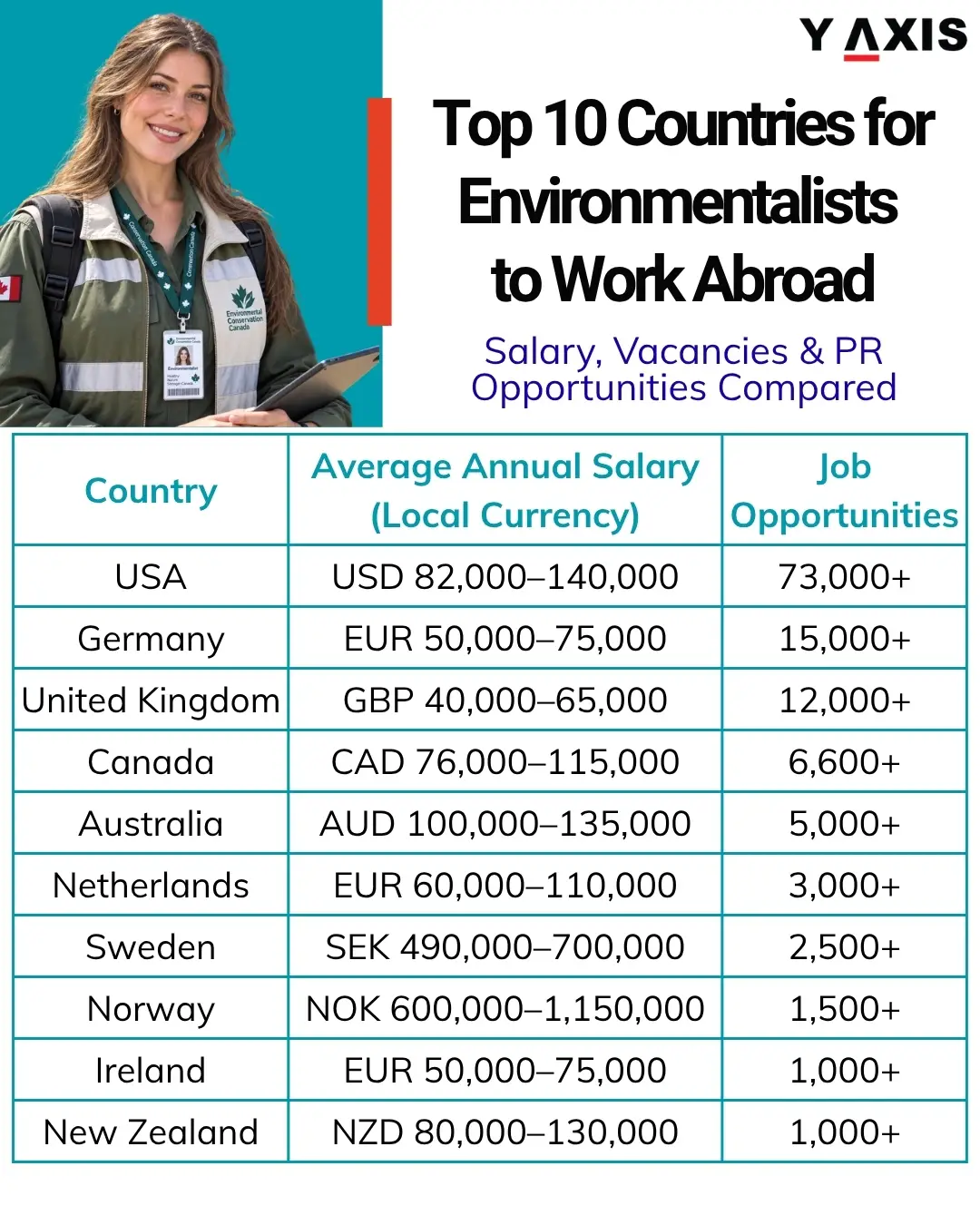
Top 10 Countries for Environmentalists to Work Abroad: Salary, Demand & PR Opportunities Compared