


Don't know what to do ?
Get Free Counseling
Last Updated: November 08, 2026
Australia Visitor Visa (Subclass 600) from Canada
Travelling to Australia from Canada requires choosing a visa that matches your purpose and length of stay. Whether you plan to explore the country, visit family and friends, or attend business activities, understanding the available visa options can help you prepare for a smooth application process. Canadian passport holders usually use the Electronic Travel Authority (ETA) for short visits. However, the Visitor visa (subclass 600) may be suitable for longer stays, specific travel purposes or travellers who are not eligible for an ETA.
The Visitor visa (subclass 600) allows eligible travellers to visit Australia for tourism, family visits or business visitor activities. Depending on the stream, visitors may be granted a stay of up to 12 months. From July 1, 2026, the Tourist stream application fee is AUD 250 when applying outside Australia and AUD 630 when applying inside Australia. Most eligible Canadian passport holders visiting for up to three months can apply for an ETA, which has a AUD 20 service fee. The Australian Government has also announced plans to introduce a No Further Stay condition on future visitor visas. This planned change should be distinguished from the conditions currently attached to existing visa grants.
Key Features of the Australia Visitor Visa
| Feature | Details |
|---|---|
| Visa subclass | 600 |
| Visa type | Temporary visitor visa |
| Main purposes | Tourism, family visits and business visitor activities |
| Maximum stay | Up to 12 months, depending on the stream and grant |
| Application method | Online through ImmiAccount |
| Work permission | Not permitted |
| Short-term study | Up to 3 months, where permitted |
| Entry type | Single or multiple entry, depending on the grant |
| Application fee | Depends on the stream and application location |
| Processing time | Varies by stream and application |
Australia Visitor Visa Latest Updates
- Visitor visa fees increased from July 1, 2026.
- The Tourist stream costs AUD 250 from outside Australia and AUD 630 from inside Australia.
- The Frequent Traveller stream costs AUD 1,845 and is restricted to eligible nationalities, not Canadians.
- Visitor visa applications are generally submitted online through ImmiAccount.
- The Government announced a plan to introduce a No Further Stay condition on future visitor visas on September 17, 2026.
What Is an Australia Visitor Visa (Subclass 600)?
The Australia Visitor visa (subclass 600) is a temporary visa for people who want to travel to Australia for holidays, visit family and friends, or undertake permitted business visitor activities. Depending on the stream, applicants can apply from outside or inside Australia. The visa may allow a stay of up to 12 months, although the actual period is decided by the Department of Home Affairs. The visa does not generally allow visitors to work in Australia. Some streams allow short-term study or training for up to three months.
What Does the Australia Visitor Visa Allow You to Do?
With a Visitor visa (subclass 600), eligible travellers can:
- Visit family members and friends in Australia.
- Enjoy holidays and sightseeing.
- Take part in permitted business visitor activities.
- Attend conferences and trade events.
- Go on cruises that include visits to Australia.
- Study or participate in training for up to three months, where permitted.
Can you extend your stay?
You may be able to apply for another visa while in Australia if your current visa does not have a No Further Stay condition or another restriction preventing a further application. However, the Government has announced plans to add a No Further Stay condition to future visitor visas. This is a planned policy change, not a reason to assume every existing visitor visa already has that condition.
Benefits of the Australia Visitor Visa
The subclass 600 visa offers several benefits to eligible visitors.
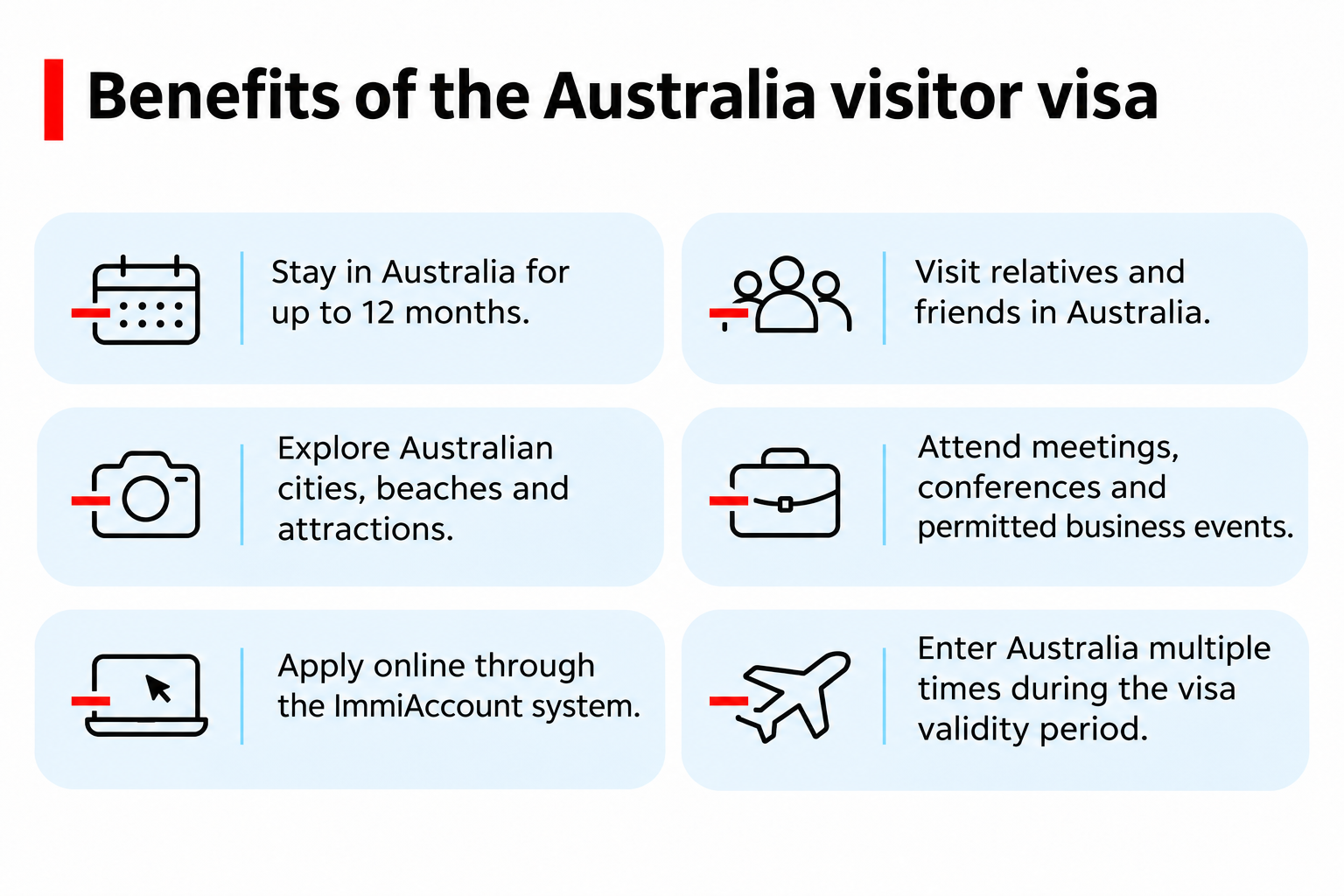
- Flexible stay: Depending on the stream and visa grant, you may stay for up to 12 months.
- Family visits: Visit relatives and friends living in Australia.
- Tourism: Explore Australian cities, beaches and attractions.
- Business visits: Attend meetings, conferences and permitted business events.
- Online application: Apply through the Australian Government's ImmiAccount system.
- Multiple entry: Some applicants may receive permission to enter Australia multiple times during the visa validity period.
Eligibility Requirements for Australia Visitor Visa
Canadian residents and other eligible travellers can apply for an Australian Visitor visa if they meet the relevant requirements.
Applicants generally need to:
- Hold a valid passport.
- Have a genuine reason for visiting Australia.
- Show sufficient funds to support their stay.
- Meet health and character requirements.
- Provide information about their travel plans.
- Intend to leave Australia before their authorised stay ends.
Depending on the stream, applicants can apply from inside or outside Australia. Sponsored Family and Business Visitor stream applicants must generally be outside Australia when applying and when the application is decided.
Documents Required for an Australia Visitor Visa
Applicants may need to provide the following documents when applying for a subclass 600 visa.
- Valid passport: Confirms the applicant’s identity and nationality.
- Passport-sized photograph: Supports identity verification.
- Bank statements: Shows that the applicant has sufficient funds to cover the trip.
- Employment letter: Confirms current employment and income.
- Travel itinerary: Explains the planned travel dates and activities in Australia.
- Accommodation details: Shows where the applicant plans to stay during the visit.
- Invitation letter: Supports the application when visiting family or friends in Australia.
- Sponsor documents: Required for applicants applying under the Sponsored Family stream.
- Previous travel history: Provides details of past international travel.
- Medical documents: Must be provided if requested by the Department of Home Affairs.
- Police certificates: Must be provided if requested by the Department of Home Affairs.
Types of Australia Visitor Visa (Subclass 600)
The subclass 600 visa has different streams based on the applicant's travel purpose, nationality and location.
| Visa Stream | Purpose | Where to Apply | Maximum Stay |
|---|---|---|---|
| Tourist Stream (Offshore) | Holidays and visiting family or friends | Outside Australia | Up to 12 months |
| Tourist Stream (Onshore) | Tourism and family visits while already in Australia | Inside Australia | Up to 12 months |
| Business Visitor Stream | Business meetings, conferences and contract negotiations | Outside Australia | Generally up to 3 months |
| Sponsored Family Stream | Visiting family members who sponsor the applicant | Outside Australia | Up to 12 months |
| Approved Destination Status (ADS) Stream | Visiting Australia as part of an approved organised tour | Outside Australia | As specified in the visa grant |
| Frequent Traveller Stream | Frequent tourism or business visits | Outside Australia | Up to 3 months per visit; visa validity may be up to 10 years |
Important: The Frequent Traveller stream is available only to citizens of specified Asian and Pacific countries. Canadian passport holders are not eligible. The ADS stream is designed for eligible organised tour groups, particularly from China.
Tourist Stream – Apply Outside Australia
This stream is suitable for people travelling to Australia for holidays, sightseeing, cruises or family visits.
- Applicants must be outside Australia when applying and when the visa is decided.
- The visa may allow a stay of 3, 6 or 12 months.
- The application fee starts at AUD 250.
- Applicants must demonstrate that they are genuine temporary visitors.
Tourist Stream – Apply Inside Australia
This stream is suitable for eligible people already in Australia who want to continue their visit.
- Applicants must be in Australia when applying and when the application is decided.
- The visa may allow a stay of up to 12 months.
- The application fee starts at AUD 630.
- Applicants must check their current visa conditions before applying.
Business Visitor Stream
This stream is designed for people travelling to Australia for permitted business activities.
It allows visitors to:
- Attend business meetings.
- Negotiate or review contracts.
- Attend conferences and trade fairs.
- Make general business enquiries.
It does not allow visitors to work for an Australian business or provide services to an Australian organisation. The application fee is AUD 250.
Sponsored Family Stream
This stream allows eligible visitors to visit family members in Australia with an approved family sponsor.
- The sponsor must generally be an Australian citizen or permanent resident who meets the sponsorship requirements.
- A security bond may be requested.
- The visa may allow a stay of up to 12 months.
- The application fee is AUD 250.
The applicant must generally apply from outside Australia.
Approved Destination Status Stream
This stream is for eligible travellers visiting Australia as part of an approved organised tour. Applicants generally need to arrange their application through an approved travel agent. Visitors must follow the approved tour itinerary and leave Australia with their tour group.
Frequent Traveller Stream
This stream is for citizens of selected countries who frequently visit Australia for tourism or business visitor activities. It may allow multiple visits over a period of up to 10 years, with a maximum stay of three months on each visit. The application fee is AUD 1,845. Canadian citizens are not eligible for this stream.
*Want to visit Australia? Contact Y-Axis for complete guidance and assistance
How to Apply for an Australia Visitor Visa from Canada?
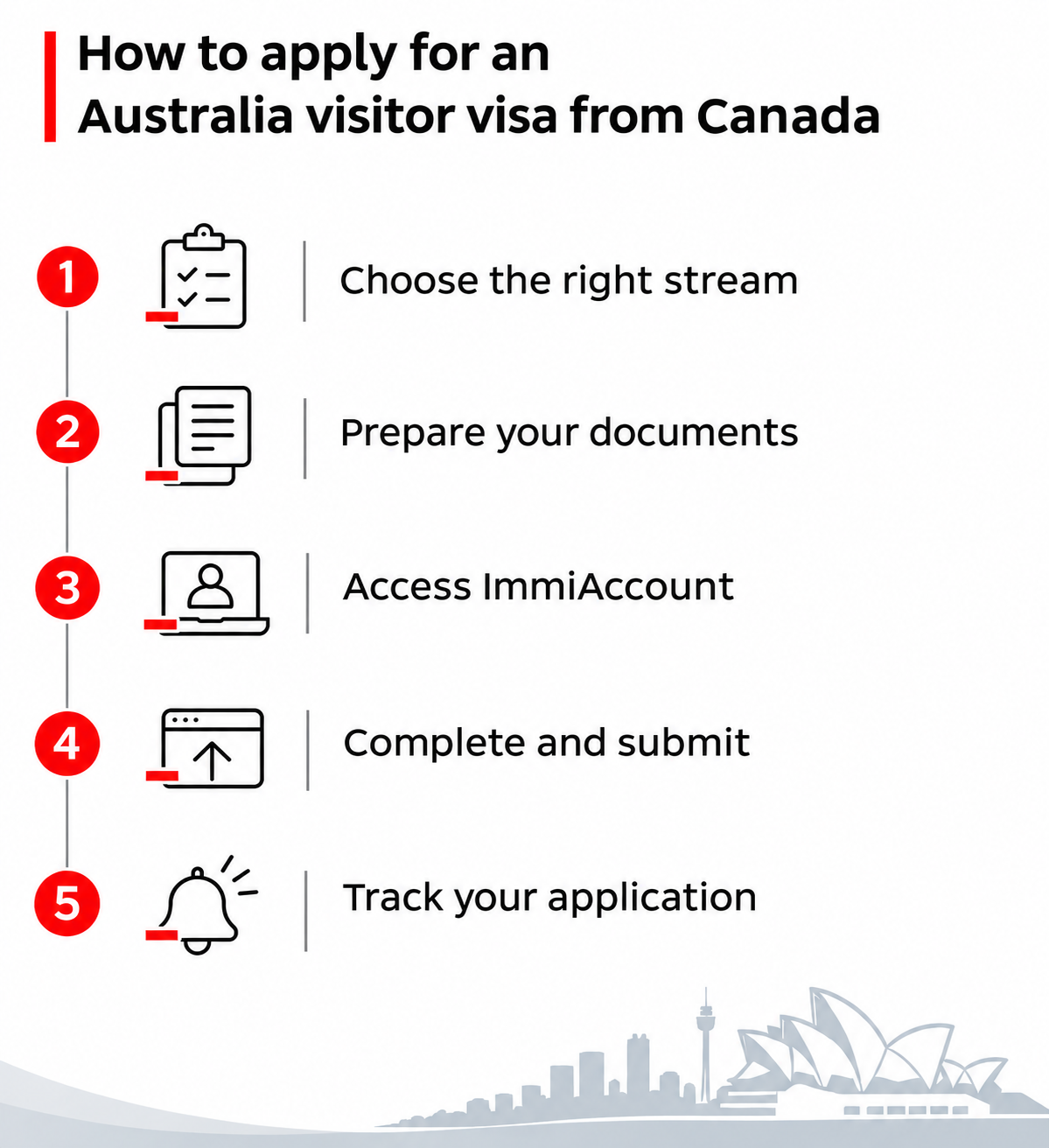
Step 1: Select the appropriate stream based on your travel purpose and location. Canadian passport holders should also check whether they qualify for an ETA.
Step 2: Collect your passport, financial documents, employment details, travel plans and supporting documents.
Step 3: Register or log in to the Australian Government's ImmiAccount portal.
Step 4: Enter your personal and travel details, upload the required documents and pay the application fee.
Step 5: Check your ImmiAccount regularly for updates. Complete any additional medical examinations, biometrics or document requests if required.
Once your visa is granted, check its validity, permitted stay and conditions before travelling.
Australia Visitor Visa Fees from Canada
The subclass 600 application fee depends on the visa stream and whether you apply inside or outside Australia.
| Visa Type | Application Fee |
|---|---|
| Tourist Stream – Outside Australia | AUD 250 |
| Tourist Stream – Inside Australia | AUD 630 |
| Business Visitor Stream | AUD 250 |
| Sponsored Family Stream | AUD 250 |
| Frequent Traveller Stream | AUD 1,845 |
| Electronic Travel Authority (Subclass 601) | AUD 20 service fee |
| eVisitor (Subclass 651) | Free, for eligible passport holders |
Fees shown are in Australian dollars and reflect the available 2026 fee information. Additional charges may apply for biometrics, medical examinations, police certificates and other services. Check the official Visa Pricing Estimator before submitting your application.
Additional Costs to Consider
Apart from the visa application fee, applicants may need to pay for:
- Medical examinations, if requested.
- Biometrics collection, if required.
- Overseas visitor health insurance.
- Police certificates, if requested.
- Translation and certification of documents.
- Travel and accommodation expenses.
Australia ETA vs eVisitor vs Visitor Visa (Subclass 600)
Canadian passport holders should check whether they can apply for an ETA before choosing the subclass 600 visa.
| Visa Type | Who Can Apply? | Maximum Stay | Application Fee |
|---|---|---|---|
| ETA (Subclass 601) | Eligible passport holders, including Canada, the USA, Japan and Singapore | Up to 3 months per visit | AUD 20 service fee |
| eVisitor (Subclass 651) | Eligible EU and certain other European passport holders, including the UK | Up to 3 months per visit | Free |
| Visitor Visa (Subclass 600) | Travellers who need a visitor visa, including those requiring a longer stay or not eligible for an ETA/eVisitor | Up to 12 months, depending on the stream | Depends on the stream |
Which visa should Canadians choose?
Most Canadian passport holders visiting Australia for tourism or family visits for up to three months can use the ETA. Those planning longer stays or who are not eligible for an ETA may need to consider the subclass 600 visa. The ETA is applied for through the Australian ETA mobile app.
Australia Visitor Visa Processing Time
The processing time for an Australian Visitor visa depends on the stream, application details and the number of applications being processed. The Department of Home Affairs provides a processing time guide based on recently decided applications.
| Visa Stream | Estimated Processing Time |
|---|---|
| Tourist Stream | 2–6 weeks |
| Sponsored Family Stream | 4–8 weeks |
| Business Visitor Stream | 2–4 weeks |
| Approved Destination Status (ADS) | 2–6 weeks |
| Frequent Traveller Stream | Varies |
Processing times can change frequently. Applications may take longer if documents are missing, additional information is requested, or health and character checks are required.
Conditions of the Australia Visitor Visa
Visitors must follow the conditions attached to their visa. The conditions can vary depending on the applicant and the visa stream.
| Visa Condition | Meaning |
|---|---|
| 8101 – No Work | You cannot work in Australia. |
| 8201 – Study Limit | You can study or train for up to 3 months. |
| 8501 – Health Insurance | You must maintain adequate health insurance if this condition is imposed. |
| 8503 – No Further Stay | You generally cannot apply for another substantive visa while in Australia, subject to limited exceptions. |
| 8531 – Must Leave Before Visa Expiry | You must leave Australia before your authorised stay ends. |
| 8558 – Maximum Stay | You cannot stay in Australia for more than 12 months in any 18-month period. |
Not all conditions apply to every applicant. Always check your visa grant letter or use VEVO to confirm the conditions attached to your visa.
Health Requirements for Applicants Aged 75 or Older
Applicants aged 75 or above may need to complete a medical examination as part of their visitor visa application. They may also be asked to show evidence of adequate health insurance for their stay in Australia. The Department of Home Affairs may request additional medical information depending on the applicant's health and circumstances. Applicants should arrange medical examinations only when instructed by the Department.
Visitor Visas for Parents of Australian Citizens and Permanent Residents
Parents of Australian citizens and permanent residents have different options depending on how long they want to stay in Australia.
Visitor Visa (Subclass 600)
Parents can apply for a Visitor visa to spend time with their children and family in Australia. Depending on their circumstances, they may receive permission to stay for up to 12 months.
Parent Visa (Subclass 103)
The subclass 103 Parent visa provides permanent residency to eligible parents of settled Australian citizens, permanent residents or eligible New Zealand citizens.
Applicants generally need to meet the balance-of-family test. This means:
- At least half of their eligible children must live in Australia; or
- More of their eligible children must live in Australia than in any other single country.
The subclass 103 visa has a long waiting period because demand is higher than the number of places available.
Sponsored Parent (Temporary) Visa (Subclass 870)
The subclass 870 visa allows eligible parents to visit their children in Australia for longer periods.
- Parents may be granted a stay of 3 or 5 years.
- The total stay can be up to 10 years.
- An approved parent sponsor is required.
- There is no balance-of-family test for this visa.
This is a temporary visa and does not provide permanent residency.
Common Reasons for Australia Visitor Visa Rejection
A Visitor visa application may be refused for several reasons, including:
- Not being a genuine visitor: The applicant does not convince the Department that the visit is temporary.
- Weak ties to the home country: Insufficient evidence of employment, family or other commitments.
- Insufficient funds: The applicant cannot show enough money to support the trip.
- Previous visa violations: Past overstays or breaches of visa conditions.
- Incomplete documents: Missing or incorrect information in the application.
- Health or character concerns: Failure to meet the required health or character standards.
Applicants should provide accurate information and submit all relevant supporting documents to reduce the risk of refusal.
Popular Places to Visit in Australia
Australia offers many attractions for visitors travelling from Canada. Some popular destinations include:
- Sydney: Visit the Sydney Opera House, Harbour Bridge and Bondi Beach.
- Melbourne: Explore its cultural attractions, shopping areas and cafés.
- Queensland: Discover the Great Barrier Reef, Gold Coast and beautiful beaches.
For more travel ideas, visitors can explore Australia's official tourism information.
How Can Y-Axis Assist You?
Planning a trip to Australia from Canada? Choosing the right visa stream and preparing the correct documents can make the application process easier.
Y-Axis can assist with visitor visa-related guidance, including:
- Understanding the available visitor visa options.
- Identifying the appropriate visa stream.
- Reviewing supporting documents.
- Providing guidance on the online application process.
- Helping applicants understand visa conditions and requirements.
For professional immigration advice, applicants should consult an appropriately registered Australian migration professional.
Our Accreditations
 |
Don't know what to do ?
Get Free Counseling
Looking for Inspiration
Explore what Global Citizens have to say about Y-Axis in shaping their future
Frequently Asked Questions

