

Posted on September 22 2026
Top 10 Countries for Molecular Scientists to Work Abroad: Salary, Demand & PR Opportunities Compared

By , Editor
Updated September 23 2026
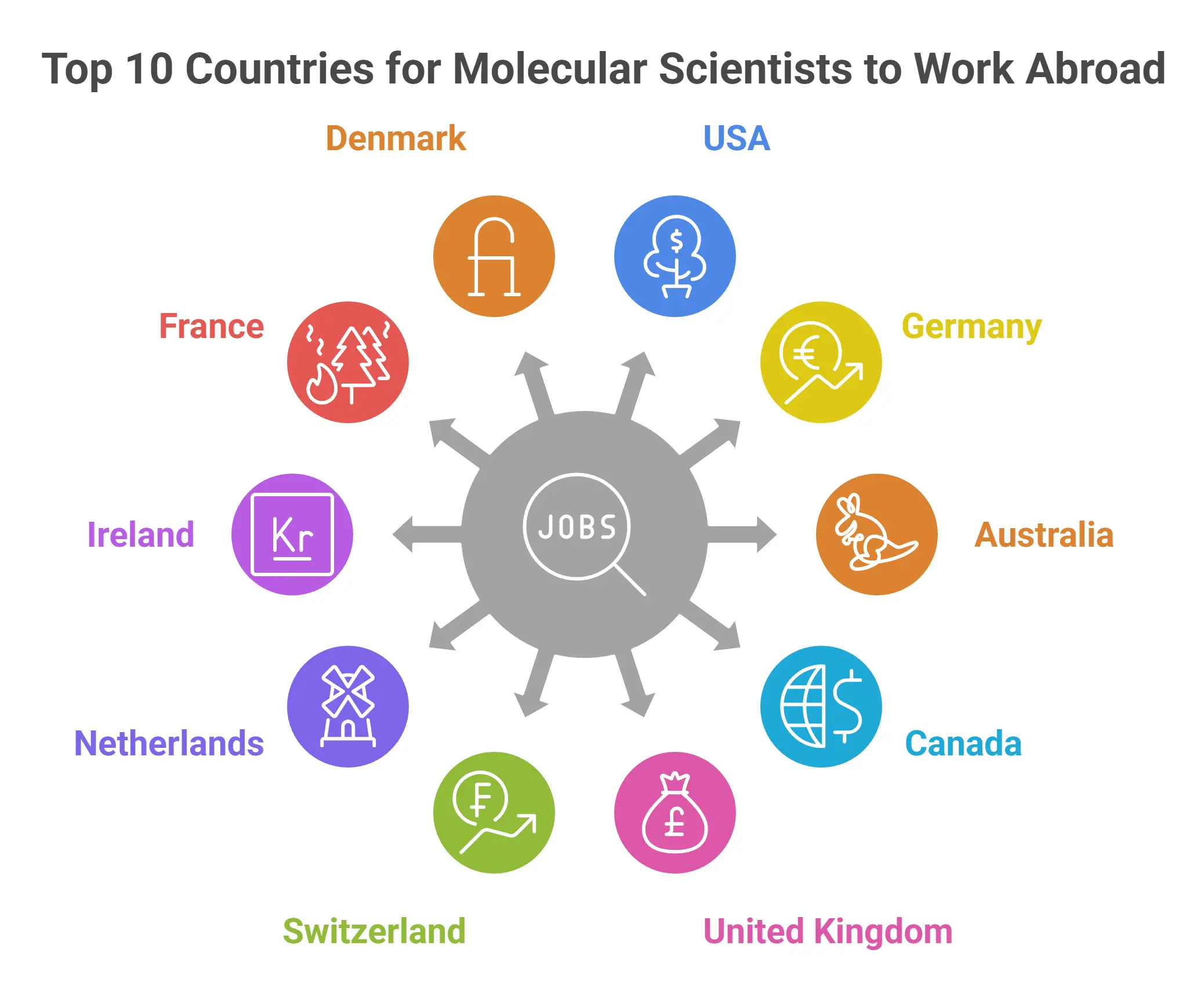
The best countries for molecular scientists to work abroad include Canada, the USA, Germany, the UK, Australia, Ireland, Switzerland, the Netherlands, France, and Denmark. These countries offer strong career opportunities in molecular biology, genomics, biotechnology, and pharmaceutical research, along with competitive salaries, work visa options, and permanent residency pathways.
The global biotechnology market is projected to reach USD 4.33 trillion by 2034, growing at a CAGR of 14.3%. Increasing investment in precision medicine, genetic engineering, and drug discovery is driving demand for molecular scientists in molecular research, drug development, molecular diagnostics, and pharmaceutical laboratories. This growth is expected to create more international job opportunities in biotechnology and life sciences.
*Want to work abroad? Sign up with Y-Axis Resume Marketing Services to find right job faster.
Benefits of Working Abroad as a Molecular Scientist
Working abroad gives molecular scientists access to advanced research facilities, specialised roles, and international career growth. The global whole genome sequencing market is projected to grow at a CAGR of 22.2% through 2030, increasing demand for genomic research and molecular testing.
- Higher Salaries: Earn competitive salaries in leading life sciences markets.
- Advanced Technologies: Work with next-generation sequencing and gene-editing technologies.
- Specialised Roles: Build careers in genomics, drug discovery, and molecular diagnostics.
- Research Opportunities: Contribute to international research and innovation projects.
- Visa Sponsorship: Access employer-sponsored work visas for qualifying research and biotechnology positions.
- Permanent Residency: Apply for PR programmes based on country-specific immigration requirements.
How to Choose the Right Country for Molecular Scientist Jobs Abroad?
Choosing the right country for molecular scientist jobs abroad depends on salary, job demand, research opportunities, visa sponsorship, and permanent residency options. Comparing these factors helps you identify countries that match your career goals and long-term plans.
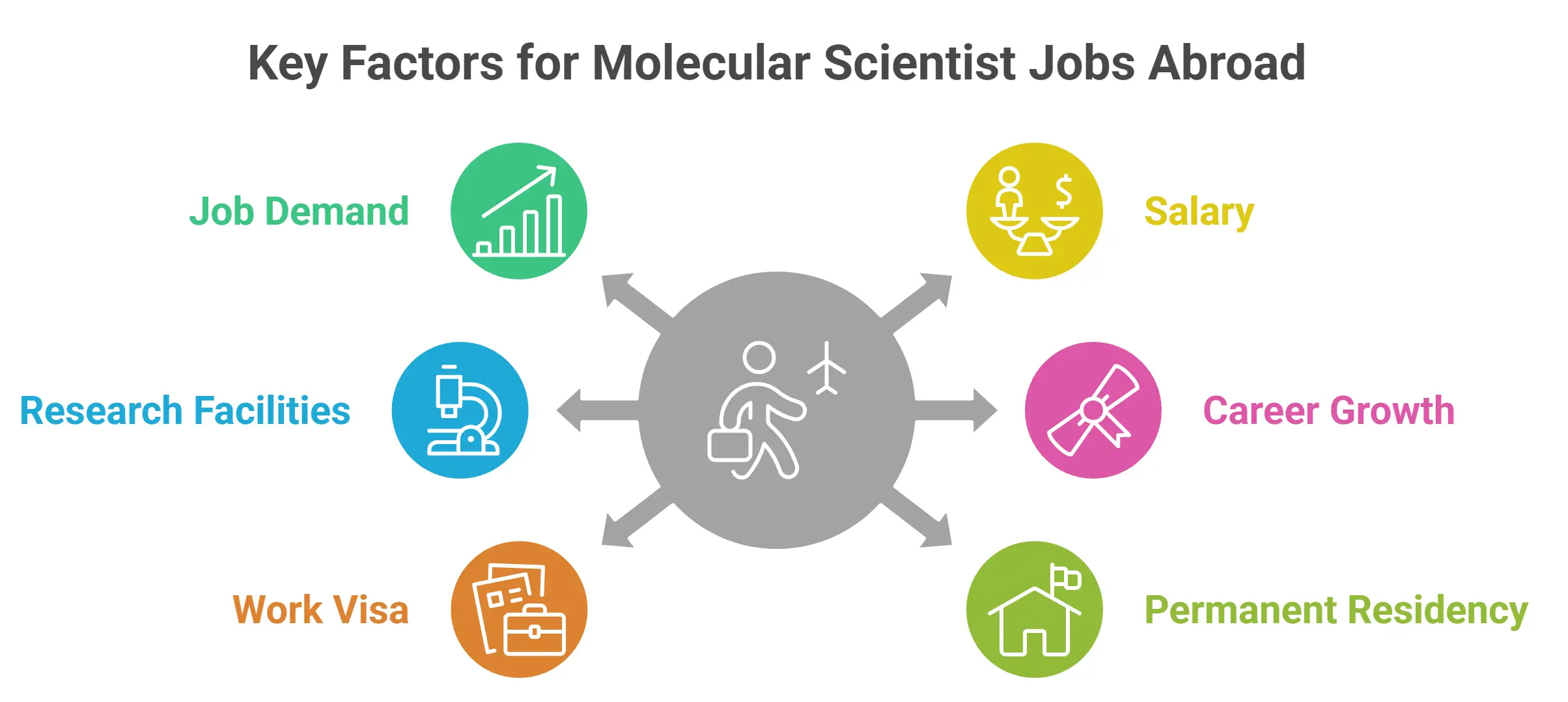
- Job Demand: Check vacancies in molecular biology, genomics, biotechnology, and pharmaceutical research.
- Salary: Compare average salaries with living costs and taxation.
- Research Facilities: Assess laboratory infrastructure, funding, and access to advanced technologies.
- Work Visa: Check visa requirements, employer sponsorship, and eligibility criteria.
- Permanent Residency: Review PR pathways, eligibility requirements, and processing timelines.
- Career Growth: Consider opportunities for specialisation, promotions, and research collaboration.
Top 10 Highest-Paying Countries for Molecular Scientists to Work Abroad
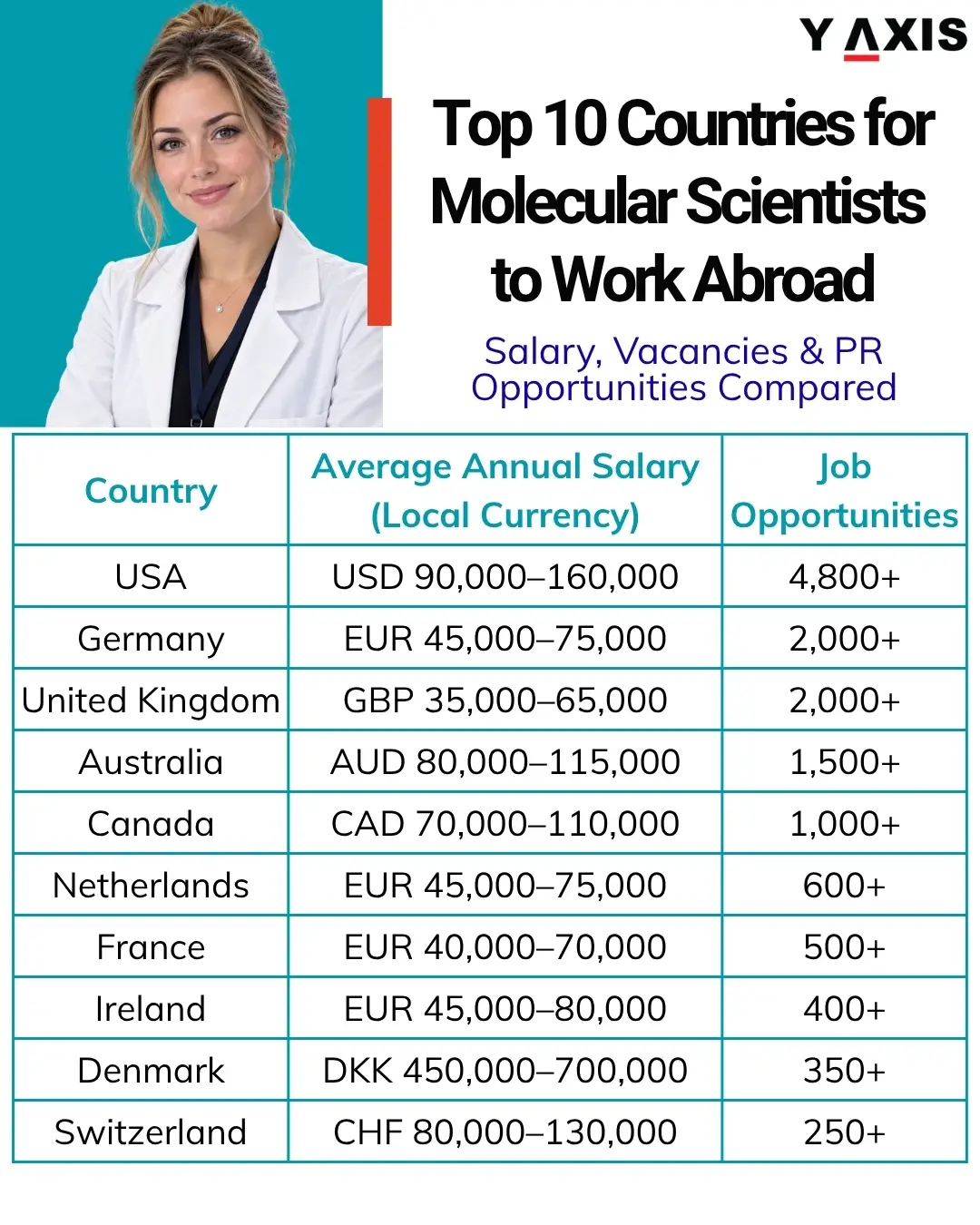
The USA, Switzerland, Germany, Denmark, Canada, and Australia offer high-paying job opportunities for molecular scientists in genomics, molecular biology, biotechnology, pharmaceutical research, and molecular diagnostics. Roles such as Molecular Scientist, Research Scientist, and Molecular Biologist offer annual salaries exceeding CAD 100,000. Strong research infrastructure, expanding biotechnology industries, specialised job demand, work visa pathways, and permanent residence options make these countries attractive destinations for molecular scientists seeking career growth and long-term settlement abroad.
|
Country |
Average Annual Salary (Local Currency) |
Estimated |
|
Switzerland |
CHF 80,000–130,000 |
250+ |
|
USA |
USD 90,000–160,000 |
4,800+ |
|
Australia |
AUD 80,000–115,000 |
1,500+ |
|
Canada |
CAD 70,000–110,000 |
1,000+ |
|
United Kingdom |
GBP 35,000–65,000 |
2,000+ |
|
Denmark |
DKK 450,000–700,000 |
350+ |
|
Ireland |
EUR 45,000–80,000 |
400+ |
|
Netherlands |
EUR 45,000–75,000 |
600+ |
|
Germany |
EUR 45,000–75,000 |
2,000+ |
|
France |
EUR 40,000–70,000 |
500+ |
*Want to work abroad? Sign up with Y-Axis Resume Marketing Services to find right job faster.
Best Countries for Molecular Scientists to Work and Settle Abroad
Molecular scientists have strong career opportunities abroad in biotechnology, pharmaceutical research, genomics, molecular diagnostics, and drug discovery. Canada, the USA, Germany, the UK, Australia, and Switzerland offer roles in research laboratories, pharmaceutical companies, and biomedical institutions. Salary levels, hiring demand, work visa requirements, and permanent residence pathways vary across countries, making it important to compare destinations for career growth and long-term settlement.
Molecular Scientist Jobs in Canada
Canada’s biotechnology and life sciences industries create opportunities for molecular scientists in genomics, pharmaceutical research, molecular diagnostics, and genetic testing. Research institutes, hospitals, universities, and biotechnology companies employ scientists in drug development and advanced laboratory research.
Canada’s life sciences and biomanufacturing sector includes more than 3,800 companies and approximately 220,000 skilled workers, with an estimated need for 65,000 additional workers by 2029. Express Entry and Provincial Nominee Programs (PNPs) offer permanent residency pathways, while employer-specific work permits support employment with Canadian organisations. Canada’s expanding research and biotechnology sectors provide opportunities for long-term scientific careers.
|
Factor |
Details |
|
Molecular Scientist Job Market & Job Vacancies for the Next Decade |
Canada is expected to offer more than 1,000 molecular scientist job opportunities over the next decade. Demand is expected across genomics, molecular diagnostics, gene therapy, drug discovery, vaccine development, and biotechnology research. |
|
Investment in Biotechnology & Biomedical Research |
Canada is investing more than CAD 2.2 billion over seven years through its Biomanufacturing and Life Sciences Strategy. This funding supports research and innovation in genomics, vaccine development, therapeutics, molecular diagnostics, and biomedical science. |
|
Top Companies Hiring Molecular Scientists |
Companies such as AbCellera, STEMCELL Technologies, BioVectra, Sanofi, Moderna, Pfizer, Roche, and Thermo Fisher Scientific offer career opportunities in molecular research, cell biology, diagnostics, drug development, and biomanufacturing. |
|
Top Cities for Molecular Scientist Jobs |
Toronto, Vancouver, Montreal, Ottawa, Calgary, and Edmonton are important locations for molecular science careers. Job opportunities are available in pharmaceutical R&D, genomics, molecular diagnostics, cell biology, and biomedical research. |
|
In-Demand Molecular Scientist Roles & Skills |
Common roles include Molecular Biologist, Genomics Scientist, Research Scientist, Molecular Diagnostics Scientist, and Assay Development Scientist. Employers value skills in PCR, qPCR, CRISPR, DNA/RNA sequencing, cell culture, molecular cloning, and bioinformatics. |
|
Work Visa Options |
A Canadian job offer can support an employer-specific work permit. An LMIA may be required, although certain research and biotechnology positions qualify for LMIA-exempt work permits through designated programmes. |
|
Fast-Track Hiring Options |
The Global Talent Stream offers faster work permit processing for qualifying positions in specialised fields such as biotechnology, genomics, molecular diagnostics, and pharmaceutical research. The Canadian employer must meet the programme’s requirements. |
|
PR / Long-Term Residence Opportunities |
Molecular scientists can apply for permanent residence through Express Entry, including the Federal Skilled Worker Program and Canadian Experience Class. Provincial Nominee Programs (PNPs) provide additional pathways based on provincial labour-market needs. |
|
Eligibility for Dependents |
A permanent residence application can generally include a spouse or common-law partner and dependent children under 22, provided the family meets Canada’s immigration requirements. |
|
Benefits for Family Members |
A spouse or common-law partner may qualify for an open work permit, subject to current immigration rules. Dependent children may attend educational institutions in Canada, while healthcare access depends on provincial rules, immigration status, and residence requirements. |
Molecular Scientist Jobs in the USA
The USA is a major centre for molecular biology, pharmaceutical development, genomics, and biotechnology research. Molecular scientists work in drug discovery, genetic engineering, molecular diagnostics, and biomedical research across pharmaceutical companies, universities, and research institutions.
The U.S. Bureau of Labor Statistics projects 12% employment growth for biochemists and biophysicists, indicating continued demand for specialised scientific expertise. Foreign scientists can pursue H-1B visas through sponsoring employers, while EB-2, EB-3, and EB-2 National Interest Waiver pathways provide permanent residency options. The country’s advanced research facilities and extensive biotechnology industry support career progression in specialised scientific fields.
|
Factor |
Details |
|
Molecular Scientist Job Market & Job Vacancies for the Next Decade |
The USA is projected to offer more than 4,800 molecular scientist job opportunities over the next decade, particularly in genomics, molecular biology, gene therapy, molecular diagnostics, drug discovery, and biotechnology research. |
|
Investment in Biotechnology & Biomedical Research |
The National Institutes of Health (NIH) receives more than USD 47 billion annually, supporting research in gene editing, DNA sequencing, cancer biology, precision medicine, and therapeutic development. |
|
Top Companies Hiring Molecular Scientists |
Major employers include Pfizer, Moderna, Genentech, Amgen, Merck, Regeneron, Illumina, and Thermo Fisher Scientific. Universities, NIH laboratories, startups, and contract research organisations also recruit molecular scientists. |
|
Top Cities for Molecular Scientist Jobs |
Boston, San Diego, San Francisco, Washington, DC, Raleigh–Durham, and New York–New Jersey are key hubs for genomics, pharmaceutical research, molecular diagnostics, and drug development. |
|
In-Demand Molecular Scientist Roles & Skills |
Popular roles include Molecular Biologist, Genomics Scientist, Research Scientist, Cell Biology Scientist, Assay Development Scientist, and Molecular Diagnostics Scientist. Key skills include PCR, qPCR, CRISPR, DNA/RNA sequencing, cell culture, molecular cloning, and bioinformatics. |
|
Work Visa Options |
The H-1B visa supports qualifying specialised scientific positions. Universities and research institutions may offer cap-exempt H-1B sponsorship, while other employment-based visas may apply to specific research roles. |
|
Fast-Track Hiring Options |
USCIS Premium Processing expedites eligible immigration petitions. Scientists with exceptional research achievements may also qualify for the O-1A visa for individuals with extraordinary ability in the sciences. |
|
PR / Long-Term Residence Opportunities |
Green Card pathways include EB-2, EB-3, EB-2 National Interest Waiver, and EB-1A. Requirements may involve employer sponsorship, advanced qualifications, research achievements, or scientific contributions. |
|
Eligibility for Dependents |
Scientists can generally bring their spouse and unmarried children under 21. Dependents may apply for H-4 or O-3 status, depending on the primary visa category. |
|
Benefits for Family Members |
H-4 children can study, and certain H-4 spouses may qualify for employment authorisation. O-3 dependents can study but generally cannot work. |
*Want to work in the USA? Avail Y-Axis Resume Marketing Services to shortlist the job faster.
Molecular Scientist Jobs in Germany
Germany’s biotechnology industry provides molecular scientists with opportunities in drug development, genomics, molecular diagnostics, and pharmaceutical research. The country has 1,020 biotechnology companies and approximately 56,000 biotechnology employees, supporting research across genetic engineering and advanced laboratory science.
Industry forecasts project Germany’s biotechnology market to reach USD 229.7 billion by 2030, with a 12% CAGR. The EU Blue Card and Skilled Worker Visa provide routes to employment, while EU Blue Card holders can pursue permanent settlement after 21 months with B1-level German or 27 months with A1-level German, subject to the required conditions. Germany’s strong research base supports long-term opportunities in molecular science and biotechnology.
|
Factor |
Details |
|
Molecular Scientist Job Market & Job Vacancies for the Next Decade |
Germany’s growing biotechnology, pharmaceutical, and biomedical research sectors are expected to create more than 2,000 molecular scientist job opportunities over the next decade, especially in genomics, drug discovery, gene therapy, and molecular diagnostics. |
|
Investment in Biotechnology & Biomedical Research |
Germany invests more than EUR 4.6 billion annually in medical biotechnology R&D, while pharmaceutical companies spend over EUR 10.7 billion on research and development. This investment supports molecular research and biopharmaceutical innovation. |
|
Top Companies Hiring Molecular Scientists |
BioNTech, Bayer, Merck, Roche, Qiagen, Boehringer Ingelheim, and Evotec are major employers. Universities and research institutes also hire Molecular Biologists, Research Scientists, and Molecular Diagnostics Scientists. |
|
Top Cities for Molecular Scientist Jobs |
Berlin, Munich, Frankfurt, Hamburg, and Heidelberg offer opportunities through biotechnology companies, pharmaceutical laboratories, and research institutions working in genomics, molecular diagnostics, and biomedical research. |
|
In-Demand Molecular Scientist Roles & Skills |
Common roles include Molecular Biologist, Genomics Scientist, Research Scientist, Cell Biology Scientist, and Molecular Diagnostics Scientist. Employers value skills in PCR, CRISPR, DNA/RNA sequencing, cell culture, molecular cloning, protein analysis, and bioinformatics. |
|
Work Visa Options |
The EU Blue Card offers a work and residence pathway for molecular scientists with recognised qualifications and a German employment contract who meet the required conditions. Researchers can also apply for a residence permit to work at approved research institutions. |
|
Fast-Track Hiring Options |
Germany’s Accelerated Skilled Worker Procedure allows employers to coordinate the residence process with the foreigners authority before the scientist submits a visa application. |
|
PR / Long-Term Residence Opportunities |
EU Blue Card holders may qualify for a settlement permit after 27 months with A1-level German or 21 months with B1-level German. Researchers can also use other settlement pathways under German residence regulations. |
|
Eligibility for Dependents |
EU Blue Card holders can generally bring their spouse and minor children through family reunification. Approved family members receive residence permits to live in Germany. |
|
Benefits for Family Members |
Spouses can generally work in Germany without a separate work permit, while children can attend German schools. Family reunification allows eligible family members to live together during the scientist’s residence period. |
*Want to Work in Germany? Let Y-Axis guide you through every step of the process.
Molecular Scientist Jobs in the UK
The UK’s established life sciences industry offers molecular scientists opportunities in genomics, drug discovery, molecular diagnostics, and biotechnology research. Universities, pharmaceutical companies, research institutes, and biotechnology businesses employ scientists in laboratory and medical research.
Government projections estimate 66,000 additional jobs in priority life sciences occupations by 2035, including 2,300 additional jobs for biochemists and biomedical scientists. The Skilled Worker visa provides an employer-sponsored route, while the Global Talent visa supports researchers with recognised scientific achievements. Scientists who build their careers in the UK can pursue Indefinite Leave to Remain (ILR) through the applicable settlement route.
|
Factor |
Details |
|
Molecular Scientist Job Market & Job Vacancies for the Next Decade |
The UK is expected to offer more than 2,000 molecular scientist job opportunities over the next decade. Demand is projected in genomics, molecular diagnostics, gene therapy, drug discovery, vaccine research, and biotechnology. |
|
Investment in Biotechnology & Biomedical Research |
The UK has attracted more than £3 billion in life sciences investment, while the government’s sector plan includes over £2 billion in funding for genomics, molecular diagnostics, drug development, and biomedical research. |
|
Top Companies & Organisations Hiring Molecular Scientists |
AstraZeneca, GSK, Oxford Nanopore, BioNTech, Lonza, Charles River Laboratories, Thermo Fisher Scientific, and Abcam are key employers. Universities, NHS laboratories, and research institutes also recruit molecular scientists. |
|
Top Cities for Molecular Scientist Jobs |
London, Cambridge, Oxford, Manchester, Edinburgh, and Glasgow offer opportunities in genomics, pharmaceutical R&D, molecular diagnostics, cell biology, and biomedical research. |
|
In-Demand Molecular Scientist Roles & Skills |
Employers recruit Molecular Biologists, Research Scientists, Genomics Scientists, Cell Biology Scientists, Molecular Diagnostics Scientists, and Assay Development Scientists. Key skills include PCR, qPCR, CRISPR, DNA/RNA sequencing, cell culture, molecular cloning, and bioinformatics. |
|
Work Visa Options |
The Skilled Worker visa allows molecular scientists to work for approved UK employers in eligible occupations. Applicants need a qualifying job offer, sponsorship, and the required salary. |
|
Fast-Track Hiring Options |
Priority visa processing can reduce processing times for qualifying applications. Researchers with recognised achievements may also qualify for the Global Talent visa, which does not require employer sponsorship. |
|
PR / Long-Term Residence Opportunities |
The Skilled Worker route can lead to Indefinite Leave to Remain after five years of qualifying residence. Global Talent holders may qualify for settlement after three or five years, depending on their route. |
|
Eligibility for Dependents |
Skilled Worker and Global Talent visa holders can generally bring their partner and dependent children through the dependant visa route, subject to the applicable requirements. |
|
Benefits for Family Members |
Dependant partners can generally work in the UK, while dependent children can attend UK schools. Family members may qualify for settlement after meeting the relevant residence and visa requirements. |
*Want to Work in the United Kingdom? Let Y-Axis guide you through the steps.
Molecular Scientist Jobs in Australia
Australia’s medical research and biotechnology sectors support careers in molecular biology, genomics, pharmaceutical development, and molecular diagnostics. Molecular scientists can work with universities, medical research institutes, biotechnology companies, and pharmaceutical organisations on advanced laboratory projects.
Employment for Life Scientists is projected to increase from 10,400 to 12,200 by 2034, representing approximately 17.8% growth. CSIRO projections also indicate that Australia’s synthetic biology sector could generate up to 50,000 new jobs by 2040. Molecular Scientists can explore employer-sponsored work visas and skilled migration pathways for permanent residence, including Subclass 189, Subclass 190, and regional visa options. Australia’s expanding research ecosystem creates opportunities in medical innovation and biotechnology.
|
Factor |
Details |
|
Molecular Scientist Job Market & Job Vacancies for the Next Decade |
Australia is expected to have more than 1,500 molecular scientist job opportunities over the next decade in genomics, gene therapy, molecular diagnostics, drug discovery, and laboratory research. |
|
Investment in Molecular Research |
More than AUD 2 billion through the Medical Research Future Fund (MRFF) supports precision medicine, genomics, cell therapies, vaccine development, and molecular biology research. |
|
Top Employers |
CSL, Cochlear, AstraZeneca, Pfizer, ResMed, Thermo Fisher Scientific, QIAGEN, and Vaxxas recruit scientists for molecular research, diagnostic testing, drug development, and biotechnology projects. Universities and medical research institutes also employ molecular scientists. |
|
Top Cities for Molecular Scientist Jobs |
Melbourne and Sydney have major biomedical research facilities and biotechnology companies. Brisbane, Adelaide, and Perth also offer molecular science roles in research laboratories, pharmaceutical companies, and diagnostic centres. |
|
Molecular Scientist Roles & Technical Skills |
Common positions include Molecular Biologist, Genomics Scientist, Research Scientist, Molecular Diagnostics Scientist, Cell Biology Scientist, and Assay Development Scientist. Important technical skills include PCR, qPCR, CRISPR, DNA/RNA sequencing, cell culture, molecular cloning, and bioinformatics. |
|
Work Visa Options |
The Skills in Demand visa (subclass 482) allows Australian employers to sponsor overseas workers for listed occupations. Molecular scientists must meet the nominated occupation, qualification, work experience, English language, and visa requirements. |
|
Employment Pathways |
Employers can sponsor molecular scientists through the subclass 482 visa. Scientists with internationally recognised research achievements may apply for the National Innovation visa (subclass 858). |
|
Permanent Residence Pathways |
Molecular scientists may apply through subclass 189, subclass 190, or subclass 186. Regional visa holders can move from subclass 491 to subclass 191 after completing the required residence period and meeting the visa conditions. |
|
Eligibility for Dependents |
Applicants may include their spouse or de facto partner and dependent children when family inclusion is permitted under their visa. Applicants must provide identity documents and proof of family relationships. |
|
Family Benefits |
Partners can work under their visa conditions, and children can attend Australian schools. Medicare access is determined by the family’s visa type and applicable healthcare arrangements. |
Molecular Scientist Jobs in Ireland
Ireland’s strong pharmaceutical and biopharmaceutical industries create demand for molecular scientists in research and development, analytical science, quality control, and drug manufacturing. The country’s biopharmaceutical sector is projected to create more than 21,000 additional jobs by 2027, strengthening opportunities for scientists with laboratory and biotechnology expertise.
The Critical Skills Employment Permit covers relevant biological science and biochemistry occupations. Permit holders can progress towards Stamp 4 residence permission, which provides greater flexibility to live and work in Ireland. With major pharmaceutical and biotechnology operations, Ireland offers molecular scientists opportunities to develop expertise in advanced drug research and biopharmaceutical production.
|
Factor |
Details |
|
Molecular Scientist Job Market & Job Vacancies for the Next Decade |
Ireland is expected to offer more than 400 Molecular Scientist job opportunities over the next decade. Demand is expected in molecular biology, genomics, molecular diagnostics, drug discovery, biotechnology, and pharmaceutical research. |
|
Investment in Biotechnology & Biomedical Research |
Ireland has announced €460 million for seven research centres focused on advanced therapies, pharmaceuticals, and biopharmaceuticals. The investment will create 577 research positions and expand work in molecular research, genomics, and biotechnology. |
|
Top Companies Hiring Molecular Scientists |
Pfizer, MSD, Johnson & Johnson, Regeneron, Alexion, AbbVie, BioMarin, and Thermo Fisher Scientific are major employers in Ireland’s life sciences sector. Their research and production operations cover molecular biology, drug development, biopharmaceuticals, and diagnostic technologies. |
|
Top Cities for Molecular Scientist Jobs |
Dublin, Cork, Galway, Limerick, and Waterford have opportunities in pharmaceutical research, molecular diagnostics, biotechnology, biomanufacturing, and biomedical science. |
|
In-Demand Molecular Scientist Roles & Skills |
Employers recruit Molecular Biologists, Research Scientists, Genomics Scientists, Molecular Diagnostics Scientists, Cell Biology Scientists, and Assay Development Scientists. Common laboratory skills include PCR, qPCR, CRISPR, DNA/RNA sequencing, cell culture, molecular cloning, and bioinformatics. |
|
Work Visa Options |
Molecular Scientists can apply for the General Employment Permit for jobs that meet its occupation and salary rules. The Critical Skills Employment Permit may apply to molecular science positions listed under its eligible occupations and salary thresholds. |
|
Fast-Track Hiring Options |
The Critical Skills Employment Permit does not require a Labour Market Needs Test. Applicants must have a job covered by the permit’s occupation list and meet its salary and employment conditions. |
|
PR / Long-Term Residence Opportunities |
Critical Skills Employment Permit holders can generally apply for Stamp 4 after two years of employment. Long-term residence may be available after 60 months of residence based on employment permits, provided the applicant meets the residence and immigration conditions. |
|
Eligibility for Dependents |
Critical Skills Employment Permit holders can generally sponsor their spouse, partner, and dependent children through Ireland’s family reunification process. Family members must provide proof of identity and their relationship with the permit holder. |
|
Benefits for Family Members |
Spouses and partners of Critical Skills Employment Permit holders can generally work in Ireland without a separate employment permit. Dependent children can attend Irish schools under the applicable immigration and education rules. |
Molecular Scientist Jobs in Switzerland
Switzerland’s pharmaceutical and biotechnology industries provide molecular scientists with opportunities in drug discovery, genomics, molecular therapies, and biopharmaceutical research. The country’s biotechnology sector is expected to record annual growth of approximately 5%, supported by research investment, startup development, and demand for specialised scientific skills.
Emerging fields such as cell and gene therapies, RNA technologies, and personalised medicine are expected to support future research opportunities. Scientists from outside the EU/EFTA generally require an employer-sponsored work permit. Long-term settlement may be possible through a Swiss C permit, based on residence and integration requirements. Switzerland’s research-intensive life sciences industry supports specialised scientific careers.
|
Factor |
Details |
|
Molecular Scientist Job Market & Job Vacancies for the Next Decade |
Switzerland is expected to offer more than 250 Molecular Scientist job opportunities over the next decade in biotechnology, molecular diagnostics, genomics, pharmaceutical research, and biomedical science. |
|
Investment in Biotechnology & Biomedical Research |
Switzerland’s biotechnology sector has received CHF 2.6 billion in total funding and CHF 2.5 billion in R&D investment. This funding supports molecular research, genomics, drug discovery, biotechnology, and advanced therapies. |
|
Top Companies & Organisations Hiring Molecular Scientists |
Major employers include Roche, Novartis, Lonza, CSL Behring, Thermo Fisher Scientific, and Syngenta. Universities, research institutes, hospitals, and biotechnology companies also hire Molecular Scientists for research and laboratory positions. |
|
Top Cities for Molecular Scientist Jobs |
Basel, Zurich, Lausanne, Geneva, and Bern offer opportunities in pharmaceutical research, biotechnology, molecular diagnostics, and biomedical science. Basel is a major employment centre for pharmaceutical and life sciences research. |
|
In-Demand Molecular Scientist Roles & Skills |
Common roles include Molecular Biologist, Research Scientist, Genomics Scientist, Molecular Diagnostics Scientist, and Cell Biology Scientist. Key technical skills include PCR, DNA/RNA sequencing, CRISPR, cell culture, molecular cloning, and bioinformatics. |
|
Work Visa Options |
Molecular Scientists from outside the EU/EFTA generally need an employer-sponsored Swiss L or B permit. The L permit covers short-term employment, while the B permit supports longer-term residence. |
|
Fast-Track Hiring Options |
Employers submit work-permit applications to the relevant cantonal authorities. Scientists with specialised research experience may be considered for positions under Switzerland’s rules for highly qualified non-EU/EFTA workers. |
|
PR / Long-Term Residence Opportunities |
Molecular Scientists can generally apply for a C settlement permit after 10 years of residence. Citizens of certain countries may apply after five years, subject to their residence status and integration conditions. |
|
Eligibility for Dependents |
Molecular Scientists holding a Swiss residence permit can generally apply for family reunification for their spouse or registered partner and unmarried children under 18. The family must meet the residence and documentation conditions. |
|
Benefits for Family Members |
Spouses and registered partners may work in Switzerland under the conditions attached to their residence status. Dependent children can attend Swiss schools, allowing families to live together in the country. |
Molecular Scientist Jobs in the Netherlands
The Netherlands is developing its biotechnology industry through a strategy extending to 2040, creating opportunities in genomics, molecular diagnostics, gene therapies, and biomanufacturing. The country also supports the European Union’s objective of increasing research and development investment to 3% of GDP by 2030.
These priorities are expected to strengthen research and innovation across the life sciences sector. Molecular scientists can use the Highly Skilled Migrant residence permit through an IND-recognised sponsor or apply for a researcher residence permit through a recognised institution. After five years of qualifying residence, permanent residency may be available. The Netherlands offers a research-focused environment for scientists working in advanced molecular technologies.
|
Factor |
Details |
|
Molecular Scientist Job Market & Job Vacancies for the Next Decade |
The Netherlands is expected to offer more than 600 Molecular Scientist job opportunities over the next decade in molecular biology, genomics, molecular diagnostics, drug discovery, and biotechnology research. |
|
Investment in Biotechnology & Biomedical Research |
The Netherlands has allocated more than EUR 1.27 billion through National Growth Fund programmes for biotechnology research and commercialisation. This funding supports genomics, biomedical research, cellular therapies, and pharmaceutical innovation. |
|
Top Companies Hiring Molecular Scientists |
Leading employers include Genmab, Galapagos, QIAGEN, Thermo Fisher Scientific, Merck, Wageningen University & Research, and Leiden University Medical Center. These organisations hire scientists for molecular research, drug development, and biotechnology projects. |
|
Top Cities for Molecular Scientist Jobs |
Amsterdam, Leiden, Utrecht, Rotterdam, Delft, and Eindhoven offer Molecular Scientist roles in genomics, molecular diagnostics, pharmaceutical research, and biotechnology. |
|
In-Demand Molecular Scientist Roles & Skills |
Common positions include Molecular Biologist, Research Scientist, Genomics Scientist, Molecular Diagnostics Scientist, and Cell Biology Scientist. Employers seek skills in PCR, CRISPR, DNA/RNA sequencing, cell culture, molecular cloning, and bioinformatics. |
|
Work Visa Options |
The Highly Skilled Migrant permit is a primary route for scientists employed by an IND-recognised sponsor. The EU Blue Card is another option for applicants who meet its salary, employment, and qualification conditions. |
|
Fast-Track Hiring Options |
IND-recognised employers can submit Highly Skilled Migrant applications directly to the Immigration and Naturalisation Service (IND), simplifying the residence permit application process. |
|
PR / Long-Term Residence Opportunities |
Molecular Scientists can generally apply for permanent residence after five consecutive years of lawful residence. Applicants must meet the required residence, income, permit, and civic integration conditions. |
|
Eligibility for Dependents |
Residence permit holders can generally bring their spouse, registered partner, and dependent children to the Netherlands through the family reunification process. |
|
Benefits for Family Members |
A Highly Skilled Migrant’s spouse or partner can generally work without a separate work permit. Dependent children can live in the Netherlands and attend Dutch schools. |
Molecular Scientist Jobs in France
France is expanding its biotechnology and biopharmaceutical capabilities through the France 2030 investment plan. The plan aims to support the production of at least 20 biomedicines by 2030, creating opportunities in gene therapies, molecular research, drug discovery, and biomanufacturing.
The broader investment plan is projected to generate 25,000 to 58,000 jobs by 2030, although the estimate covers several industries rather than molecular scientist positions alone. Molecular scientists can pursue the Talent Passport for research positions or the EU Blue Card for highly qualified employment. France’s investment in biomedicine and pharmaceutical innovation supports career opportunities in advanced research and life sciences.
|
Factor |
Details |
|
Molecular Scientist Job Market & Job Vacancies for the Next Decade |
France is expected to offer more than 500 Molecular Scientist job opportunities over the next decade in genomics, molecular diagnostics, gene therapy, drug discovery, and biotechnology research. |
|
Investment in Biotechnology & Biomedical Research |
Through the France 2030 strategy, France has allocated EUR 800 million to advance biotherapies and innovative biomanufacturing, including gene therapies, cell therapies, and biological medicines. |
|
Top Companies Hiring Molecular Scientists |
Sanofi, Institut Pasteur, Servier, bioMérieux, Cellectis, Ipsen, Pierre Fabre, and Thermo Fisher Scientific recruit Molecular Scientists for research, diagnostic testing, drug development, and biotechnology projects. |
|
Top Cities for Molecular Scientist Jobs |
Paris, Lyon, Grenoble, Toulouse, Strasbourg, and Montpellier offer opportunities in genomics, molecular diagnostics, pharmaceutical R&D, cell biology, and biotechnology research. |
|
In-Demand Molecular Scientist Roles & Skills |
Common positions include Molecular Biologist, Research Scientist, Genomics Scientist, Molecular Diagnostics Scientist, and Cell Biology Scientist. Employers seek skills in PCR, qPCR, CRISPR, DNA/RNA sequencing, cell culture, and bioinformatics. |
|
Work Visa Options |
The Talent–Researcher residence permit is available to Molecular Scientists conducting research with an approved French research institution. Scientists employed by companies may use other Talent residence categories based on their job role and salary. |
|
Fast-Track Hiring Options |
France does not have a dedicated fast-track visa for Molecular Scientists. However, the Talent–Researcher permit provides a specific residence route for scientists conducting approved research activities. |
|
PR / Long-Term Residence Opportunities |
Molecular Scientists may apply for a 10-year long-term resident card after five years of lawful residence. Applicants must meet the required residence, income, and integration conditions. |
|
Eligibility for Dependents |
Talent residence permit holders can generally bring their spouse and minor children to France through the accompanying-family procedure. |
|
Benefits for Family Members |
Spouses holding a Talent–Family residence permit can generally work in France without a separate work permit. Dependent children can live in France and attend school. |
Molecular Scientist Jobs in Denmark
Denmark’s life sciences sector offers molecular scientists opportunities in pharmaceutical research, biotechnology, genomics, and molecular diagnostics. The country has more than 700 life sciences companies, including over 400 startups, and the sector employs more than 69,000 full-time workers. Denmark’s Life Science Strategy aims to increase pharmaceutical production and foreign investment above previous levels by 2030, supporting further development in drug research and biotechnology.
Molecular scientists can apply through the Positive List for Higher Education, which includes occupations such as Biochemist, Biologist, and Biomedical Scientist. The Researcher Scheme and Fast-track Scheme provide additional work and residence routes. Denmark’s established life sciences industry supports careers in specialised research and pharmaceutical innovation.
|
Factor |
Details |
|
Molecular Scientist Job Market & Job Vacancies for the Next Decade |
Denmark’s biotechnology and pharmaceutical sectors are expected to generate more than 350 Molecular Scientist job opportunities over the next decade. Demand is expected in molecular biology, genomics, drug discovery, molecular diagnostics, and biopharmaceutical research. |
|
Investment in Biotechnology & Biomedical Research |
Denmark’s DKK 15.3 billion life sciences strategy supports investment in pharmaceutical R&D, biotechnology, genomics, and advanced therapies, creating opportunities for Molecular Scientists. |
|
Top Companies Hiring Molecular Scientists |
Major employers include Novo Nordisk, Genmab, Novonesis, Lundbeck, Leo Pharma, Thermo Fisher Scientific, and Bavarian Nordic. Universities, hospitals, and research institutions also recruit Molecular Biologists, Research Scientists, and Genomics Scientists. |
|
Top Cities for Molecular Scientist Jobs |
Copenhagen, Aarhus, Odense, Aalborg, and Lyngby offer Molecular Scientist positions in pharmaceutical research, biotechnology, molecular diagnostics, genomics, and biomedical science. |
|
In-Demand Molecular Scientist Roles & Skills |
Common roles include Molecular Biologist, Research Scientist, Genomics Scientist, Molecular Diagnostics Scientist, Cell Biology Scientist, and Assay Development Scientist. Key skills include PCR, qPCR, CRISPR, DNA/RNA sequencing, cell culture, molecular cloning, and bioinformatics. |
|
Work Visa Options |
Molecular Scientists can use Denmark’s Positive List when their occupation appears on the list. The Pay Limit Scheme provides another route for jobs that meet the specified annual salary threshold. |
|
Fast-Track Hiring Options |
Denmark’s Fast-Track Scheme allows certified employers to submit work and residence applications through the Danish Agency for International Recruitment and Integration (SIRI), streamlining the hiring process for international Molecular Scientists. |
|
PR / Long-Term Residence Opportunities |
Permanent residence generally requires eight years of legal residence in Denmark. The period can reduce to four years when the applicant meets all four supplementary requirements. |
|
Eligibility for Dependents |
Molecular Scientists holding a Danish work or residence permit can generally bring their spouse or partner and children under 18 as accompanying family members. |
|
Benefits for Family Members |
A Molecular Scientist’s spouse or partner can generally work in Denmark, while dependent children can attend Danish schools under their family residence permit. |
Job Outlook for Molecular Scientists over the Next Decade
The job outlook for Molecular Scientists is positive over the next decade, driven by growing demand in genomics, molecular diagnostics, gene therapy, drug discovery, and biotechnology research. The global molecular diagnostics market is projected to reach USD 48 billion by 2035, supporting demand for genetic testing, precision medicine, and advanced laboratory research. Countries such as the USA, Canada, Germany, Australia, and Switzerland are investing in life sciences and expanding their biotechnology sectors.
Molecular Scientists with expertise in PCR, CRISPR, DNA/RNA sequencing, molecular cloning, and bioinformatics can access international career opportunities, competitive salaries, advanced research environments, and long-term career growth in the global life sciences industry.
*Want to work abroad? Sign up with Y-Axis Resume Marketing Services to find right job faster.
FAQs
Which are the highest-paying countries for Molecular Scientists?
The USA, Switzerland, Canada, Australia, Germany, and the UK offer competitive salaries for Molecular Scientists. Income varies according to qualifications, research experience, technical expertise, specialisation, job responsibilities, and employer.
What is the average salary of a Molecular Scientist in Canada?
Molecular Scientists in Canada can earn approximately CAD 70,000–110,000 annually. Salaries vary based on professional experience, research specialisation, location, and the employer’s industry, including biotechnology, pharmaceuticals, and molecular diagnostics.
Are Molecular Scientists in demand in Canada?
Canada offers opportunities for Molecular Scientists in genomics, molecular diagnostics, biotechnology, pharmaceutical research, and healthcare research. Employment prospects depend on the candidate’s specialisation, technical skills, research experience, and the province where they seek employment.
What qualifications are required to become a Molecular Scientist?
A bachelor’s degree in molecular biology, biotechnology, biochemistry, genetics, or a related field can support entry-level roles. Master’s degrees and PhDs are commonly required for advanced research, specialist, and academic positions.
Which countries offer strong career opportunities for Molecular Scientists?
Canada, the USA, Germany, Australia, the UK, Switzerland, and the Netherlands offer opportunities in molecular diagnostics, genomics, drug development, biotechnology, and scientific research. Career prospects depend on the country’s research investment, industry growth, and demand for specialised scientific skills.
What Are the Requirements for International Molecular Scientists to Work in Canada?
International Molecular Scientists seeking jobs in Canada generally need relevant academic qualifications, laboratory research experience, technical expertise, and valid work authorisation. Employers may assess knowledge of molecular biology, genomics, PCR, DNA/RNA sequencing, and bioinformatics when hiring candidates for biotechnology, pharmaceutical research, and molecular diagnostics roles.
What skills are required to work as a Molecular Scientist?
Key skills include PCR, qPCR, CRISPR, DNA/RNA sequencing, molecular cloning, cell culture, bioinformatics, assay development, and laboratory data analysis. Employers may also require experience with research documentation, laboratory safety, statistical analysis, and specialised scientific equipment.
Can Molecular Scientists apply for Canada Express Entry?
Molecular Scientists may apply through Express Entry if they meet the requirements of an eligible immigration program. Their work experience, education, language test results, age, and Comprehensive Ranking System score influence their permanent residence options.
Which industries hire Molecular Scientists?
Molecular Scientists are hired across several research and technology-driven industries, including:
• Pharmaceutical research and drug discovery
• Biotechnology and genetic engineering
• Molecular diagnostics
• Genomics and precision medicine
• Healthcare research
• Academic and government laboratories
• Agricultural biotechnology
• Medical technology
What is the average salary of a Molecular Scientist in the USA?
Molecular Scientists in the USA can earn approximately USD 90,000–160,000 annually. Salaries depend on academic qualifications, research experience, technical specialisation, job responsibilities, location, and employer.
Can Molecular Scientists work abroad with a master’s degree?
Yes. A master’s degree in molecular biology, biotechnology, genetics, biochemistry, or a related field can support applications for research, laboratory, molecular diagnostics, and biotechnology positions. Senior research and university roles may require a PhD or substantial research experience.
Which visa is required to work as a Molecular Scientist in Canada?
The required Canadian work permit depends on the job offer, employer, applicant’s circumstances, and immigration pathway. Potential options include an employer-specific work permit, Post-Graduation Work Permit, or another applicable work authorisation.
What is the job outlook for Molecular Scientists over the next decade?
The job outlook is supported by increasing research and investment in genomics, precision medicine, molecular diagnostics, gene therapy, drug discovery, and biotechnology. Demand is expected to vary across countries and specialisations as healthcare technologies and laboratory research continue to advance.
Can Molecular Scientists get permanent residence in Canada?
Yes. Molecular Scientists may explore Express Entry and Provincial Nominee Programs for Canadian permanent residence. Their options depend on work experience, education, language scores, immigration profile, and the requirements of the selected pathway.
Which countries offer permanent residence opportunities for Molecular Scientists?
Canada, Australia, Germany, the UK, Ireland, and the Netherlands offer immigration pathways that may support long-term residence for international workers. Each country has different requirements for work permits, permanent residence, employment history, and settlement.
What is the average salary of a Molecular Scientist in Australia?
Molecular Scientists in Australia can earn approximately AUD 80,000–115,000 annually. Salaries vary according to research experience, technical skills, specialisation, industry, employer, and work location.
Do Molecular Scientists need a PhD to work abroad?
A PhD is not mandatory for every Molecular Scientist position. Bachelor’s and master’s degree holders may access laboratory and industry roles, while advanced research, academic, and specialist positions often require doctoral qualifications or extensive research experience.
Which companies hire Molecular Scientists internationally?
Pharmaceutical, biotechnology, diagnostics, and life sciences companies hire Molecular Scientists for research and development roles. Major employers include Pfizer, Roche, Novartis, Thermo Fisher Scientific, BioNTech, Merck, Genentech, and CSL, depending on the country and available vacancies.
Can Molecular Scientists bring their families while working abroad?
Family immigration options depend on the destination country and the worker’s visa category. Several work permits allow eligible spouses and children to accompany the main applicant, while other pathways require separate applications and supporting documentation.
How can Molecular Scientists find jobs abroad?
Molecular Scientists can search for international vacancies through company career portals, university websites, research institutes, government job portals, and specialist recruitment platforms. Applications should clearly highlight research experience, laboratory techniques, academic qualifications, publications, and specialised scientific skills.
Tags:
Molecular Scientist Jobs Abroad
Molecular Scientist Salary
Molecular Research Jobs
Molecular Biology Careers
Molecular Biotechnology Jobs
Molecular Scientist Work Visa
Scientist PR Pathways
Life Science Jobs Abroad
Share
Latest Article
Popular Post
Trending Article

Posted On October 20 2026
What Are the Different Types of Germany Visas to Immigrate?