

Posted on September 16 2026
Top 10 Countries for Environmentalists to Work Abroad: Salary, Demand & PR Opportunities Compared

By , Editor & Director
Updated September 16 2026
The best countries for environmentalists to work abroad include the USA, Germany, Australia, Canada, the UK, New Zealand, the Netherlands, Norway, Sweden, and Ireland. They offer strong career opportunities in conservation, climate action, renewable energy, and sustainable development, with good salaries, job demand, work visa options, and PR pathways.
Environmentalist jobs are growing worldwide, with increasing demand for environmentalists in climate action, clean energy, and environmental protection. The World Economic Forum estimates climate-change adaptation could create 5 million net jobs globally by 2030, while climate-change mitigation could add another 3 million. This growth is creating more opportunities for environmentalists to work abroad and build international careers.
*Want to work abroad? Sign up with Y-Axis Resume Marketing Services to find right job faster.
Why Are Environmentalist Jobs in Demand Worldwide?
Environmentalist jobs are in demand worldwide due to climate change, stricter environmental regulations, clean energy growth, pollution control, and the need to protect natural resources. The global transition to a greener economy is also creating new roles across government, consulting, conservation, energy, and industry. The International Labour Organization estimates that 24 million jobs could be created globally by 2030 through the green economy transition.
- Climate change: More roles in climate adaptation and mitigation.
- Clean energy: Renewable projects need environmental expertise.
- Pollution control: Growing need to manage air, water, and soil pollution.
- Conservation: More jobs in wildlife, forests, oceans, and biodiversity protection.
- Environmental regulations: Demand for environmental assessment and compliance is increasing.
- Sustainable development: Businesses need to reduce waste, emissions, and resource use.
How to Choose the Best Country for Environmentalist Jobs Abroad?
The best country for environmentalist jobs abroad depends on salary, job demand, visa options, PR pathways, cost of living, and career growth. Environmentalists should also consider the types of roles available, from conservation and pollution control to climate action and renewable energy.
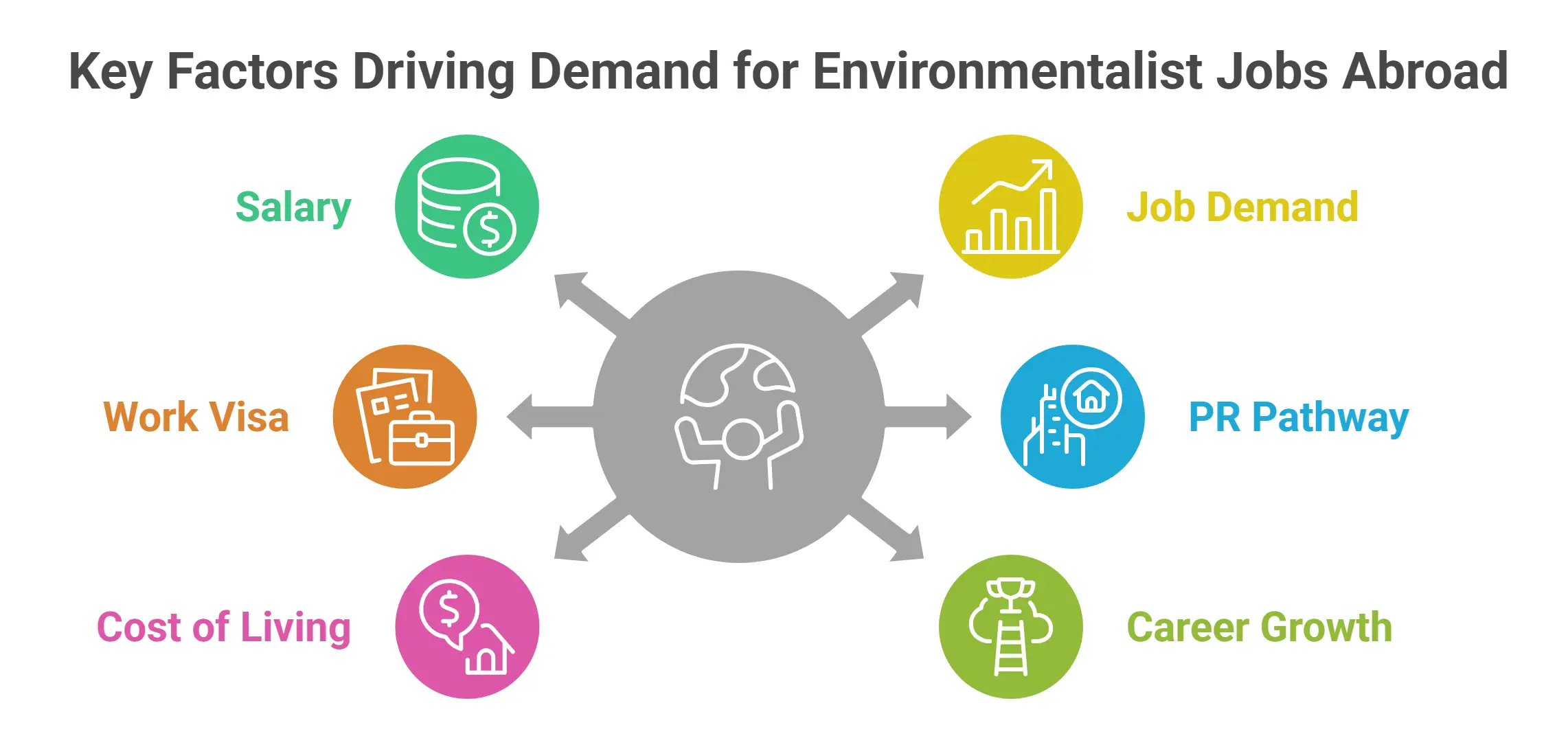
- Salary: Compare average environmentalist salaries and earning potential.
- Job demand: Check current vacancies and future employment growth.
- Work visa: Check visa requirements for environmentalist jobs.
- PR pathway: Look for clear routes to permanent residency.
- Cost of living: Compare housing, taxes, transport, and daily expenses.
- Career growth: Consider demand, specializations, and long-term opportunities.
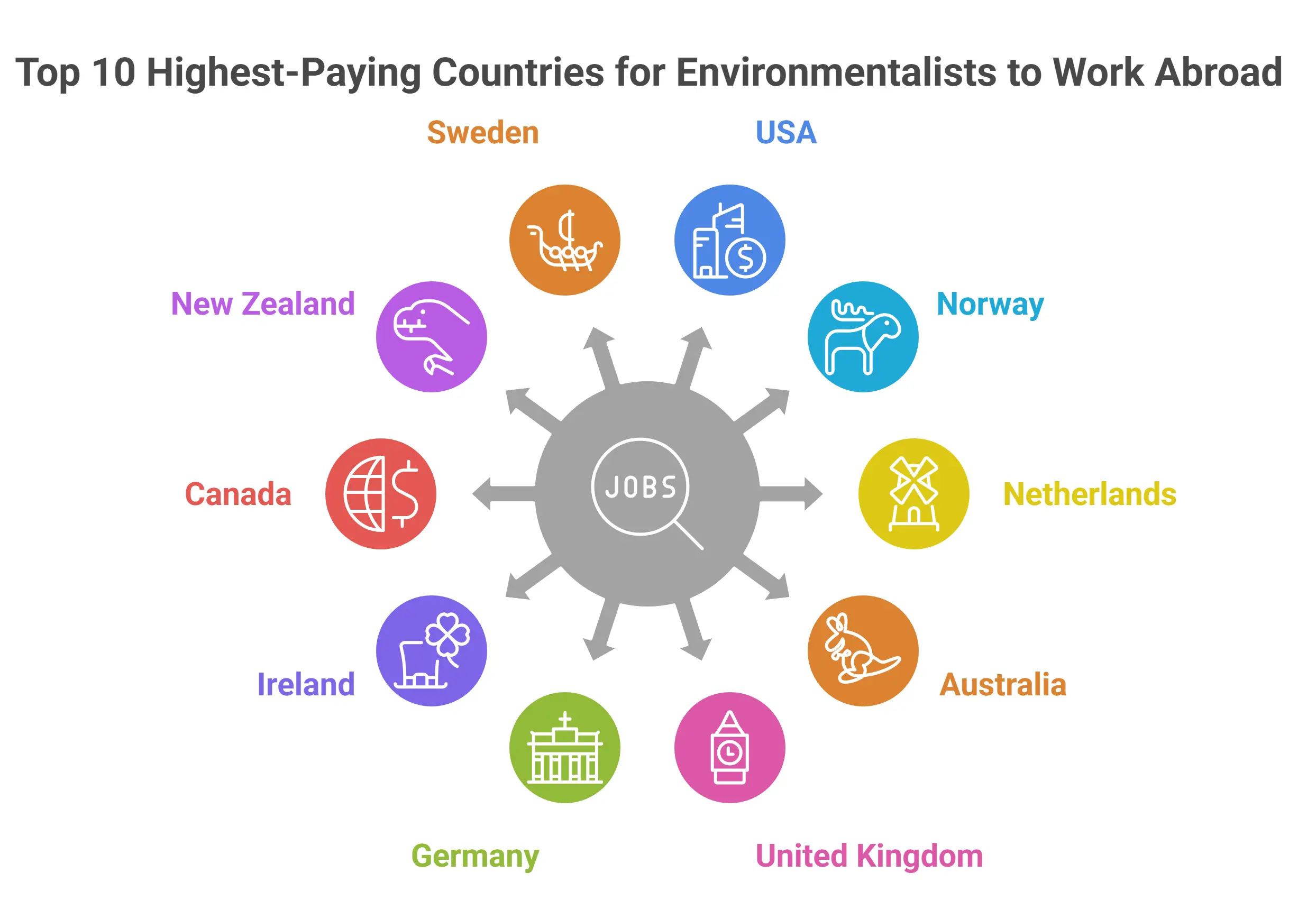
Top 10 Highest-Paying Countries for Environmentalists to Work Abroad
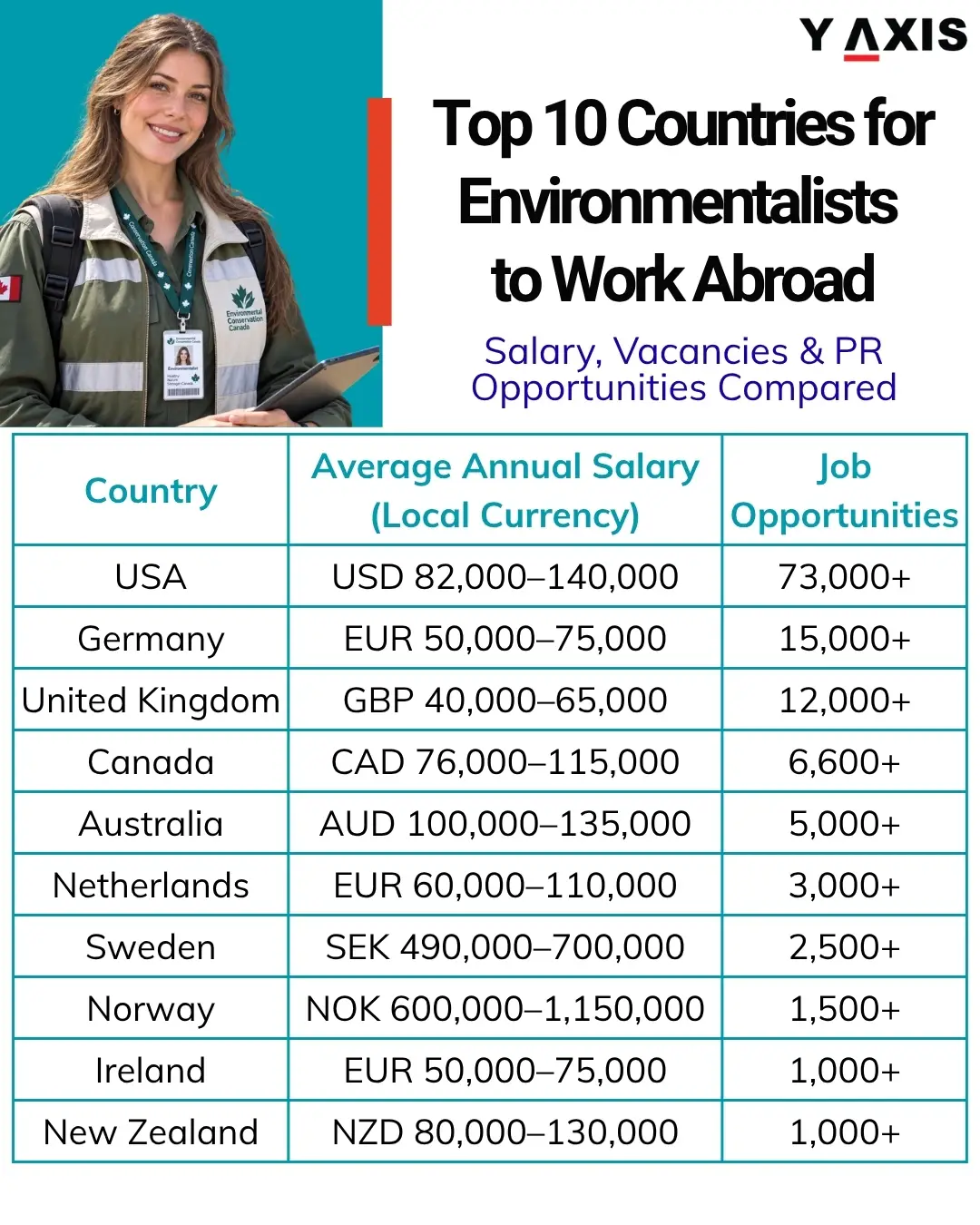
The highest-paying countries for environmentalists to work abroad include the USA, Australia, Canada, Norway, Germany, and the UK. Salaries in many environmentalist roles exceed CAD 100,000 a year, with strong opportunities in environmental engineering, consulting, sustainability, conservation, and renewable energy. The World Economic Forum ranks Environmental Engineers among the top 15 fastest-growing jobs globally through 2030, and has strong career prospects in this field. These countries also offer growing job markets, career advancement, work visa options, and PR pathways for environmentalists.
|
Country |
Average Annual Salary (Local Currency) |
Estimated Environmentalist Job Opportunities |
|
USA |
USD 82,000–140,000 |
73,000+ |
|
Norway |
NOK 600,000–1,150,000 |
1,500+ |
|
Netherlands |
EUR 60,000–110,000 |
3,000+ |
|
Australia |
AUD 100,000–135,000 |
5,000+ |
|
United Kingdom |
GBP 40,000–65,000 |
12,000+ |
|
Germany |
EUR 50,000–75,000 |
15,000+ |
|
Ireland |
EUR 50,000–75,000 |
1,000+ |
|
Canada |
CAD 76,000–115,000 |
6,600+ |
|
New Zealand |
NZD 80,000–130,000 |
1,000+ |
|
Sweden |
SEK 490,000–700,000 |
2,500+ |
*Want to work abroad? Sign up with Y-Axis Resume Marketing Services to find right job faster.
Best Countries for Environmentalists to Work and Settle Abroad
Canada, Australia, Germany, New Zealand, and Ireland are among the best countries for environmentalists to work and settle abroad. They offer environmentalist job opportunities, competitive salaries, work visa options, and pathways to permanent residency. Environmentalists can pursue careers in conservation, climate action, renewable energy, environmental consulting, pollution control, and sustainable development while gaining international experience and building a long-term career abroad.
Environmentalist Jobs in Australia
Environmentalist jobs in Australia cover everything from conservation and biodiversity to environmental science, land management, and climate action. Around 32,000 Environmental Scientists work in the country, with the occupation adding about 1,000 jobs annually. Environmentalists can find careers with government agencies, environmental consultancies, research institutions, conservation organisations, and companies involved in natural-resource management.
Australia also offers several migration options, including the Skills in Demand visa, Skilled Independent visa, and Skilled Nominated visa, with skilled migration pathways leading to permanent residence. Its vast natural environment and active conservation work make Australia a particularly attractive place to develop an environmental career.
|
Factor |
Details |
|
Environmentalist Job Market & Job Vacancies for the Next Decade |
Australia has a growing environmental job market, with more than 5,000 environmentalist opportunities expected over the coming decade. Demand spans conservation, environmental regulation, infrastructure, resource projects, and clean energy. |
|
Investment in Environmental Protection & Clean Energy |
Australia has committed more than AUD 70 billion to decarbonisation, supporting renewable energy, electricity transmission, and clean industries. This is increasing demand for environmental assessment, biodiversity protection, and compliance. |
|
Top Companies Hiring Environmentalists |
Major employers include AECOM, WSP, GHD, Jacobs, Aurecon, ERM, and Arcadis, alongside mining and energy companies, government agencies, and conservation organisations. |
|
Top Cities for Environmentalist Jobs |
Sydney, Melbourne, Brisbane, Perth, and Adelaide offer environmentalist jobs in consulting, government, mining, energy, infrastructure, research, and conservation. Perth and Brisbane are particularly strong for resource and infrastructure projects. |
|
In-Demand Environmentalist Roles & Skills |
Key roles include Environmental Scientist, Environmental Consultant, Environmental Research Scientist, Conservation Officer, Park Ranger, and Environmental Specialist. Important skills include GIS, environmental impact assessment, ecological surveying, monitoring, data analysis, and pollution control. |
|
Work Visa Options |
The Skills in Demand visa (subclass 482) allows employer sponsorship for occupations covered by Australia’s skilled occupation framework. The Employer Nomination Scheme (subclass 186) can provide permanent residence. |
|
Fast-Track Hiring Options |
The Skills in Demand visa (subclass 482) provides an employer-sponsored route into skilled environmental jobs. Environmentalists with internationally recognised achievements can also consider the National Innovation visa (subclass 858). |
|
PR / Long-Term Residence Opportunities |
Options include the Skilled Independent (189), Skilled Nominated (190), and Employer Nomination Scheme (186) visas. Regional environmentalists can also progress from subclass 491 to subclass 191 permanent residence. |
|
Eligibility for Dependents |
Skilled Australian visas can include a spouse or de facto partner and dependent children. Family requirements and documents vary by visa subclass. |
|
Benefits for Family Members |
Family members can live in Australia with the environmentalist. Partners may work under their visa conditions, while dependent children can attend Australian schools. Medicare access depends on the visa and applicable rules. |
Environmentalist Jobs in Canada
Canada offers a strong job market for environmentalists, with opportunities in environmental science, conservation, environmental consulting, climate action, clean technology, and environmental protection. More than 363,000 jobs are part of Canada’s environmental and clean technology sector, while environmental engineers and technicians face a moderate risk of labour shortage through 2033.
Environmentalists can work in government, consulting, energy, research, conservation, and environmental services. Employer-specific work permits, Express Entry, and Provincial Nominee Programs provide routes to work in Canada, with permanent residence available through several immigration pathways. Canada combines strong environmental demand with good prospects for long-term career growth and settlement.
|
Factor |
Details |
|
Environmentalist Job Market & Job Vacancies for the Next Decade |
Canada is expected to have more than 6,600 environmentalist job opportunities in environmental science, conservation, ecological assessment, pollution control, water conservation, and environmental consulting. |
|
Investment in Environmental Protection & Clean Energy |
More than CAD 40 billion is being invested in clean-economy initiatives, supporting environmental work in climate action, pollution reduction, clean energy, water protection, and ecosystem management. |
|
Top Companies Hiring Environmentalists |
Major employers include WSP, GHD, Stantec, AECOM, Dillon Consulting, Hatch, SLR Consulting, SNC-Lavalin, and Jacobs. Government departments, conservation organisations, utilities, and natural-resource companies also hire environmentalists. |
|
Top Cities for Environmentalist Jobs |
Toronto, Vancouver, Calgary, Edmonton, Ottawa, and Montreal offer environmentalist jobs in consulting, conservation, water management, energy, ecological assessment, research, and natural-resource management. |
|
In-Demand Environmentalist Roles & Skills |
Key roles include Environmental Scientist, Environmental Biologist, Environmental Consultant, Conservation Scientist, Ecologist, Environmental Specialist, and Sustainability Specialist. In-demand skills include GIS, ecological surveys, environmental impact assessment, field monitoring, remediation, data analysis, and environmental compliance. |
|
Work Visa Options |
Environmentalists with a Canadian job offer can use an employer-specific work permit. The Global Talent Stream offers faster processing for certain high-skilled positions. |
|
Fast-Track Hiring Options |
The Global Talent Stream allows Canadian employers to recruit certain high-skilled environmental and related talent through expedited processing, with an LMIA required where applicable. |
|
PR / Long-Term Residence Opportunities |
Environmentalists can pursue permanent residence through Express Entry, including the Federal Skilled Worker Program and Canadian Experience Class. Provincial Nominee Programs offer additional routes through provincial or territorial nomination. |
|
Eligibility for Dependents |
Environmentalists moving to Canada can generally include a spouse or common-law partner and dependent children under 22, based on the immigration program used. |
|
Benefits for Family Members |
A spouse or common-law partner may qualify for an open work permit, while dependent children can study in Canada. Healthcare access follows provincial rules and immigration status. |
Environmentalist Jobs in the USA
The USA has a huge market for environmentalist jobs, from environmental science and conservation to pollution control, environmental consulting, environmental health, and environmental protection. There are 93,400 Environmental Scientists and Specialists in the country, with employment projected to grow 6% through 2035. Environmentalists can work for federal and state agencies, consulting companies, research institutions, businesses, and conservation organisations.
Employment-based immigration through EB-2 and EB-3 can provide a route to permanent residence, while some environmentalists with advanced degrees or exceptional expertise may use the EB-2 National Interest Waiver. The size and diversity of the US market give environmentalists plenty of scope to advance their careers.
|
Factor |
Details |
|
Environmentalist Job Market & Job Vacancies for the Next Decade |
The USA is expected to have more than 73,000 environmentalist job opportunities over the next decade, with demand across environmental science, consulting, conservation, pollution control, compliance, and environmental assessment. |
|
Investment in Environmental Protection & Clean Energy |
The USA could invest USD 330–740 billion in additional clean-electricity capacity by 2035, creating more environmental work in impact assessment, permitting, ecological protection, and regulatory compliance. |
|
Top Companies & Organisations Hiring Environmentalists |
Major employers include AECOM, Jacobs, Tetra Tech, WSP, ERM, Arcadis, Stantec, and Ramboll, with roles in environmental consulting, impact assessment, remediation, and compliance. The EPA and state environmental agencies also employ environmentalists. |
|
Top States for Environmentalist Jobs |
California, Texas, New York, Florida, Washington, and Massachusetts have extensive environmentalist employment across consulting, government, energy, conservation, research, and environmental management. |
|
In-Demand Environmentalist Roles & Skills |
Key roles include Environmental Scientist, Environmental Consultant, Environmental Specialist, Ecologist, Environmental Planner, and Sustainability Specialist. Employers value GIS, environmental impact assessment, sampling, ecological surveys, data analysis, remediation, and regulatory compliance. |
|
Education Requirements |
A bachelor’s degree in environmental science, biology, natural science, or a related field is common for environmentalist jobs. Research and advanced positions may require a master’s degree or professional certification. |
|
Work Visa Options |
The H-1B visa provides an employer-sponsored route for specialty environmental jobs that require specialised knowledge and a relevant degree or equivalent background. |
|
Fast-Track Hiring Options |
USCIS Premium Processing can speed up eligible H-1B petitions. Environmentalists with extraordinary ability in science may also use the O-1A visa. |
|
PR / Long-Term Residence Opportunities |
EB-2 and EB-3 Green Cards provide employment-based routes to permanent residence. Environmentalists with advanced expertise or recognised achievements may also pursue EB-2 National Interest Waiver or EB-1A. |
|
Eligibility for Dependents |
H-1B environmentalists can generally bring a spouse and unmarried children under 21 on H-4 status. O-1A environmentalists can bring the same family members on O-3 status. |
|
Benefits for Family Members |
H-4 children can study in the USA, and certain H-4 spouses can obtain work authorisation. O-3 family members can study but generally cannot work. |
*Want to work in the USA? Avail Y-Axis Resume Marketing Services to shortlist the job faster.
Environmentalist Jobs in the UK
The UK has a wide range of environmentalist jobs, including environmental consulting, conservation, climate policy, pollution control, waste management, and environmental regulation. An estimated 652,100 full-time-equivalent green jobs support employment across government, energy, industry, professional services, and environmental organisations.
The country’s climate and clean-energy programmes are also creating new areas of environmental work. Environmentalists can use the Skilled Worker visa for sponsored jobs and later pursue Indefinite Leave to Remain for permanent settlement. The combination of a mature environmental sector, varied career options, and an established immigration system makes the UK a practical destination for environmentalists.
|
Factor |
Details |
|
Environmentalist Job Market & Job Vacancies for the Next Decade |
Environmental careers are expanding across the UK, with more than 12,000 environmentalist job opportunities projected over the next decade in environmental assessment, ecology, conservation, pollution control, water management, climate policy, and environmental management. |
|
Investment in Environmental Protection & Clean Energy |
More than £100 billion in private clean-energy investment is expected in the UK, supporting renewable power, low-carbon infrastructure, nature recovery, and environmental protection projects. |
|
Top Companies & Organisations Hiring Environmentalists |
Major employers include AECOM, WSP, AtkinsRéalis, Jacobs, ERM, Arup, Ramboll, Ricardo, and SLR Consulting, alongside government agencies and environmental organisations. |
|
Top Cities for Environmentalist Jobs |
London has the widest range of environmental consulting and policy roles. Birmingham, Manchester, and Bristol offer opportunities linked to infrastructure and development, while Edinburgh and Glasgow have strong environmental, energy, and conservation sectors. |
|
In-Demand Environmentalist Roles & Skills |
Key roles include Environmental Scientist, Environmental Consultant, Ecologist, Environmental Manager, Environmental Planner, Sustainability Consultant, and Environmental Advisor. Important skills include GIS, impact assessment, ecological surveys, environmental monitoring, data analysis, and environmental regulation. |
|
Work Visa Options |
The Skilled Worker visa allows environmentalists to take sponsored jobs with approved UK employers when the occupation and salary meet the visa rules. |
|
Fast-Track Hiring Options |
Priority processing can speed up some Skilled Worker applications. Environmental scientists and researchers with recognised achievements may also use the Global Talent visa, which does not require employer sponsorship. |
|
PR / Long-Term Residence Opportunities |
The Skilled Worker route can lead to Indefinite Leave to Remain after 5 years of qualifying residence. The Global Talent route can lead to settlement after 3 or 5 years, depending on the route. |
|
Eligibility for Dependents |
Skilled Worker and Global Talent visa holders can generally bring their partner and dependent children through the dependant route under the requirements of their visa. |
|
Benefits for Family Members |
Dependant partners can generally work in the UK, while dependent children can attend UK schools. Family members can also apply for settlement when they meet the required residence and immigration conditions. |
* Want to Work in the United Kingdom? Let Y-Axis guide you through the steps.
Environmentalist Jobs in Germany
Germany is a major destination for environmentalists working on climate protection, conservation, renewable energy, pollution control, and sustainable development. The country’s goal of reaching climate neutrality by 2045 is driving environmental work across energy, transport, manufacturing, agriculture, and land management. Environmentalists can work in government, environmental consulting, research, energy, and industry.
The EU Blue Card and skilled-worker residence permit offer routes into German employment, while long-term residence can lead to permanent settlement. Germany’s large-scale energy transition gives environmentalists the opportunity to work on projects that are directly shaping the country’s environmental future.
|
Factor |
Details |
|
Environmentalist Job Market & Job Vacancies for the Next Decade |
Germany offers more than 15,000 environmentalist job opportunities over the next decade across climate protection, environmental consulting, water management, conservation, pollution control, and environmental analysis. |
|
Investment in Environmental Protection & Clean Energy |
Germany is investing more than EUR 200 billion through 2030 in climate action and the energy transition, supporting environmental work in emissions reduction, renewable energy, environmental assessment, and sustainable infrastructure. |
|
Top Companies Hiring Environmentalists |
Major employers include Siemens, Bosch, E.ON, RWE, EnBW, Veolia, TÜV SÜD, WSP, and ERM, alongside government agencies, research institutions, and environmental organisations. Roles span environmental consulting, compliance, climate projects, and sustainability. |
|
Top Cities for Environmentalist Jobs |
Berlin, Munich, Hamburg, Frankfurt, and Cologne offer environmentalist jobs in consulting, government, energy, research, and sustainability. Hamburg is particularly strong for water management and marine environmental protection. |
|
In-Demand Environmentalist Roles & Skills |
Key roles include Environmental Scientist, Environmental Consultant, Environmental Manager, Environmental Analyst, Ecologist, Sustainability Specialist, and Environmental Engineer. Important skills include GIS, environmental impact assessment, monitoring, climate analysis, pollution control, and regulatory compliance. |
|
Work Visa Options |
The EU Blue Card offers a route for environmentalists with a recognised university qualification, a German job contract, and the required salary. The Skilled Worker residence permit is another option for environmentalists with recognised qualifications and a German job offer. |
|
Fast-Track Hiring Options |
Germany’s Accelerated Skilled Worker Procedure lets employers start the residence process with the foreigners authority before the environmentalist submits the visa application, helping speed up international recruitment. |
|
PR / Long-Term Residence Opportunities |
EU Blue Card holders can apply for a settlement permit after 27 months, or after 21 months with B1-level German. Other work-residence routes can also lead to permanent settlement after the required residence period. |
|
Eligibility for Dependents |
EU Blue Card holders can generally bring their spouse and minor children through family reunification. Approved family members receive residence permits to live in Germany. |
|
Benefits for Family Members |
Spouses can work in Germany without a separate work permit, while children can attend German schools. Family members can also live with the environmentalist throughout the residence period. |
*Want to Work in Germany? Let Y-Axis guide you through every step of the process.
Environmentalist Jobs in New Zealand
New Zealand offers some of the strongest career opportunities for environmentalists working in conservation and nature protection. Ecology, biodiversity, environmental research, natural-resource management, and environmental protection are important areas of employment. Environmental Research Scientist and Environmental Engineer are included on New Zealand’s Green List, connecting these occupations with dedicated residence pathways.
The Accredited Employer Work Visa is another route into the country for environmental jobs with accredited employers, while Green List occupations can lead to Straight to Residence or Work to Residence. New Zealand’s focus on protecting its ecosystems makes it an excellent destination for environmentalists building careers around conservation and environmental research.
|
Factor |
Details |
|
Environmentalist Job Market & Job Vacancies for the Next Decade |
New Zealand could offer more than 1,000 environmentalist job opportunities over the next decade, covering environmental science, ecology, conservation, environmental monitoring, climate policy, environmental compliance, and sustainability. |
|
Investment in Environmental Protection & Clean Energy |
New Zealand is investing more than NZD 2.8 billion in climate and emissions-reduction initiatives, supporting clean energy, emissions management, biodiversity protection, and sustainable resource use. |
|
Top Companies & Organisations Hiring Environmentalists |
Major employers include Tonkin + Taylor, Beca, WSP, GHD, Aurecon, Jacobs, and Stantec, alongside government agencies, councils, conservation organisations, and research institutions. Roles span environmental consulting, ecological assessment, conservation, monitoring, and sustainability. |
|
Top Cities for Environmentalist Jobs |
Auckland, Wellington, Christchurch, Hamilton, and Dunedin offer environmentalist jobs across consulting, government, conservation, infrastructure, research, and environmental management. Wellington has particularly strong opportunities in environmental policy and government work. |
|
In-Demand Environmentalist Roles & Skills |
Common roles include Environmental Scientist, Environmental Research Scientist, Ecologist, Conservation Scientist, Environmental Technician, Environmental Engineer, and Environmental Consultant. Key skills include GIS, ecological surveys, environmental monitoring, impact assessment, data analysis, conservation, and environmental reporting. |
|
Work Visa Options |
The Accredited Employer Work Visa (AEWV) is a main route for environmentalists with a job offer from an accredited New Zealand employer. Green List occupations can also provide faster residence pathways for listed environmental roles. |
|
Fast-Track Hiring Options |
Environmental Research Scientist and Environmental Engineer are Green List Tier 1 occupations with a Straight to Residence pathway. The AEWV also provides an employer-sponsored route for other environmental roles. |
|
PR / Long-Term Residence Opportunities |
Green List Tier 1 environmental roles can use the Straight to Residence pathway. Other environmentalists can pursue residence through the Skilled Migrant Category Resident Visa and later apply for a Permanent Resident Visa. |
|
Eligibility for Dependents |
Environmentalists on eligible work or resident visas can generally bring their partner and dependent children. The family visa available depends on the main visa holder’s status. |
|
Benefits for Family Members |
Partners may obtain a work visa, while dependent children can study in New Zealand under their visa conditions. Families with resident status have broader access to education and public services. |
Environmentalist Jobs in the Netherlands
The Netherlands has a particularly strong need for environmental work involving ecology, water management, conservation, climate policy, and environmental consulting. Ecologists, environmental specialists, and nature managers contribute to biodiversity protection, ecosystem management, climate resilience, and environmental policy.
Water management is another major field, with environmentalists working on aquatic ecosystems, flood protection, natural resources, and climate adaptation. The Highly Skilled Migrant route provides a work pathway through an IND-recognised employer, while 5 years of legal residence can open the route to permanent residence. The Netherlands offers environmentalists a distinctive career mix that combines ecology with advanced water and climate management.
|
Factor |
Details |
|
Environmentalist Job Market & Job Vacancies for the Next Decade |
The Netherlands is expected to have more than 3,000 environmentalist job opportunities over the next decade, particularly in water management, ecology, climate adaptation, biodiversity, environmental consulting, and sustainability. |
|
Investment in Environmental Protection & Clean Energy |
The Netherlands is investing more than EUR 35 billion through 2030 in climate and energy measures, supporting renewable energy, climate adaptation, water management, biodiversity protection, and emissions reduction. |
|
Top Companies Hiring Environmentalists |
Major employers include Arcadis, Royal HaskoningDHV, Witteveen+Bos, Sweco, Antea Group, TNO, and Wageningen University & Research, alongside water authorities, government agencies, and energy companies. |
|
Top Cities for Environmentalist Jobs |
Amsterdam, Rotterdam, The Hague, Utrecht, Delft, and Eindhoven offer environmentalist jobs in consulting, government, water management, engineering, research, and sustainability. Rotterdam is particularly strong in water management, environmental infrastructure, and energy-transition projects. |
|
In-Demand Environmentalist Roles & Skills |
In-demand roles include Environmental Consultant, Environmental Scientist, Ecologist, Environmental Advisor, Sustainability Specialist, Water Management Specialist, and Environmental Planner. Key skills include GIS, environmental impact assessment, ecological surveys, water management, climate analysis, data analysis, and regulatory compliance. |
|
Work Visa Options |
The Highly Skilled Migrant permit is a major route for environmentalists hired by an IND-recognised sponsor who receive the required salary. The EU Blue Card is another option for environmentalists with higher education, an employment contract, and the required salary. |
|
Fast-Track Hiring Options |
The Highly Skilled Migrant route allows an IND-recognised employer to submit the residence application directly to the IND, streamlining recruitment and residence processing for environmentalists from outside the Netherlands. |
|
PR / Long-Term Residence Opportunities |
Environmentalists can generally apply for permanent residence after 5 consecutive years of lawful residence, along with the required residence history, income, and civic integration status. |
|
Eligibility for Dependents |
Dutch residence-permit holders can generally bring their spouse or registered partner and dependent children through the family reunification process. |
|
Benefits for Family Members |
A Highly Skilled Migrant’s spouse or partner can generally work without a separate work permit, while dependent children can attend Dutch schools and live with the main visa holder. |
Environmentalist Jobs in Norway
Norway’s natural environment creates a broad range of opportunities for environmentalists, particularly in marine conservation, biodiversity, environmental protection, climate action, pollution control, and sustainable resource management. Its extensive coastline, forests, waterways, and marine ecosystems make nature protection an important part of environmental work.
Norway also aims to cut greenhouse-gas emissions by at least 55% by 2030 and become a low-emission society by 2050. Environmentalists from outside the EEA generally need a job offer and skilled-worker residence permit to work in Norway. Permanent residence is possible after meeting the required conditions, giving environmentalists a route to build a long-term career in the country.
|
Factor |
Details |
|
Environmentalist Job Market & Job Vacancies for the Next Decade |
Norway is expected to have more than 1,500 environmentalist job opportunities over the next decade in environmental assessment, biodiversity, conservation, pollution control, water management, and consulting. Offshore wind, hydrogen, batteries, and electrification are creating additional roles. |
|
Investment in Environmental Protection & Clean Energy |
Norway’s Enova programme has a minimum annual funding level of NOK 7.958 billion, supporting clean energy, climate technology, emissions reduction, and energy efficiency. |
|
Top Companies & Organisations Hiring Environmentalists |
Major employers include Equinor, Statkraft, DNV, Norconsult, Multiconsult, Ramboll, and Sweco, along with government agencies, research institutions, and conservation organisations. |
|
Top Cities for Environmentalist Jobs |
Oslo, Bergen, Trondheim, Stavanger, and Tromsø offer jobs in consulting, government, energy, research, and conservation. Oslo is strong for environmental policy and consulting, while Stavanger has energy-sector opportunities. |
|
In-Demand Environmentalist Roles & Skills |
Key roles include Environmental Scientist, Environmental Consultant, Ecologist, Environmental Advisor, Conservation Specialist, Environmental Engineer, and Sustainability Specialist. Key skills include GIS, impact assessment, ecological surveys, monitoring, climate analysis, and regulatory compliance. |
|
Work Visa Options |
Environmentalists with a university degree and Norwegian job offer can apply for a skilled-worker residence permit. The job must require their qualifications and provide Norwegian-standard pay and working conditions. |
|
Fast-Track Hiring Options |
Norway’s Early Employment Start scheme can allow skilled environmentalists to start work before their residence application is decided when the required conditions are met. |
|
PR / Long-Term Residence Opportunities |
Environmentalists can generally apply for permanent residence after 3 years, with requirements including income, A2-level Norwegian, and a social-studies test unless exempt. |
|
Eligibility for Dependents |
Skilled environmentalists can generally bring their spouse or cohabitant and children through family immigration. |
|
Benefits for Family Members |
Spouses and cohabitants can work, while children can attend Norwegian schools and live with the main visa holder. |
Environmentalist Jobs in Sweden
Sweden has built a strong environmental sector around climate action, biodiversity, conservation, pollution control, water protection, and sustainable development. Its environmental policy includes 16 national environmental quality objectives, covering clean air and water, healthy ecosystems, biodiversity, and sustainable resource use.
Sweden’s ambition to reach net-zero emissions by 2045 is also driving continued environmental work. Environmentalists from outside the EU/EEA generally need a Swedish employment contract and work permit to take an environmental job. Long-term work and residence can lead to permanent residence, giving Sweden a solid foundation for an international environmental career.
|
Factor |
Details |
|
Environmentalist Job Market & Job Vacancies for the Next Decade |
Sweden is expected to have more than 2,500 environmentalist job opportunities over the next decade across environmental science, consulting, climate action, conservation, wastewater management, pollution control, and environmental assessment. |
|
Investment in Environmental Protection & Clean Energy |
Sweden allocates SEK 18 billion to climate, environment and nature and SEK 10 billion to energy, supporting climate transition, environmental protection, renewable energy, and emissions reduction. |
|
Top Companies Hiring Environmentalists |
Leading employers include Sweco, AFRY, Ramboll, WSP, Tyréns, and NCC, alongside the Swedish Environmental Protection Agency, municipalities, energy companies, and research organisations. |
|
Top Cities for Environmentalist Jobs |
Stockholm, Gothenburg, Malmö, Uppsala, and Västerås offer environmentalist jobs in consulting, government, engineering, energy, wastewater management, research, and environmental protection. |
|
In-Demand Environmentalist Roles & Skills |
Key roles include Environmental Scientist, Environmental Consultant, Environmental Engineer, Ecologist, Environmental Inspector, and Sustainability Specialist. Core skills include GIS, environmental assessment, monitoring, wastewater management, climate analysis, and regulatory compliance. |
|
Work Visa Options |
Environmentalists from outside the EU/EEA generally need a Swedish work permit based on an employment contract. Highly qualified environmentalists can also use the EU Blue Card. The work permit requires a salary of at least 90% of Sweden’s median salary. |
|
Fast-Track Hiring Options |
Applications from highly qualified environmentalists can receive faster processing, with decisions in under 30 days when the required conditions are met. |
|
PR / Long-Term Residence Opportunities |
Environmentalists can apply for permanent residence after at least 4 years of work permits and employment in Sweden during the past 7 years, along with the required financial support. |
|
Eligibility for Dependents |
Swedish work permit holders can generally bring their spouse, registered or cohabiting partner, and unmarried children under 21 to Sweden. |
|
Benefits for Family Members |
Spouses and partners can work in Sweden, while children can attend Swedish schools under their residence status. |
Environmentalist Jobs in Ireland
Ireland’s green economy is creating more opportunities for environmentalists in conservation, climate action, biodiversity, environmental protection, waste management, and sustainable development. Around 400,000 green jobs contribute to the Irish economy, including occupations connected with environmental work. Ireland plans to cut greenhouse-gas emissions by 51% by 2030 and reach climate neutrality by 2050, keeping environmental protection high on the national agenda.
Environmental health professionals and professional foresters are included on Ireland’s Critical Skills Occupations List, while the General Employment Permit covers a wider range of environmental jobs. Ireland’s expanding environmental sector and English-speaking workplace make it a strong option for environmentalists planning an international career.
|
Factor |
Details |
|
Environmentalist Job Market & Job Vacancies for the Next Decade |
Ireland has more than 1,000 environmentalist job opportunities projected over the next decade across environmental science, ecology, conservation, environmental consulting, climate action, water management, and environmental compliance. |
|
Investment in Environmental Protection & Clean Energy |
Ireland has committed €300 million to enterprise decarbonisation, supporting emissions reduction and increasing demand for environmental assessment, carbon management, sustainability, and climate projects. |
|
Top Companies Hiring Environmentalists |
Major employers include AECOM, Arup, RPS, Jacobs, PM Group, SLR Consulting, and ERM, alongside the Environmental Protection Agency, local authorities, energy companies, and research organisations. |
|
Top Cities for Environmentalist Jobs |
Dublin, Cork, Galway, Limerick, and Waterford offer environmentalist jobs across consulting, government, infrastructure, energy, conservation, research, and environmental management. |
|
In-Demand Environmentalist Roles & Skills |
Key roles include Environmental Scientist, Environmental Consultant, Ecologist, Environmental Advisor, Environmental Engineer, Conservation Specialist, and Sustainability Consultant. Core skills include GIS, environmental impact assessment, ecological surveys, monitoring, data analysis, and regulatory compliance. |
|
Work Visa Options |
The General Employment Permit covers a broad range of environmental occupations. Specific environmental roles on the Critical Skills Occupations List can use the Critical Skills Employment Permit. |
|
Fast-Track Hiring Options |
The Critical Skills Employment Permit supports faster recruitment for listed shortage occupations and does not require a Labour Market Needs Test. |
|
PR / Long-Term Residence Opportunities |
Critical Skills Employment Permit holders can move to Stamp 4 after 2 years. Long-term residence can be pursued after 60 months of residence based on employment permits. |
|
Eligibility for Dependents |
Critical Skills Employment Permit holders can generally bring their spouse, partner, and dependent children to Ireland through family reunification. |
|
Benefits for Family Members |
Spouses and partners can generally work without a separate employment permit, while dependent children can attend Irish schools. |
Job Outlook for Environmentalists over the Next Decade
The job outlook for environmentalists over the next decade is positive, with demand expected to rise across environmental science, conservation, climate action, renewable energy, pollution control, and sustainability. Environmentalists can find growing opportunities as governments strengthen environmental regulations and businesses invest in cleaner technologies and lower-emission operations. Environmental Scientists, Environmental Engineers, Ecologists, Environmental Consultants, Conservation Scientists, and Sustainability Specialists are likely to remain in demand.
The World Economic Forum lists Environmental Engineers among the fastest-growing job roles through 2030. Demand will also increase for skills in GIS, environmental impact assessment, biodiversity, climate analysis, environmental monitoring, carbon management, and regulatory compliance, creating strong opportunities for international environmental careers.
*Want to work abroad? Sign up with Y-Axis Resume Marketing Services to find right job faster.
FAQs
Which are the best countries for environmentalists to work abroad?
Canada, Australia, the USA, the UK, Germany, New Zealand, the Netherlands, Norway, Sweden, and Ireland are among the strongest destinations for environmentalist careers. Canada and Australia combine strong environmental job markets with immigration pathways, while Germany and the Netherlands offer opportunities in climate, sustainability and environmental consulting. New Zealand stands out for selected environmental roles with residence pathways.
Which country pays environmentalists the highest salary?
The USA, Norway, Australia, the Netherlands and Germany offer some of the highest environmentalist salaries in this comparison. Senior Environmental Engineers, Environmental Consultants, Environmental Managers and Sustainability Specialists generally earn more than entry-level Environmental Scientists and Ecologists. Actual pay varies by occupation, experience, location and employer, so salary should be compared alongside living costs and taxes.
Are environmentalist jobs in demand worldwide?
Yes. Demand for environmentalist jobs is growing across climate action, renewable energy, conservation, pollution control, water management and environmental compliance. Environmental Scientists, Environmental Engineers, Ecologists, Environmental Consultants and Sustainability Specialists are particularly relevant to expanding environmental programmes. The strongest opportunities are concentrated in countries increasing clean-energy investment and strengthening environmental regulations.
What are the highest-paying environmentalist jobs abroad?
Environmental Engineers, Environmental Managers, Environmental Consultants, Sustainability Managers, Environmental Scientists and senior environmental specialists are among the highest-paying environmental careers abroad. Engineering and management roles generally command higher salaries because they involve technical responsibility, project management or regulatory oversight. The USA, Australia, Norway, the Netherlands and Germany offer strong earning potential in these roles.
Which countries have the highest demand for environmentalists?
The USA has one of the largest environmental job markets, while Canada, Australia, Germany, the UK and the Netherlands have strong demand across environmental consulting, climate programmes, clean energy and environmental regulation. New Zealand, Norway, Sweden and Ireland also offer opportunities in conservation, biodiversity, water management and sustainability.
What is the average environmentalist salary abroad?
Environmentalist salaries vary significantly by country and occupation. In this comparison, typical annual ranges include CAD 76,000–115,000 in Canada, AUD 100,000–135,000 in Australia, USD 82,000–140,000 in the USA, GBP 40,000–65,000 in the UK and EUR 50,000–75,000 in Germany. Senior technical and management roles can earn more.
Which countries offer environmentalist jobs with PR opportunities?
Canada, Australia, New Zealand, Germany, the UK, Ireland, Norway, Sweden and the Netherlands offer routes from environmental employment to permanent residence. The pathway varies by country and occupation. Canada uses Express Entry and Provincial Nominee Programs, Australia offers skilled and employer-sponsored visas, while New Zealand has Green List residence pathways for selected environmental occupations.
What qualifications do you need to become an environmentalist?
Most environmentalist careers require a bachelor’s degree in environmental science, biology, ecology, environmental engineering, geography, natural resources or a related field. Environmental Engineers may need an engineering qualification and professional registration, while research and senior technical roles often require postgraduate study. Employers may also look for GIS, environmental assessment, monitoring and data-analysis skills.
What skills are needed for environmentalist jobs abroad?
Key skills include GIS, environmental impact assessment, ecological surveys, environmental monitoring, climate analysis, biodiversity management, water management, pollution control and regulatory compliance. Data analysis and environmental reporting are also important across consulting and government roles. Knowledge of local environmental regulations can strengthen job prospects when moving to another country.
What is the job outlook for environmentalists over the next 10 years?
Environmental careers have a positive long-term outlook as governments and businesses expand climate action, clean energy, conservation, pollution control and sustainability programmes. Environmental Scientists, Environmental Engineers, Ecologists, Environmental Consultants and Sustainability Specialists should continue to see demand. The World Economic Forum also places Environmental Engineers among the fastest-growing job roles through 2030.
Which environmentalist jobs are most in demand?
The strongest demand is concentrated in Environmental Science, Environmental Engineering, Environmental Consulting, Ecology, Conservation, Sustainability and Environmental Compliance. Common roles include Environmental Scientist, Environmental Engineer, Environmental Consultant, Ecologist, Conservation Scientist, Environmental Advisor and Sustainability Specialist. Renewable energy, water management, biodiversity protection and climate projects are major areas of employment growth.
Can environmentalists get jobs abroad without a master’s degree?
Yes. Many environmental jobs abroad accept a bachelor’s degree in environmental science, biology, ecology, engineering or a related discipline. A master’s degree is more important for research positions, advanced environmental science roles and some senior technical careers. Practical experience in GIS, environmental assessment, field monitoring, conservation or compliance can also strengthen a candidate’s profile.
Which countries are best for environmentalists to settle permanently?
Canada, Australia, New Zealand, Germany, Ireland and the UK are strong choices for environmentalists seeking long-term residence. Canada offers Express Entry and Provincial Nominee Programs, Australia has skilled and employer-sponsored permanent visas, and New Zealand includes Environmental Engineer and Environmental Research Scientist on its Green List residence pathways.
How can I get an environmentalist job abroad?
Choose a country where your environmental occupation has strong demand, then check the required degree, professional registration, work experience and language requirements. Apply for relevant roles with employers that hire internationally, secure a job offer when required, and use the country’s skilled-worker or employer-sponsored visa route to begin working legally.
What are the best countries for environmental science jobs?
Canada, the USA, Australia, Germany, the UK, New Zealand and the Netherlands offer strong environmental science careers. Jobs cover environmental research, ecological assessment, conservation, climate analysis, pollution monitoring, water management and environmental consulting. Canada has more than 30,000 environmental biologists employed nationally, while Environmental Engineers face a moderate shortage risk through 2033.
Are environmentalist jobs in demand in Canada?
Yes. Canada has demand across environmental engineering, environmental science, consulting, conservation and environmental management. Job Bank identifies a moderate risk of labour shortage for Environmental Engineers from 2024 to 2033, with 65,600 employed nationally in 2023. Prospects vary considerably by occupation and province, so environmentalists should check the specific NOC and location before applying.
What is the average environmentalist salary in Canada?
Environmental salaries differ by occupation. For example, Job Bank lists a CAD 40 hourly median wage for Environmental Biologists, while Environmental Engineers have a CAD 48.56 hourly median wage nationally. Environmental consulting, engineering and management roles can offer higher earnings with experience. Salaries also vary by province, employer, education and specialisation.
Which environmental jobs are in demand in Canada?
Environmental Engineers have particularly strong demand, with Job Bank projecting a moderate risk of labour shortage nationally through 2033. Other careers include Environmental Scientists, Environmental Biologists, Ecologists, Environmental Consultants, Environmental Impact Analysts and Environmental Technicians. Demand differs by province; Environmental Engineering currently shows good prospects in Quebec, Saskatchewan and Nunavut and moderate prospects in several other provinces.
Can environmentalists get PR in Canada?
Yes. Environmentalists can pursue Canadian permanent residence through Express Entry or Provincial Nominee Programs, provided their occupation and personal profile fit the selected immigration programme. Factors such as skilled work experience, education, language ability, age and Canadian work experience can affect eligibility and ranking. Environmentalists should check their specific NOC before choosing an immigration route.
Can environmentalists apply for Express Entry in Canada?
Yes. Environmentalists can enter Express Entry through programmes such as the Federal Skilled Worker Program or Canadian Experience Class when they satisfy the programme requirements. Some environmental occupations may also fit a current Express Entry category, but the exact NOC matters. An environmental job title alone does not automatically place someone in a category-based selection stream.
Tags:
Environmentalists
Environmentalist Jobs
Environmentalist Jobs Abroad
Top Countries for Environmentalists
Best Countries for Environmentalists
Environmentalist Careers
Environmentalist Salary
Environmentalist Salary by Country
Environmentalist Job
Share
Latest Article
Popular Post
Trending Article

Posted On October 22 2026
What Are the Different Types of UK Visas to Immigrate?